
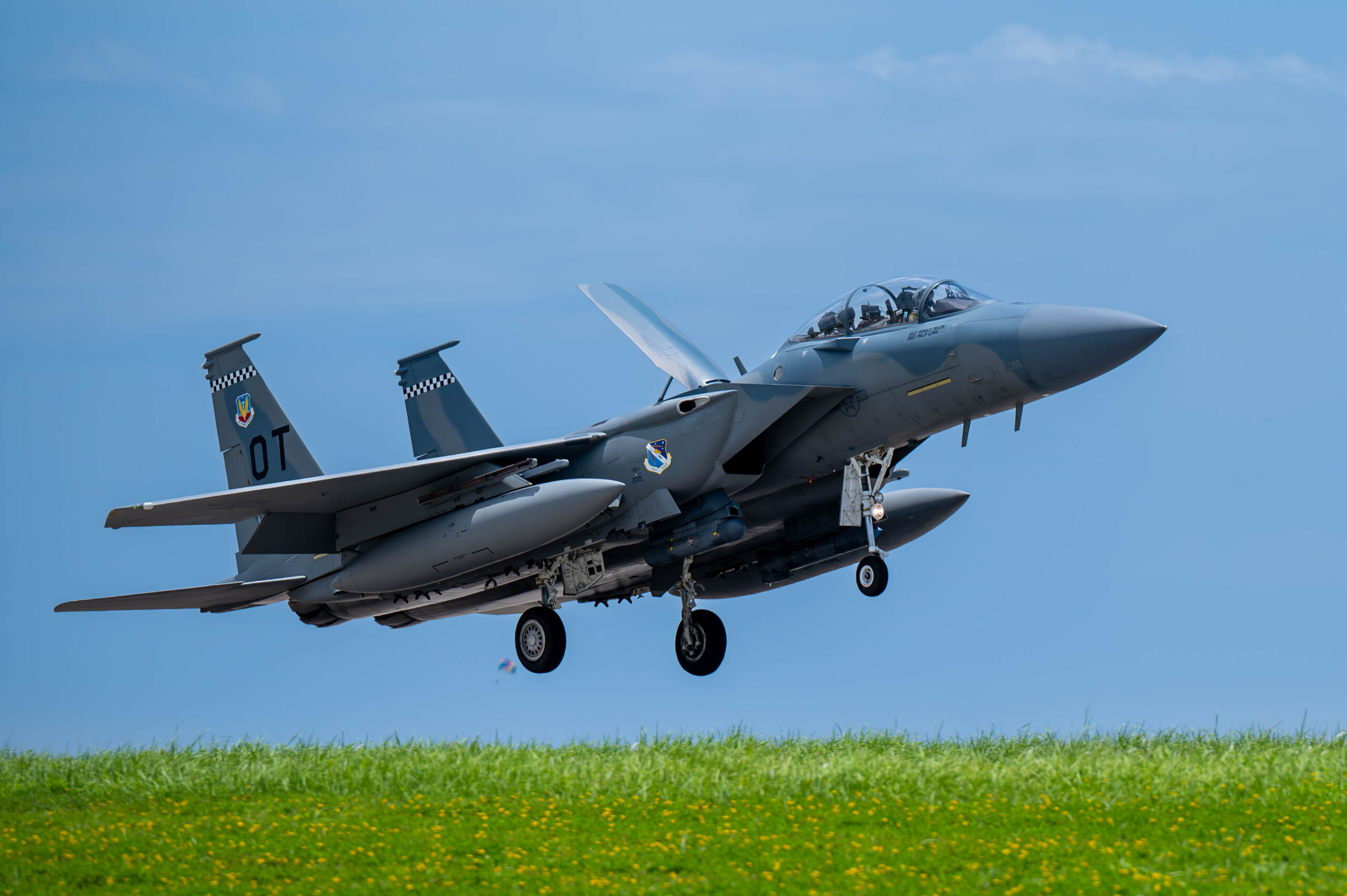
The United States Air Force’s decision to significantly increase its planned acquisition of F-15EX Eagle II fighter jets has been met with a cautionary assessment from a recent Pentagon report, which highlights potential risks related to costs, schedules, and long-term production sustainability. While the expanded purchase aims to bolster the service’s fighter fleet, officials will need to address these challenges in the coming years.
Earlier this year, the Air Force announced its intention to more than double its planned F-15EX fleet, expanding the procurement from 129 to 267 aircraft. This strategic shift, unveiled during the fiscal 2027 budget rollout, is intended to recapitalize and eventually replace the aging F-15E Strike Eagle fleet. The Air Force has emphasized that the F-15EX will operate alongside the F-35A, with both platforms providing distinct capabilities deemed essential for future combat operations.
However, the selected acquisition report for the F-15EX, released by the Pentagon in August, indicates that this expanded procurement introduces “new cost and schedule uncertainties” that program officials are actively working to mitigate. Boeing, the manufacturer of the F-15EX, declined to comment on the concerns outlined in the acquisition report. The Air Force did not immediately respond to inquiries regarding the report’s findings.
One significant concern raised in the report pertains to the long-term viability of the expanded production plan. The original F-15EX acquisition strategy envisioned eight production lots for the aircraft. The revised plan, however, extends this to 12 lots. This prolonged production timeline is expected to necessitate “a major technical refresh” for the aircraft, driven by the increasing challenge of diminishing manufacturing sources and potential material shortages for key components over time.
The report specifies that critical systems such as the F-15EX’s radar, mission computer, electronic warfare suite, and engines could eventually become obsolete. Replacing or upgrading these components would constitute “a significant redesign effort.” To manage this complex risk, the program’s proposed method involves thorough testing and integration of these upgraded subsystems as part of future operational flight program releases, which are currently scheduled between 2031 and 2035. This approach, according to the report, aims to provide “a structured, risk-reduced pathway for flight testing and fielding these new capabilities without causing a gap in the production line.”
Another area of uncertainty highlighted is the financial implications of extending production. Program officials have acknowledged that they have not yet fully estimated the total costs associated with the expanded procurement. While a rapid cost estimation process is underway to inform the fiscal 2028 budget request, the F-15EX program is currently relying on government estimates for its initial budget sizing. The report states that formal studies have been commissioned to obtain preliminary cost and schedule estimates from the contractors involved in the program.
The Pentagon report also detailed several schedule-related issues impacting both the immediate and long-term delivery timelines for the F-15EX. Shortages of specific parts and materials are identified as a risk that could slow the production of jets in Lot 2 and subsequent lots. The most acutely affected components include Elbit-made large area displays and low-profile heads-up displays, General Electric F110 engines, and Collins-manufactured cartridges essential for the ejection systems.
While some of these shortages were mitigated for Lot 1B deliveries by strategically stocking up on supplies during a production halt caused by a factory strike from August to November 2025, the risks persist for future production batches. The Pentagon is implementing measures to maintain the F-15EX’s production schedule, including establishing borrowing and payback agreements with foreign military sales (FMS) customers to secure crucial parts.
Despite these efforts, a strike at Boeing’s St. Louis, Mo., plant, where the F-15EX is manufactured, has resulted in permanent delays to the jet’s overall production timeline. The report notes that Boeing’s contract stipulated the delivery of all 12 Lot 3 jets in early calendar year 2026. However, due to the strike, the company is now projected to deliver only six of those aircraft by the end of 2026.
These “unrecoverable delays” are creating cascading effects on the Air Force’s plans for fielding the Eagle II. The acquisition report indicates that the 142nd Wing of the Oregon Air National Guard will not receive all of its F-15EXs from Lot 2 until at least mid-2026. Furthermore, the first Lot 3 F-15EXs, which are designated for overseas deployment, will not be fielded until at least the first quarter of fiscal year 2027.
Crucially, these overseas-bound jets are intended for stationing at Kadena Air Base in Okinawa, Japan. Kadena previously hosted F-15C and D Eagle fighters, but the Air Force began retiring those older aircraft in November 2022. Since then, various fighter squadrons have rotated through Kadena to maintain a presence. The planned permanent force of F-15EXs, initially slated to begin arriving in spring 2026, has now been delayed into 2027, potentially extending the reliance on rotational deployments.
To address these delays, the F-15EX program management office is collaborating with the Defense Department’s Business Operators for National Defense (BOND) team. Their objective is to optimize the F-15EX production schedule and prioritize the Lot 3 jets destined for overseas assignments as they move through the final assembly process. The program office is also working with Air Combat Command (ACC) and the National Guard Bureau (NGB) to develop a coordinated “bridging strategy,” ensuring that older jets or alternative force structures are available to meet the Air Force’s operational requirements until the delayed F-15EXs arrive.
The report further states that the fourth lot of F-15EXs is also already behind schedule. While Boeing was expected to commence delivery of these jets in 2026, they are now not anticipated to begin arriving until calendar year 2028. To meet its revised delivery requirements, Boeing will need to increase its F-15EX production rate to two aircraft per month.
Why This Matters
The F-15EX Eagle II represents a critical component of the U.S. Air Force’s future fighter fleet, designed to provide a robust, heavy-payload platform that complements the stealth and advanced capabilities of the F-35A. Its primary role is to ensure air superiority and maintain fighter capacity as older F-15 models are retired. Therefore, the challenges outlined in the Pentagon’s report have significant implications for national security, defense planning, and international alliances.
Firstly, the identified cost uncertainties could strain the defense budget. Unforeseen expenditures on a major procurement program like the F-15EX could necessitate trade-offs in other critical areas, potentially affecting research and development, maintenance, or other acquisition programs. This could lead to difficult budgetary decisions in an already constrained fiscal environment.
Secondly, and perhaps more immediately impactful, are the widespread schedule delays. The deferred arrival of F-15EXs directly affects the operational readiness of units such as the Oregon Air National Guard’s 142nd Wing, which relies on these new aircraft to maintain its mission capabilities. More critically, the delays in deploying F-15EXs to Kadena Air Base in Japan create a potential gap in permanent fighter coverage in a strategically vital region. The Indo-Pacific theater is a priority for U.S. defense strategy, and sustained, robust airpower is essential for deterring aggression and reassuring allies. Prolonged reliance on rotational deployments, rather than a stable, permanently stationed force, could complicate strategic planning and potentially be perceived as a reduction in consistent U.S. presence.
Thirdly, the report highlights the fragility of the defense industrial base. Issues like diminishing manufacturing sources and material shortages underscore the challenges in sustaining long-term production of complex military hardware. Boeing’s need for a “major technical refresh” points to the inherent difficulties in maintaining technological currency over extended production runs, adding complexity and cost to the program. Production disruptions, such as the Boeing strike, further reveal vulnerabilities in the supply chain and manufacturing capacity that can have far-reaching effects on military readiness.
Finally, the F-15EX program’s struggles illustrate the broader complexities of modern defense procurement. Balancing the need for advanced capabilities with realistic cost and schedule projections remains a constant challenge. The ability of the Air Force and its industrial partners to effectively manage these risks will be a critical test, determining not only the success of the F-15EX program but also influencing public and congressional confidence in future large-scale defense acquisitions.