
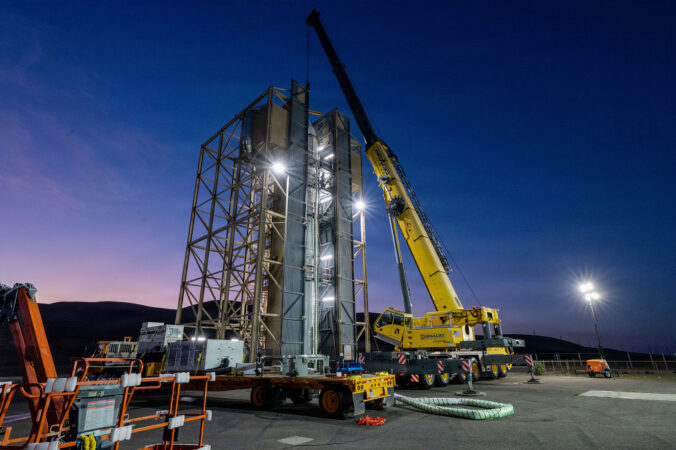
The United States Space Force is actively seeking input from private launch providers regarding its ambitious plans to establish a new “Mission Development Zone” (MDZ) at Vandenberg Space Force Base in California. This proposed zone is envisioned as a comprehensive hub designed to significantly expand capabilities for payload processing, testing, assembly, and potentially even the manufacturing of rockets and spacecraft components.
This initiative comes in response to a projected dramatic increase in demand for space launches over the next five to ten years. Vandenberg, one of the nation’s two primary coastal spaceports, anticipates its launch cadence could surge to as many as 200 missions annually by the end of the current decade. This represents a substantial escalation from the 66 space launch missions successfully supported by the base in 2023. The Space Force’s proactive approach through the MDZ aims to ensure the necessary infrastructure is in place to meet this burgeoning operational tempo.
To accommodate such a high volume of launches, Vandenberg requires more than just additional launch pads. It necessitates a robust support ecosystem, including enhanced road networks capable of handling increased and heavier traffic, expanded administrative offices, advanced processing facilities, and dedicated assembly and test infrastructure that launch suppliers depend on. The Mission Development Zone is the strategic solution proposed by Vandenberg to address these multifaceted requirements comprehensively.
While officials at Space Launch Delta 30, the unit responsible for overseeing operations at Vandenberg, have developed an initial vision for the MDZ, they emphasize the critical importance of industry collaboration. They are specifically soliciting feedback from commercial entities on various aspects, including potential financing models, optimal design and construction methodologies, long-term maintenance strategies for the infrastructure, and the specific types of facilities and layouts that would best serve the industry’s evolving needs.
In a notice issued on September 30, Space Launch Delta 30 underscored the strategic imperative of this development. The notice stated, “Ensuring that United States operators can efficiently process space systems, conduct missions in space, launch, and reenter United States airspace is critical to economic growth, national security, and accomplishing Federal space objectives.” It further clarified that “Development and utilization of the MDZ will be in support of maximizing spaceport capability and assured access to space to achieve national security objectives.” This highlights the dual benefit of the MDZ, serving both commercial innovation and governmental strategic interests.
Colonel James Horne, the commander of Space Launch Delta 30, elaborated on potential financing mechanisms during an interview with Air & Space Forces Magazine in July. He indicated that the range is exploring options to lease parcels of land within the MDZ to commercial providers, who would then be responsible for constructing their own facilities. This model aims to leverage private sector investment and expertise. Colonel Horne expressed optimism regarding the timeline, suggesting that groundbreaking on MDZ projects could commence as early as the upcoming year, signaling a rapid progression from planning to execution.
Beyond providing essential administrative and logistics support, Colonel Horne noted that the Mission Development Zone could evolve to host more advanced capabilities, such as rocket manufacturing facilities or commodity production plants, should sufficient industry demand materialize. This forward-looking perspective recognizes the potential for vertical integration and localized production to enhance efficiency and reduce logistical complexities for launch operators.
The rationale behind encouraging on-site production of both rocket components and crucial commodities like propellants and purge gases is compelling. Colonel Horne highlighted the significant logistical advantages, noting that “If you don’t build it here, you have to ship it here either by road or water, primarily.” He added, “I think as companies look at what their future launch rates may be here, they’re looking at the trade space between, do we build it somewhere and ship it or do we invest capital here to start building that production capacity to enable increased throughput.” On-site production would not only reduce transportation costs and lead times but also mitigate potential bottlenecks on base access roads or at Vandenberg’s harbor. As an example of current logistical demands, Horne pointed out that a single launch mission can necessitate the movement of as many as 50 trucks transporting various commodities on and off the base, underscoring the potential for efficiency gains through localized supply chains. This infrastructure optimization would also involve building dedicated pipelines to transport commodities to launch sites, further streamlining operations.
Why This Matters
The Space Force’s initiative to create a Mission Development Zone at Vandenberg Space Force Base holds profound implications for the future of U.S. space capabilities, national security, and economic competitiveness. Firstly, it directly addresses the burgeoning demand for space launches, driven by a confluence of commercial mega-constellations, government satellite deployments, and critical national security missions. By proactively expanding infrastructure, the U.S. aims to maintain its leadership in space access, ensuring that both private and public sector needs can be met without delay or constraint.
Secondly, the MDZ represents a strategic move towards enhancing the resilience and self-sufficiency of the domestic space industrial base. The potential for on-site manufacturing of rockets, spacecraft components, and key commodities like propellants would significantly reduce reliance on external supply chains, which can be vulnerable to disruptions. This localization of production strengthens national security by ensuring assured access to critical components and reducing logistical complexities, especially for time-sensitive military and intelligence launches.
Furthermore, this public-private partnership model, where commercial entities may lease land to build their own facilities, signals a modernized approach to government space infrastructure. It leverages private capital and innovation to accelerate development, fostering a more agile and responsive space ecosystem. This collaborative framework could serve as a blueprint for future infrastructure projects, promoting economic growth by attracting investment and creating high-tech jobs in the space sector.
Lastly, in an increasingly competitive global space landscape, the MDZ solidifies Vandenberg’s role as a vital national asset. By accommodating a higher launch cadence and offering advanced support services, the U.S. reinforces its commitment to rapid, reliable, and frequent access to space. This is crucial for maintaining technological superiority, supporting global communications, monitoring climate change, and executing defense objectives, thereby underpinning broader U.S. geopolitical and economic interests in the 21st century.