
Frankfurt, Germany –Volkswagen, the German automotive giant, announced a significant strategic overhaul on Thursday, including a plan to reduce its model offerings by as much as half. This move is aimed at curbing escalating costs and enhancing its competitive position, particularly against the rapidly expanding influence of Chinese electric vehicle manufacturers. However, the company’s announcement following a crucial board meeting provided no specific details regarding potential job cuts or factory closures, leaving workers and local communities across Germany in a state of uncertainty.
The restructuring initiative signals a clear acknowledgment from Volkswagen’s leadership that the company has become overly complex and expanded too broadly. This complexity is now viewed as a hindrance in navigating the global transition from traditional internal combustion engine vehicles to electric mobility. This paradigm shift has already disrupted many long-established automakers and facilitated the rapid emergence of new players, predominantly from China.
Recent reports in the German press had suggested that Volkswagen was contemplating drastic measures, including the potential layoff of up to 100,000 workers by the end of the decade and the closure of four manufacturing plants within Europe. Such widespread reductions would represent a significant departure from Volkswagen’s historical practice and the general approach of German industry, which typically favors more gradual and incremental adjustments to its workforce and operations.
The company’s 20-person supervisory board includes a majority of representatives from labor unions and political leaders from the German state of Lower Saxony, a major shareholder. These influential board members have previously indicated their opposition to deep, sudden cuts, highlighting the complex interplay between economic necessity, social responsibility, and political influence within German corporate governance.
Despite the lack of explicit announcements on layoffs, the company’s revised production targets suggest that workforce adjustments may be inevitable. Volkswagen now aims to produce approximately nine million vehicles annually, a substantial reduction from its pre-pandemic goal of 12 million units and a more recent target of 10 million. Oliver Blume, Volkswagen’s chief executive, stated in a video message that there is a necessity to “get rid of excess capacity,” a phrase that implicitly points towards the potential for factory closures.
Mr. Blume underscored the heightened global instability, remarking, “The geopolitical situation has become more critical in the last 12 months.” He emphasized the critical nature of the coming years for determining leadership in the automotive sector, stating, “The next few years will decide who will play a decisive role in the automotive industry.” However, his statements offered limited specifics regarding how the company plans to maintain its position as the world’s second-largest automaker by sales, a ranking it currently holds behind Toyota.
“The urgent questions were not answered by the supervisory board today,” commented Ferdinand Dudenhöffer, director of the Center Automotive Research in Bochum, Germany, in an email following the announcement. He added, “The insecurity remains,” reflecting the ongoing concerns among industry observers and stakeholders.
Volkswagen’s vast operational footprint encompasses 111 production facilities spanning every continent except Australia and Antarctica. Its extensive portfolio of brands includes luxury marques like Audi, Porsche, Lamborghini, and Bentley, as well as mainstream brands such as Skoda. Additionally, Volkswagen holds an 88 percent stake in Traton, a commercial vehicle manufacturer responsible for MAN, Scania, and International trucks. This broad diversification, while offering market reach, has also contributed to significant operational complexity.
A notable aspect of Volkswagen’s current structure is the degree to which some of its brands offer models with very similar characteristics, differentiated primarily by design and minor features. This practice, while providing market segmentation, can lead to increased development, production, and marketing costs due to internal redundancies. This contrasts with strategies adopted by competitors such as General Motors and Ford Motor, which years ago retired numerous legacy brands like Pontiac, Oldsmobile, Saturn, and Mercury in a bid to streamline their production and marketing operations.
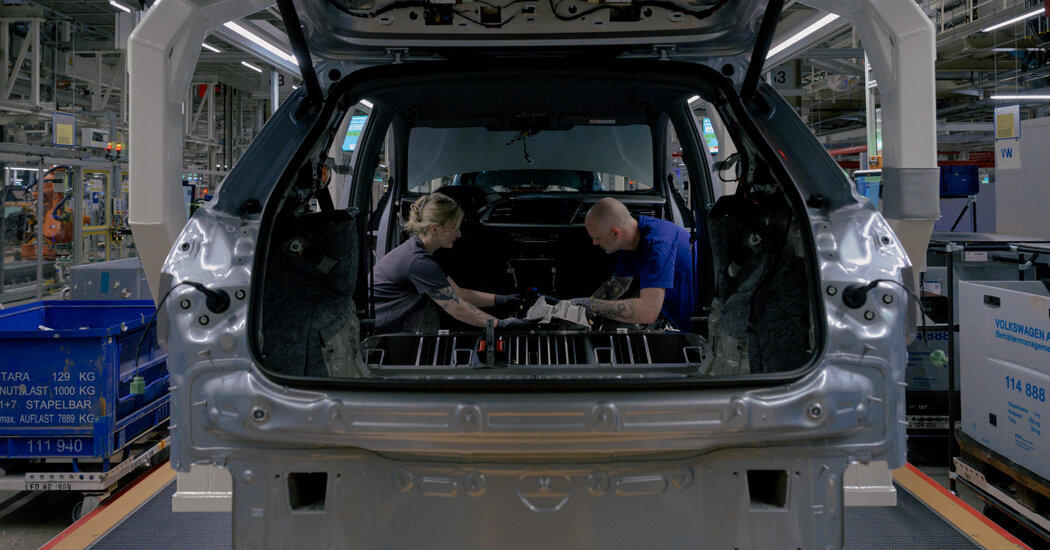
In Neckarsulm, a city in southwestern Germany, the local economy is deeply intertwined with the Audi plant, which employs approximately 15,000 workers. The prospect of a plant closure has generated widespread apprehension among residents, who fear devastating consequences for their community. Cayli Halin, 54, an employee at the plant’s testing center, articulated this sentiment starkly: “If Audi dies, everything here dies.”
The recent announcement did not clarify the potential number of job losses among Volkswagen’s global workforce of 657,000 employees as the company scales back production. Financially, the company reported a 28 percent decline in first-quarter profit, amounting to 1.6 billion euros ($1.8 billion), with sales down by 2 percent. Furthermore, the luxury Porsche brand, typically a significant contributor to Volkswagen’s overall profitability, has faced headwinds from the 25 percent tariffs imposed by the U.S. on imported cars, affecting models manufactured in Germany and exported to the American market.
The challenges confronting Volkswagen serve as a significant indicator for other established Western and Japanese automakers. These companies are, to varying degrees, grappling with the accelerated pace of technological change and intense competition from Chinese manufacturers such as BYD and Geely. These Chinese firms have rapidly gained market share by offering electric vehicles equipped with advanced features at highly competitive price points.
Data from the European Automobile Manufacturers’ Association reveals that Chinese automakers surpassed Japanese carmakers in terms of vehicle sales in the European Union and Britain during May. This surge in Chinese market penetration is largely attributable to years of strategic investment in electric vehicle technology, often encouraged by government subsidies. This early focus has provided them with a substantial advantage as European consumer demand for electric vehicles continues to grow. Approximately one in five new vehicles sold in Europe is now electric, with sales experiencing a significant boost this year due to increased fuel prices driven by global geopolitical events, particularly the conflict in Ukraine.
Volkswagen finds itself in a particularly vulnerable position given its historical reliance on the Chinese market, where it was once the leading automaker. The company’s sales in China experienced a sharp 20 percent decline in the first quarter of the year, continuing a trend of significant reductions over several years. This loss of market dominance in a crucial region amplifies the urgency of its current restructuring efforts.
Concerns over potential plant closures have resonated deeply across Germany, where the automotive industry, and Volkswagen in particular, holds a revered status in the national consciousness and serves as a fundamental pillar of the national economy. The prospect of widespread job losses in such a vital sector is a matter of profound national concern.
The German government, under Chancellor Friedrich Merz, has actively sought to support the industry through various measures, including new subsidies and advocating for relaxed automotive regulations from European Union officials in Brussels. These efforts are aimed at bolstering the competitiveness of German automakers against their increasingly formidable Chinese rivals. While Mr. Merz did not directly address the rumored Volkswagen layoffs before Thursday’s board meeting, his spokesman, Stefan Kornelius, previously stated last week that “our goal is to prevent plant closures in Germany,” underlining the government’s commitment to protecting domestic manufacturing jobs.
Ali Alp Cagan, 31, an information technology professional at the Audi plant, expressed personal confidence in his job security due to strong demand for IT skills. However, he acknowledged the broader unease, stating, “Overall, however, the situation is already nervous.” Mr. Cagan and other workers interviewed during a recent shift change attributed the company’s current difficulties to a perceived failure to innovate, suggesting that Chinese manufacturers have surpassed them in producing more affordable and technologically advanced vehicles.
The precarious situation within the German auto industry has also created an environment conducive to the rise of both far-right and far-left political parties. At the Audi plant in Neckarsulm, members of the Marxist-Leninist Party of Germany were recently observed distributing flyers, urging workers to participate in an unauthorized pre-emptive strike in response to potential factory closures, reflecting heightened social and political tensions.
Civic leaders and local business owners in Neckarsulm are expressing profound worry for their community’s economic future. Pauline Spies, 56, owner of Michigan Tours travel agency, reported a noticeable decline in business directly linked to the company’s troubles. Harry Leinmüller, 67, whose wife operates the Teecultur tea shop positioned to cater to plant workers, has similarly observed a drop in local spending. He voiced concerns about the long-term impact of layoffs, noting, “There are so many young people here; some have bought building plots in the countryside. Many won’t be able to pay for their houses anymore.” He critically added, “The Chinese are faster than us and have more know-how.”
Mayor Steffen Hertwig, 56, while acknowledging that a plant closure would be “fatal” for the area, expressed firm belief that Volkswagen would not close the innovative Audi factory in Neckarsulm. He drew a distinction, asserting that the current situation “is in no way comparable to Detroit in the 1980s,” suggesting confidence in the plant’s future despite the broader industry challenges.
Why This Matters
The strategic overhaul announced by Volkswagen carries far-reaching implications, extending beyond the confines of the German automotive giant to impact the global economy, labor markets, and the future trajectory of the automotive industry. Firstly, it underscores the profound and rapid transformation occurring within the global auto sector, driven primarily by the shift to electric vehicles and intensified competition from new entrants, particularly from China. For decades, established automakers like Volkswagen thrived on incremental innovation and brand loyalty. Now, they face an existential challenge to adapt quickly to new technologies, supply chains, and consumer expectations, or risk obsolescence.
Secondly, Volkswagen’s struggle, despite its immense scale and historical success, highlights a critical juncture for traditional industrial powers. Germany, a global manufacturing powerhouse, heavily relies on its automotive sector for economic stability, innovation, and high-wage employment. Any significant contraction or restructuring by a company as central as Volkswagen could have ripple effects across the German economy, potentially leading to job losses not only within manufacturing but also in ancillary industries and local service sectors. This situation presents a significant test for Germany’s social market economy model, which historically balances corporate interests with strong labor protections and social welfare.
Thirdly, the rise of Chinese automakers and their dominance in electric vehicle technology represents a significant geopolitical and economic shift. China’s early and sustained investment in EVs, supported by government policies, has positioned its companies as formidable global competitors. Their ability to offer advanced, feature-rich EVs at lower price points puts immense pressure on Western manufacturers, challenging long-held assumptions about automotive leadership. This dynamic could reshape global trade flows, technological standards, and manufacturing footprints, potentially leading to increased protectionist measures or new international collaborations.
Finally, the uncertainty surrounding job security for hundreds of thousands of Volkswagen employees worldwide, and the anxieties of communities like Neckarsulm, reflect broader societal concerns about the future of work in an era of rapid technological change and globalized competition. It forces a conversation about how governments, corporations, and labor unions can best manage transitions that inevitably displace traditional jobs, foster new skills, and ensure economic stability for affected regions and workers. The outcome of Volkswagen’s restructuring will serve as a bellwether for how other legacy industries adapt to the demands of a new global economic and technological landscape.