
This article’s audio is presented by the Air & Space Forces Association, venerating and aiding our service members, space professionals, and their kin. Learn further details at afa.org
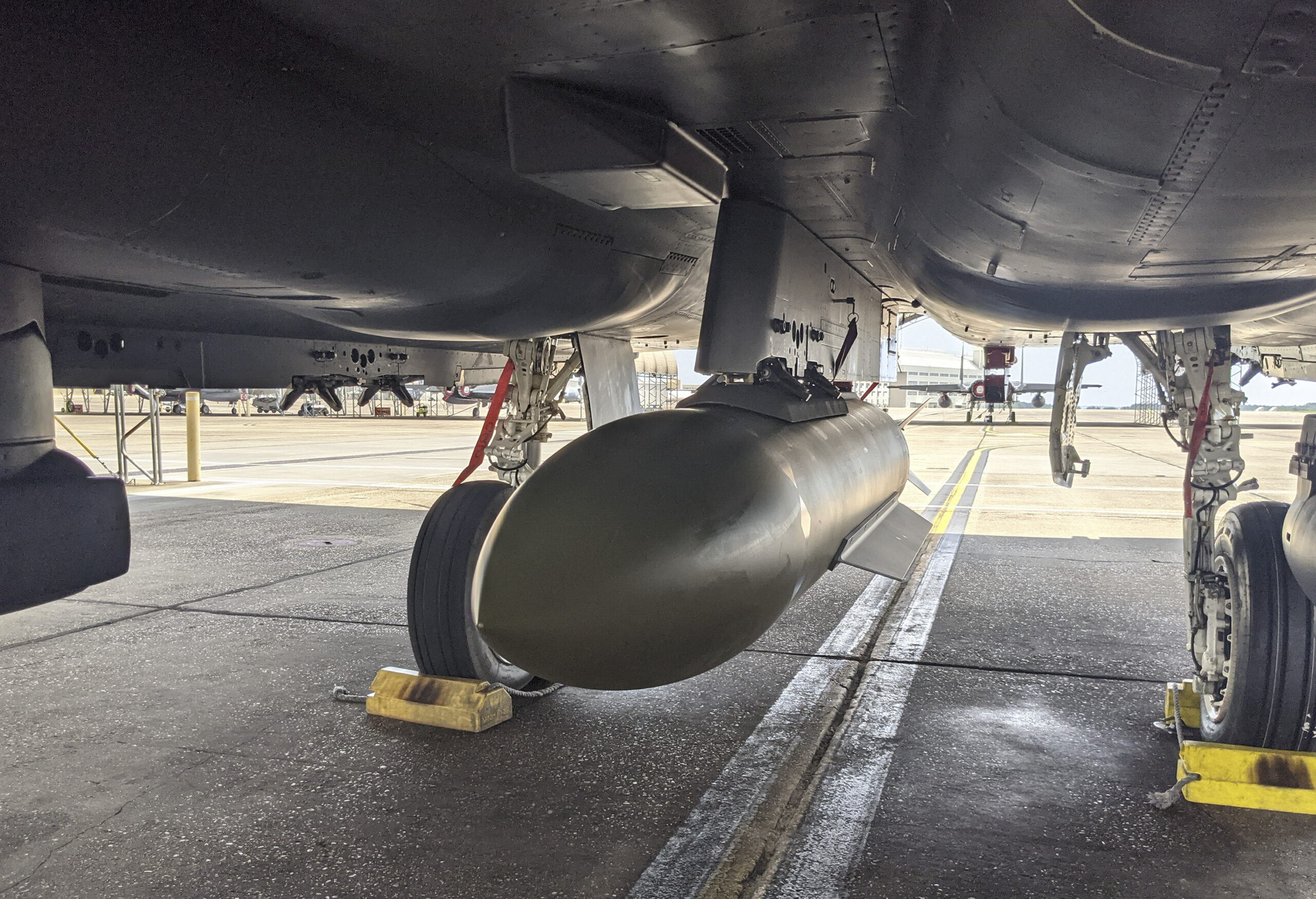
During Operation Epic Fury, the Air Force is deploying a combination of its most modern munitions and its most venerable aircraft to engage distinct objectives within the Strait of Hormuz—specifically, an advanced hard-target penetrator weapon and the renowned A-10 Thunderbolt II ground-attack aircraft.
Gen. Dan Caine, the Air Force Chairman of the Joint Chiefs of Staff, alluded to both armament platforms during a news briefing held at the Pentagon on March 19.
“The U.S. armed forces deployed 5,000-pound deep-penetrating munitions into the subterranean depots housing littoral defense cruise projectiles and ancillary gear,” Caine stated.
American authorities informed Air & Space Forces Magazine that the munitions consisted of GBU-72 Advanced 5K Penetrators.
Regarding the A-10s, Caine remarked, “The ‘Warthog’ is currently engaged in combat operations across the southern sector, tracking and neutralizing rapid assault naval vessels in the Strait of Hormuz,” using the aircraft’s informal designation.
U.S. Central Command revealed on March 17 that it had “utilized numerous 5,000-pound penetrating warheads” to strike reinforced missile installations along Iran’s southern shore adjacent to the Strait of Hormuz. Caine failed to particularize the munition’s model or the quantity deployed against the repositories.
Caine refrained from specifying the exact number of rapid-assault naval craft the A-10s had hit. In total, the U.S. armed forces assert they have annihilated 120 Iranian maritime craft and 44 mine-deploying vessels thus far during the operation.
The strait represents a vital geopolitical bottleneck through which approximately one-fifth of global petroleum shipments transit daily. It has been nearly completely restricted for conventional tanker movements owing to Iranian assaults and intimidations since the commencement of Operation Epic Fury, leading to escalating petroleum and energy costs worldwide.
The GBU-72 was designed for both combat planes and heavy bombers to engage profoundly interred, reinforced objectives, numerous examples of which Iran possesses to safeguard its ordnance, unmanned aerial vehicles, and atomic production facilities.
“These munitions are custom-engineered to breach concrete or rock formations and operate post-perforation of such impediments,” Caine noted.
Authorities indicated this marks the initial deployment of the GBU-72 in Operation Epic Fury. It was earlier employed against a subterranean Houthi location in Yemen in May 2024, CBS News conveyed at that juncture. Houthi insurgents, backed by Iran, have carried out continuous assaults on naval ships in the Red Sea near the Yemeni littoral in recent periods, triggering retaliatory attacks by American forces in the area.
The GBU-72 underwent its inaugural trial deployment at Eglin Air Force Base, Fla., in 2021 and transitioned to Joint Direct Attack Munition assimilation, evaluative, and trial aerial maneuvers in 2022, as per an Air Force announcement.
The warhead was engineered to surpass the capabilities of the predecessor GBU-28, which has been operational since the 1991 Persian Gulf Conflict.
“Its destructive capacity is anticipated to be considerably greater relative to analogous preceding armaments like the GBU-28,” stated James Culliton, then-GBU-72 Program Manager, in an announcement.
The GBU-28 is able to pierce through 150 feet of earth or 15 feet of fortified concrete.
Overcoming such constructions is the purview of “proximate armaments” like the GBU-72, which are more potent once adversary aerial protection systems have been incapacitated, an assertion Secretary of Defense Pete Hegseth put forth concerning Iran.
U.S. officials have not identified which aircraft bore the penetrating munitions utilized in Iran. The 2021 munition deployment at Eglin transpired via a 96th Test Wing F-15E Strike Eagle. Aircraft photographer Ian Recchio photographed a B-1B Lancer bomber transporting a GBU-72 in June 2024.
The A-10’s assaults on rapid-assault naval vessels in the strait provide the venerable aircraft a function alongside its newer aerial counterparts in the ongoing mission. Broadly disseminated social media footage suggests the Warthog has also been engaging Iran-supported paramilitary factions in Iraq.
The initial series-produced aircraft was supplied to Davis-Monthan Air Force Base, Ariz., in 1975.
The A-10 was purpose-built for proximate aerial assistance, operating at reduced elevations and deliberate velocities to facilitate extended patrol durations. These attributes are beneficial for identifying and pursuing naval craft.
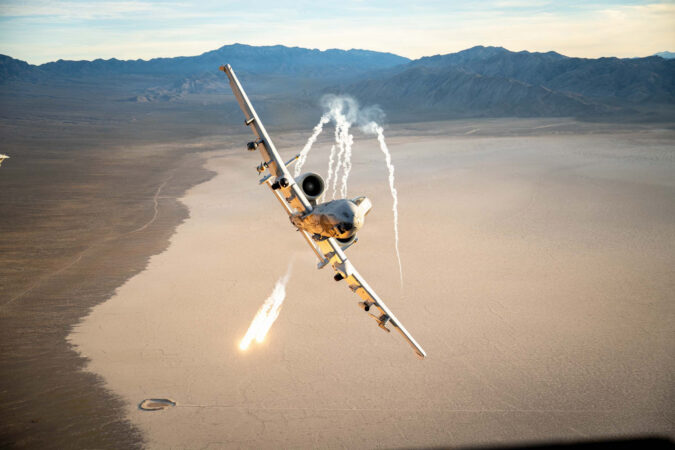
The aircraft can function beneath 1,000-foot overheads with 1.5-mile sightlines, as per Air Force statistics. It is also remarkably resilient. The Warthog can withstand direct impacts from anti-armor and potent-explosive rounds.
For offensive capabilities, the A-10 is equipped with a 30mm GAU-8/A Gatling gun able to discharge 3,900 rounds each minute. It can also bear a selection of air-to-ground armaments, including AGM-65 Maverick and AIM-9 Sidewinder projectiles, according to Air Force data.
During the early February military consolidation preceding the commencement of Operation Epic Fury, the Air Force and Navy published an announcement stating A-10s were practicing for a proximate aerial assistance role in support of the littoral combat vessel USS Santa Barbara in the Arabian Gulf.
CENTCOM also displayed visuals of the A-10 during mid-air replenishment sorties throughout the operation on March 15.
While infrequent, this is not the initial instance that the A-10 has been employed in drills or engagements versus a naval objective.
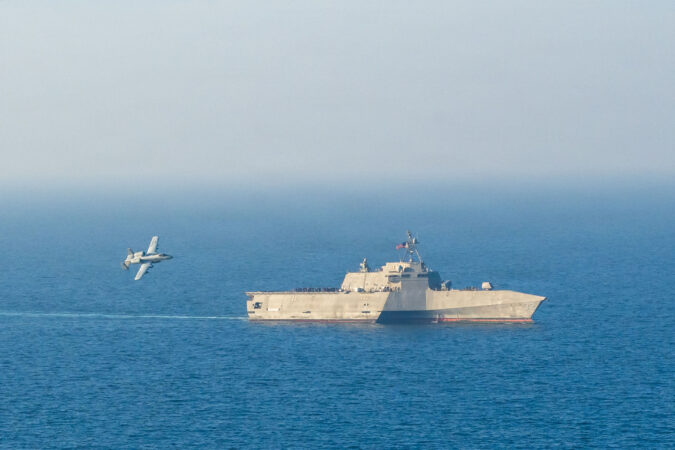
In September 2023, two Thunderbolts from the 75th Fighter Squadron conducted drills with the USS Stethem in the Gulf of Oman, as per an announcement.
The identical announcement additionally indicated, earlier that year, that the warplane had collaborated with maritime resources USS Bataan and USS Thomas Hudner in the Gulf of Oman, and escorted a Navy reconnaissance plane and three Coast Guard patrol boats in the Arabian Gulf.
From an engagement perspective, an A-10, in concert with a Navy P-3C Maritime Surveillance aircraft and the guided-missile destroyer USS Barry, attacked the Libyan Coast Guard ship, Vittoria, and two minor vessels, after the Vittoria discharged weapons at commercial ships off the Libyan littoral on March 28, 2011, as per an announcement.
The A-10 struck the two minor craft, annihilating one and compelling the desertion of the other, as per the announcement.
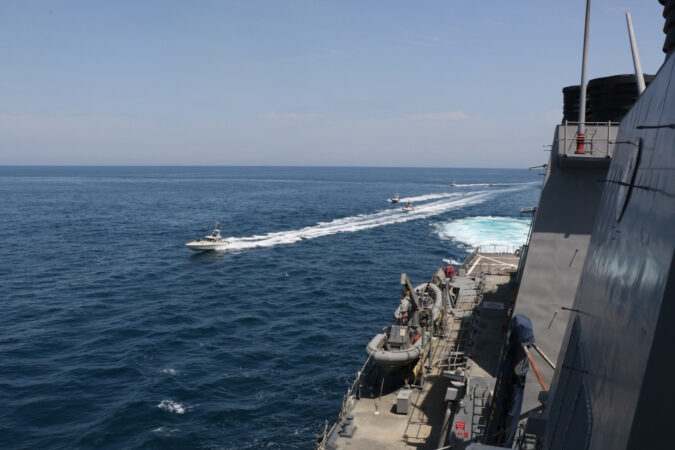
Rapid assault craft have historically been deployed by the Iranian Navy to impede maritime traffic in the Arabian Gulf and particularly within the Strait of Hormuz.
In 2020, the U.S. Navy published footage and photographs of 11 Iranian rapid boats converging on several U.S. Navy vessels in the Gulf from short distances and at swift velocities, approaching within 50 yards of one vessel and 10 yards of a second.
This article’s audio is presented by the Air & Space Forces Association, venerating and aiding our service members, space professionals, and their kin. Learn further details at afa.org