
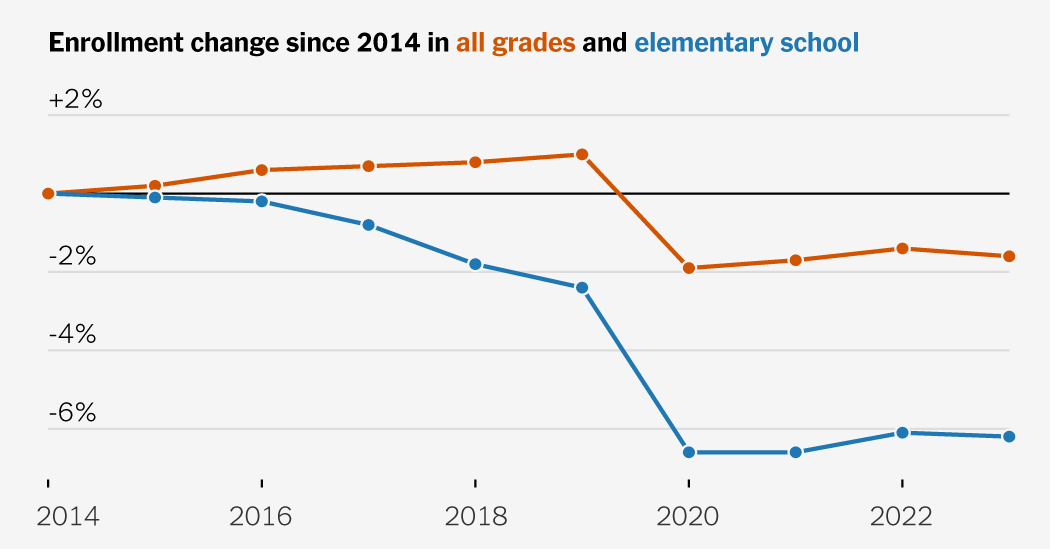
Public school districts across the United States are confronting a significant demographic shift: a sustained decline in student enrollment. This trend is a direct consequence of a multi-year reduction in birth rates among American women, leading to a diminishing population of young children available to enter the education system. The implications of this demographic change are now profoundly impacting school systems nationwide, necessitating difficult operational and financial adjustments.
The reduction in student numbers is widespread, with the kindergarten through 12th-grade public school population having decreased in at least 30 states since the mid-2010s. This pattern indicates a systemic issue rather than isolated incidents, reflecting broader societal trends affecting family formation and migration across the country. The long-term nature of this decline suggests that the challenges for public education are set to persist for the foreseeable future.
While initial observations might suggest that declining enrollment is primarily an urban phenomenon, a New York Times analysis revealed that major metropolitan districts, including Los Angeles, Chicago, and New York, are indeed experiencing significant reductions. However, the analysis also demonstrated that smaller and suburban districts are shrinking at a comparable rate, indicating that no specific geographic or demographic segment is immune to this overarching trend. This widespread impact necessitates a national conversation on adaptive strategies for public education.
The financial ramifications of fewer students are immediate and severe for many districts. Public school funding in the United States is largely tied to enrollment numbers, meaning a decrease in students directly translates to a reduction in allocated resources. Consequently, numerous districts are grappling with painful budget cuts, which often lead to difficult decisions regarding staffing levels, program offerings, and the controversial topic of school closures. These discussions are often fraught with community tension and political resistance.
Several interconnected factors contribute to this decline in public school enrollment. For families residing in urban centers, escalating housing costs and other living expenses are increasingly pushing them out of cities into more affordable areas, often outside the immediate jurisdiction of urban school districts. Additionally, shifts in national immigration policy, particularly a more stringent approach to border crossings, have resulted in fewer children arriving from other countries. Historically, immigrant populations have played a crucial role in buoying enrollment numbers in various school systems across the nation, making this reduction particularly impactful.
The COVID-19 pandemic also played a role in accelerating these trends, as many public school districts experienced a temporary, but in some cases lasting, exodus of students during periods of remote learning and health concerns. The pandemic era also intensified competition from alternative educational models. Public schools now face increased rivalry from private institutions, the growing popularity of homeschooling, and the emergence of virtual schools, all of which offer alternative pathways for families seeking different educational environments or greater flexibility.
Post-pandemic data indicates a modest, though not fully sustained, increase in private school enrollment, including in Catholic schools which saw a bump during the health crisis despite a decade-long overall decline. This shift is further supported by the proliferation of new school voucher programs in many U.S. states. These programs provide public funds to help families afford private education, potentially diverting more students away from public school systems and exacerbating the enrollment decline.
Despite the influence of these various factors, demographers and education experts largely agree that the most significant driver behind declining public school enrollment is the unprecedentedly low U.S. fertility rate. This rate, which measures the average number of children born per woman, reached its most recent peak in 2007 and has subsequently plummeted by 24 percent. This substantial and sustained decrease in births creates a demographic deficit that inevitably translates into fewer school-aged children years later.
As the children born during the higher fertility years mature and move through the education system – for instance, many of those born in 2007 are expected to graduate high school in 2025 – there are simply insufficient numbers of younger children to replace them in the lower grades. This demographic pipeline issue suggests a deepening problem. Projections from the National Center for Education Statistics, a key research division within the Department of Education, forecast a continued decrease in enrollment in the coming years, indicating that the current situation is far from its nadir.
Marguerite Roza, director of the Edunomics Lab at Georgetown University, an institution specializing in education finance research, succinctly summarized the gravity of the situation, stating, “This year is actually the tip of the iceberg.” Her comment underscores the expectation that the most profound impacts of the declining birth rate are yet to be fully realized by the nation’s public schools.
The city of Portland, Oregon, a metropolitan area home to approximately 44,000 public school students, offers a concrete example of this trend. The district has experienced a 9 percent reduction in enrollment since 2014. While falling birthrates are identified as the primary contributor, Superintendent Kimberlee Armstrong highlighted an additional challenge: families are actively relocating out of the city. This exodus, which intensified during the pandemic and has persisted, contributes significantly to the student population decline.
Superintendent Armstrong elaborated on the motivations behind these family relocations, noting, “People are choosing to raise kids somewhere other than in the city — moving to suburbs or places where they have access to affordable housing.” She emphasized that this is not merely an issue of losing students from the school system, but rather a broader concern about the city of Portland experiencing a sustained loss of families, which carries wider economic and social implications.
In an effort to counteract these trends, the Portland district has initiated an enrollment campaign and invested in early childhood education programs like pre-kindergarten and literacy initiatives. Despite these efforts, Armstrong acknowledged that while a recent uptick in kindergarten enrollment was positive, “it doesn’t fix it long term.” The district faces a projected $50 million budget shortfall for the upcoming fiscal year, leading to prospective layoffs and the difficult consideration of school closures.
Denver, Colorado, presents another illustrative case, where school enrollment began its decline in 2020, influenced by years of lower birthrates and rising living costs that compelled families to leave the city. However, between 2022 and 2024, Denver experienced a temporary reversal of this trend due to a significant surge in immigration, which brought several thousand new children into the school system, offering a brief reprieve from the shrinking numbers.
This reversal proved temporary. With a subsequent decrease in immigration, partly attributed to changes in federal immigration policies, Denver’s school enrollment is once again on a downward trajectory, illustrating the volatility that external factors can introduce into local demographic patterns and school planning.
Ashley Elementary School in Denver, a dual-language institution offering instruction in both English and Spanish, serves as a micro-example of this fluctuating enrollment. Its student population had more than doubled from 175 to nearly 400 students during the immigration surge. However, as migrant families dispersed to other U.S. locations or returned to their home countries, enrollment at Ashley Elementary has now receded to 250 students, highlighting the swift and significant impact of demographic shifts on individual schools.
Facing a substantial $674,000 budget deficit, Principal Janet Estrada has been forced to make difficult staffing reductions for the upcoming academic year. These cuts include an assistant principal, a school secretary, a first-grade teacher, and half of the school’s teacher’s aides, directly impacting the school’s operational capacity and student support services.
While the reduced student body might lessen the overall demand for certain positions, these cuts simultaneously diminish the educational opportunities available to the remaining students. Notably, the elimination of a dedicated art teacher means students at Ashley Elementary will no longer have a specific art class, underscoring how budget constraints can narrow the curriculum and extracurricular offerings.
Principal Estrada articulated the frustration felt by many educators and administrators caught in this broader trend, stating, “I feel like a broken record trying to tell my community members, ‘It’s not Ashley, it’s not because of what we’re doing there, this is a national trend.’” Her comments reflect the challenge of communicating that local impacts are often symptoms of larger, nationwide demographic and economic forces.
The enrollment challenge is not confined to urban centers or areas experiencing significant outward migration. Even affluent school districts, traditionally magnets for families due to their reputation for high-performing schools—such as those in Palo Alto, California, and Montclair, New Jersey—are struggling to maintain their student populations, suggesting the pervasive nature of the underlying demographic shifts.
Conversely, certain areas have shown greater resilience or even growth. These include rural areas situated on the periphery of major metropolitan hubs, which may attract families seeking more space and lower costs, as well as states experiencing broader population increases. States like Idaho, Utah, and Texas have seen overall population growth, which can initially buffer school enrollment. However, even these growth areas have reported recent dips, indicating that the national trend is beginning to affect them as well.
William H. Frey, a demographer and senior fellow at the Brookings Institution, highlighted a broader pattern of internal migration within the U.S. Americans are increasingly relocating from high-cost coastal and Midwestern states to Southern and some Western states, often moving away from large cities. The COVID-19 pandemic significantly accelerated these existing demographic movements, as remote work options and a desire for more affordable living became more prevalent.
Frey summarized the driving force behind these internal migrations: “People are broadly moving to where they can get an affordable house and a good job and their families are going to feel good living there.” This emphasis on affordability and quality of life suggests that economic factors play a substantial role in where families choose to reside and, consequently, where children attend school.
This ongoing demographic shift presents a multifaceted challenge for the public schools that experience declining enrollment and for the students who remain within those systems. While fewer students might seem to imply reduced operational needs, schools with insufficient student numbers still require fundamental infrastructure and staffing, including a principal, administrative staff, and a core teaching faculty. This reality can lead to an elevated cost per student, making per-pupil spending less efficient even as overall budgets shrink.
In an effort to manage budget shortfalls, schools often resort to cutting elective courses, reducing extracurricular activities, or offering fewer Advanced Placement classes. Such reductions can, paradoxically, make a school less attractive to prospective families, potentially accelerating the enrollment decline in a negative feedback loop. Maintaining a rich academic and extracurricular environment becomes increasingly difficult under these fiscal pressures.
One of the most drastic, yet financially impactful, measures districts can take is closing school buildings. While this can yield substantial cost savings, it is almost universally a politically charged and emotionally contentious decision. Community members often view schools as vital hubs of neighborhood identity and stability, leading to intense opposition to closures.
To date, relatively few districts have undertaken large-scale school closures, largely due to the significant political pressure from affected families and local communities. Furthermore, these decisions often draw criticism that closures disproportionately affect minority and low-income students, who may have fewer alternative educational options and greater reliance on local public schools as community anchors. The dilemma highlights the complex interplay between demographic realities, fiscal responsibility, and social equity in public education.
Why This Matters
The widespread decline in public school enrollment across the United States is more than an educational issue; it signals profound demographic and societal shifts with far-reaching consequences. Fewer children entering the education system today translates into a smaller workforce and consumer base in the coming decades, potentially impacting economic growth, innovation, and national productivity. This demographic contraction can strain social security systems, healthcare, and other public services designed for a larger, younger population, leading to complex intergenerational equity challenges.
For communities, school closures are not merely budget adjustments; they represent the loss of vital social infrastructure. Schools often serve as community centers, providing services beyond education, fostering local identity, and anchoring neighborhoods. Their closure can lead to decreased property values, reduced local engagement, and a sense of decline, particularly in areas already struggling economically. It can also exacerbate educational inequities, as remaining students may face longer commutes or fewer specialized programs if smaller schools are consolidated.
The financial strain on public education, fueled by declining enrollment, necessitates difficult policy choices. Districts must grapple with how to maintain quality education with fewer resources, potentially leading to reduced teacher salaries, larger class sizes, or cuts to essential programs like arts, sports, and special education. This could ultimately undermine the very quality of education that attracts families, creating a negative cycle. Understanding and addressing this trend is crucial for policymakers, urban planners, and communities to adapt to changing demographics and ensure the long-term vitality of both the education system and the nation’s social fabric.
School districts across the United States are grappling with a complex and often contentious challenge: declining student enrollment. This widespread demographic shift is compelling many urban centers to confront the difficult decision of closing schools, a measure frequently met with significant community opposition but increasingly viewed by educational administrators as a necessary step for financial solvency and the maintenance of academic quality. The ongoing debate highlights the intricate balance between preserving community institutions, fulfilling fiscal responsibilities, and the imperative to provide robust academic opportunities for all students.
Recent developments in major U.S. cities underscore the national scope of this issue. Philadelphia and Austin, Texas, for example, have both recently approved plans to consolidate schools, signaling a growing trend of districts taking decisive action in response to shrinking student populations. In Oakland, California, a city where previous attempts to close schools have historically faced fervent opposition from parents and community groups, a notable shift has occurred: more than 60 principals collectively signed a rare letter supporting closures. This unusual show of internal consensus among educational leaders suggests a widespread acknowledgment of the gravity of the situation and the perceived necessity of such measures, even in historically resistant areas.
The city of Pittsburgh offers a particularly vivid illustration of this struggle. A plan initially proposed to close nine schools was voted down by the school board in November, reflecting the deep divisions and strong community sentiment surrounding the issue. However, the proposal has since been reintroduced for consideration this spring, indicating the persistent and urgent nature of the challenge. Gene Walker, the president of the Pittsburgh school board, has articulated the compelling rationale behind the proposed closures, stating unequivocally that such actions are “necessary.” He highlighted the stark reality facing the district, which has experienced a substantial loss of approximately 25 percent of its enrollment over the past decade.
This significant decline in student numbers has tangible and detrimental consequences for educational offerings. Mr. Walker pointed to one K-8 school in the district with such a sparse student body that it is unable to offer core subjects like algebra, thereby limiting the academic trajectory and future opportunities for its students. The proposed plan in Pittsburgh aims to rectify these deficiencies by consolidating resources and bolstering academic and enrichment offerings at the remaining institutions. Under the new structure, all elementary schools, for instance, would be equipped to provide essential programs such as art, music, and a foreign language — subjects often cut or unavailable in under-enrolled schools due to budgetary constraints and staffing limitations.
Mr. Walker emphasized the long-term vision guiding these difficult decisions, stating, “It’s better than looking our young people in the eye and saying we don’t have the ability to give you what you deserve, because we are not willing to make this really hard change.” This perspective underscores the belief that immediate, challenging decisions are essential to ensure a higher quality of education and more equitable opportunities for future generations of students in the district.
Research on the impact of school closures presents a nuanced picture regarding their effects on students. While some studies indicate that closures can, in certain circumstances, negatively affect student academic performance, other findings suggest that students can benefit significantly if they are subsequently reassigned to higher-quality schools. This distinction is critical for policymakers, as it implies that the outcome is not solely dependent on the act of closure itself but critically on the quality of the receiving institutions and the support provided during the transition. The goal, as articulated by proponents like Mr. Walker, is not merely to shrink the district but to optimize the educational environment for the students who remain, ensuring they have access to robust and comprehensive programs.
The debate over school closures is further complicated by broader demographic projections and historical precedents. Some demographers suggest that the current low U.S. fertility rates could potentially rebound in the future, speculating that some young women today might simply be delaying childbearing into their 30s and 40s. A similar phenomenon occurred in the 1970s, following the women’s movement, when women postponed pregnancies to pursue higher education and careers. In that period, some school districts that had closed facilities later faced issues of overcrowding when birth rates eventually rose again, creating a cautionary tale for current decision-makers.
However, school leaders like Gene Walker argue that districts cannot afford to wait on such uncertain demographic shifts, especially when facing immediate and severe resource constraints. “Even if it did rebound, you are looking at 10 to 15 years down the road,” Mr. Walker remarked, highlighting the pressing nature of current challenges. He added a stark warning about the long-term viability of the district: “If we wait another 10 to 15 years, I don’t know if this district survives.” This statement encapsulates the profound dilemma faced by many urban school systems: the urgent need to address current realities and ensure educational quality and financial stability now, even with the inherent risk that future demographic changes might create new challenges.
Beyond fertility rates, other factors contribute to declining public school enrollment across the nation. These include shifts in urban populations, internal migration patterns, the increasing growth of charter and private school options, and even historical trends like “white flight” from city centers which have profoundly reshaped the landscape of public education over decades. These multifaceted pressures often leave public school systems with aging infrastructure, underutilized facilities, and a reduced tax base, making the decision to consolidate not just an educational consideration, but a critical financial imperative.
The process of school closure is rarely straightforward or without emotional impact. It frequently ignites passionate protests from parents, teachers, and community members who view schools as vital neighborhood anchors, repositories of local history, and central to community identity. The emotional toll of closing a school, particularly one that has served generations of families, is immense and often deeply felt. Yet, school boards are increasingly finding themselves in a position where the alternative – maintaining under-enrolled, underfunded schools that cannot offer a comprehensive or equitable education – is deemed a greater disservice to students. The challenging balance involves weighing immediate community concerns and attachments against the long-term educational and financial health of the entire district, in an effort to secure a sustainable future for public education.
Why This Matters
The widespread trend of school closures across major U.S. cities, primarily driven by declining enrollment, carries profound implications that extend far beyond the classroom, affecting students, communities, and the very fabric of public education.
For Students:The most immediate and significant impact of school closures is on the students themselves. While closures can disrupt existing friendships, routines, and a child’s sense of belonging, they also present a critical opportunity for improved educational outcomes if students are successfully transitioned into well-resourced, high-quality schools. The consolidation of resources can enable remaining schools to offer a broader and richer curriculum, including specialized subjects like art, music, foreign languages, and advanced mathematics that might be unattainable in smaller, under-enrolled facilities due to budgetary or staffing constraints. Conversely, poorly managed transitions or reassignments to struggling schools can exacerbate academic setbacks and emotional distress, potentially disproportionately affecting vulnerable student populations. Fundamentally, this issue touches upon educational equity and every student’s right to access a quality learning environment.
For Communities and Neighborhoods:Schools often serve as the heartbeats of their neighborhoods, functioning as essential community hubs for social gatherings, athletic events, civic engagement, and local identity. Their closure can lead to a significant loss of community cohesion, reduce property values in the immediate vicinity, and eliminate safe and familiar spaces for children and families. It can also create substantial logistical challenges for parents, necessitating longer commutes for their children, disrupting established childcare arrangements, and increasing transportation costs. The decision to close a school, therefore, is not merely an administrative or financial calculation; it is a decision with profound social, cultural, and economic ramifications that can reshape the character and vitality of urban areas for decades.
For Public Finances and Governance:Declining enrollment leaves school districts with the burden of maintaining underutilized buildings, incurring high operational and maintenance costs, and inefficiently allocating scarce resources. Consolidating schools can lead to significant cost savings by reducing overhead, allowing districts to redirect funds from facility upkeep and utilities to critical academic programs, competitive teacher salaries, and essential student support services. This directly impacts how taxpayer money is spent and the overall financial health and sustainability of local governments. However, the process itself also involves substantial upfront costs, including potential severance packages for staff, adjustments to transportation systems, and necessary renovations or expansions of receiving schools. It demands complex governance decisions that delicately balance fiscal prudence with community needs and educational imperatives.
Reflecting Broader Societal Trends:The widespread phenomenon of declining school enrollment is a stark indicator of broader demographic and societal shifts occurring across the nation. It reflects lower birth rates in the U.S., evolving internal migration patterns within and between cities, and changing choices in educational pathways, such as the growth of charter schools, private schooling, and homeschooling options. Understanding and effectively responding to these complex trends is crucial for urban planners, policymakers, and community leaders. The challenge of school closures compels a critical reevaluation of how public institutions adapt to changing populations and prepare for future demands. It underscores the dynamic nature of urban environments and the constant need for public services to evolve in response to societal change.
The Future of Public Education:Ultimately, the debate over school closures is central to the long-term sustainability and adaptability of the American public education system. It compels districts to critically assess their existing infrastructure, the breadth and quality of their educational offerings, and their long-term financial models. The decisions made today regarding school consolidation will largely shape the educational landscape for the next generation, determining whether public schools can remain vibrant, equitable, and effective institutions capable of serving diverse student populations in an era defined by demographic shifts and fiscal constraints.