
A lot of the conversation around AI in healthcare focuses on diagnostics and drug discovery or on doctor-patient visits. But a less visible part of the system affects whether patients actually get seen at all, and it has less to do with the number of doctors in the world (too few) and more with the administrative work (too much) that happens between a primary care doctor writing a referral and a specialist’s office getting a patient on the schedule. That gap, it turns out, is huge, stubbornly manual, and increasingly attracting serious interest from venture capitalists.
Key Takeaways:
- **The Hidden Healthcare Crisis:** The administrative bottleneck in specialist referrals, often overlooked, is a significant barrier to patient care, leading to lost appointments and delayed treatment.
- **Basata’s AI-Driven Solution:** Founded by former tech and medical device executives, Basata leverages AI to automate referral processing and patient scheduling, aiming for same-day appointment confirmations.
- **Augmenting vs. Displacing:** While a crowded market sees heavy investment in AI for administrative tasks, Basata focuses on an end-to-end, specialty-specific approach, arguing that its technology empowers existing staff rather than replacing them.
Unseen Bottlenecks: How AI is Tackling Healthcare’s Referral Black Hole
While much of the excitement and investment in Artificial Intelligence within healthcare gravitates towards groundbreaking diagnostics, advanced drug discovery, or enhancing the direct doctor-patient interaction, a critical, yet largely invisible, segment of the system dictates whether patients even *reach* the specialist care they need. This segment isn’t about the scarcity of doctors but the overwhelming deluge of administrative tasks that stand between a primary care physician’s referral and a specialist’s booked appointment. This “care gap” is vast, stubbornly manual, and, finally, catching the serious attention of venture capitalists.
Phoenix-based Basata, a two-year-old startup, is at the forefront of this administrative revolution. Co-founded by Kaled Alhanafi, a former executive at tech giants Lyft and Cruise, and Chetan Patel, who dedicated a decade to building cardiac devices at Medtronic, Basata emerged from the founders’ shared, frustrating personal encounters with this very problem.
When Personal Frustration Sparks Innovation
For Patel, the issue hit home with frightening clarity when his wife fainted on a flight, leaving him with their young children. Despite his deep expertise in cardiology and the specific devices that could aid her, he recounts the administrative labyrinth to secure appropriate care proved far more arduous and time-consuming than it should have been. “We have the best doctors, we have some of the best medicines, but the care gap is just so wide,” he lamented, underscoring the systemic inefficiency.
Alhanafi’s experience mirrored Patel’s. After his father received a serious carotid artery diagnosis, he was referred to three cardiology groups. Shockingly, only one practice responded within a crucial couple of weeks. Another called back only *after* the surgery had already taken place, and the third, to this day, has never made contact. These aren’t isolated incidents; they are common narratives for nearly anyone who has attempted to navigate the specialist referral system in recent years. Specialty practices, often receiving hundreds or thousands of referrals – predominantly via outdated fax machines – struggle with small administrative teams, leading to a massive intake backlog that causes patients to fall through the cracks.
Basata’s Digital Lifeline: AI-Powered Referrals and Scheduling
Basata aims to mend this broken process. When a referral, still typically a faxed document, arrives at a specialist’s office, Basata’s system springs into action. It intelligently reads and processes the document, extracting all pertinent clinical information. Following this, an AI voice agent directly contacts the patient to facilitate appointment scheduling. This innovative approach extends beyond initial scheduling; patients can also call the practice at any hour and interact with an AI agent capable of answering questions or handling routine administrative needs, such as prescription renewals.
Alhanafi proudly shares recordings of patients expressing genuine surprise at the unprecedented speed of contact after their referral. The ultimate goal, he states, is for a patient to have a confirmed appointment scheduled before they even leave the parking lot after their primary care visit.
Techcrunch event
San Francisco, CA
|
October 13-15, 2026
The company’s strategy emphasizes careful, specialty-specific integration with existing electronic medical record (EMR) systems. This deliberate approach, focusing first on cardiology, then urology, ensures deep compatibility rather than a shallow, broad-market attempt. The founders recently declined a significant deal in a new specialty because they hadn’t yet thoroughly mapped its unique workflows and EMR intricacies, prioritizing efficacy over rapid expansion.
Basata’s revenue model is usage-based, charging practices per document processed and per call handled, rather than a per-seat license. The company reports impressive traction, having processed referrals for approximately 500,000 patients to date, with a remarkable 100,000 of those occurring in the last month alone, signaling rapid adoption and a clear market need.
Funding Fueling the Fight: Investors See the Opportunity
The company has successfully raised $24.5 million in total funding, bolstered by a recent $21 million Series A round. This round was led by Lan Xuezhao of Basis Set Ventures, a former PhD researcher who modeled the human brain before transitioning into corporate strategy at McKinsey and Dropbox, and ultimately into venture capital. Illustrious investors like Cowboy Ventures, founded by Aileen Lee, also participated. Victoria Treyger, a former general partner at Felicis Ventures who recently launched her own venture firm, Sofeon, made this her firm’s inaugural investment.
Navigating a Crowded, High-Stakes Arena
Basata operates in an increasingly competitive and well-funded space. Tennr, a New York-based startup founded in 2021, has already secured over $160 million in funding from heavyweights like Andreessen Horowitz, IVP, Lightspeed, and Google Ventures, now boasting a valuation of $605 million. Tennr specializes in document intelligence, leveraging proprietary language models trained on tens of millions of medical documents. Similarly, Assort Health, backed by Lightspeed, focuses on automating patient phone communication for specialty practices and last year achieved a $750 million valuation.
Aileen Lee of Cowboy Ventures highlighted the invaluable asset of Basata founders’ extensive experience in this crowded market. “There are a lot of [VCs] chasing around high school dropouts and college dropouts, but when you’re selling to medical practices, trust is a really big deal,” she observed. “These doctors want to look you in the eye and know that they can count on you.”
Basata’s founders contend their key differentiation lies in offering a comprehensive, end-to-end workflow tailored to specific specialties, rather than a tool addressing only a single part of the process. While sustaining this against better-funded competitors with broader offerings may present challenges, the strong market signal for their approach is undeniable.
AI’s Role: Augmentation or Displacement?
As with many AI companies automating human tasks, Basata will inevitably confront the nuanced question of where the line falls between augmenting workers and displacing them. For now, the founders emphasize that the administrative staff they collaborate with are not concerned about job loss; their immediate worry is being overwhelmed by unmanageable workloads. Alhanafi points out that these seasoned administrative staff members, often decades into their roles, possess intimate knowledge of their work but are simply buried under a volume that no reasonable number of new hires could effectively absorb.
Whether AI ultimately expands the capabilities of these workers or gradually renders many of their functions unnecessary is a complex question extending far beyond healthcare. For the moment, Basata’s compelling pitch is the former: by liberating administrators from the most repetitive and tedious aspects of their jobs, AI empowers them to excel at the more complex and human-centric facets. The fact that 70% of Basata’s new deals now originate from word-of-mouth referrals strongly suggests that those closest to the problem find this argument not only convincing but transformative.
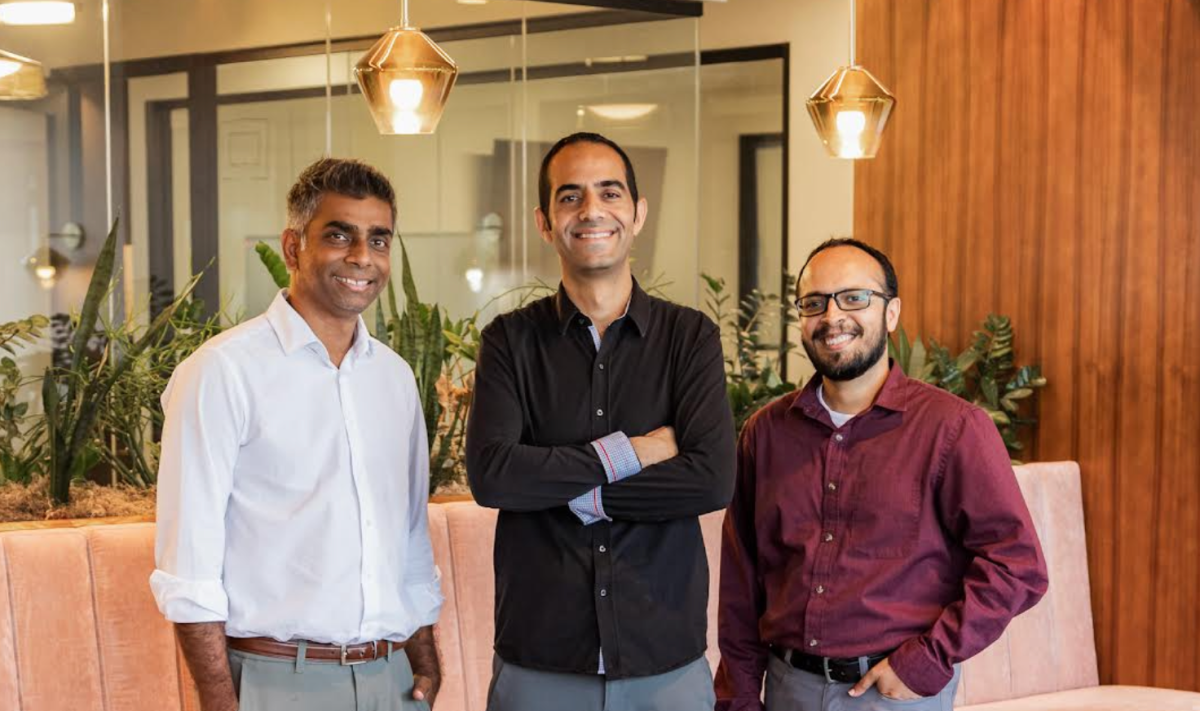
Pictured above, left to right: Chetan Patel, who is co-founder and president of Basata; Kaled Alhanafi, the company’s CEO; and Vivin Paliath, the company’s third co-founder and CTO.
Bottom Line:
Basata is tackling a critical, often-overlooked administrative chasm in healthcare that delays patient care and burdens providers. By combining AI-driven document processing with intelligent voice agents for scheduling, the company offers a pragmatic, specialty-focused solution that not only streamlines operations but also significantly improves the patient experience. In a competitive landscape, Basata’s commitment to end-to-end integration and the palpable relief it brings to overworked administrative staff suggests a powerful model for how AI can genuinely augment human capabilities in a vital industry. The market is ripe for disruption, and Basata is proving that addressing the hidden complexities of healthcare administration can lead to tangible improvements for everyone involved.
When you purchase through links in our articles, we may earn a small commission. This doesn’t affect our editorial independence.
{content}
Source:{feed_title}