
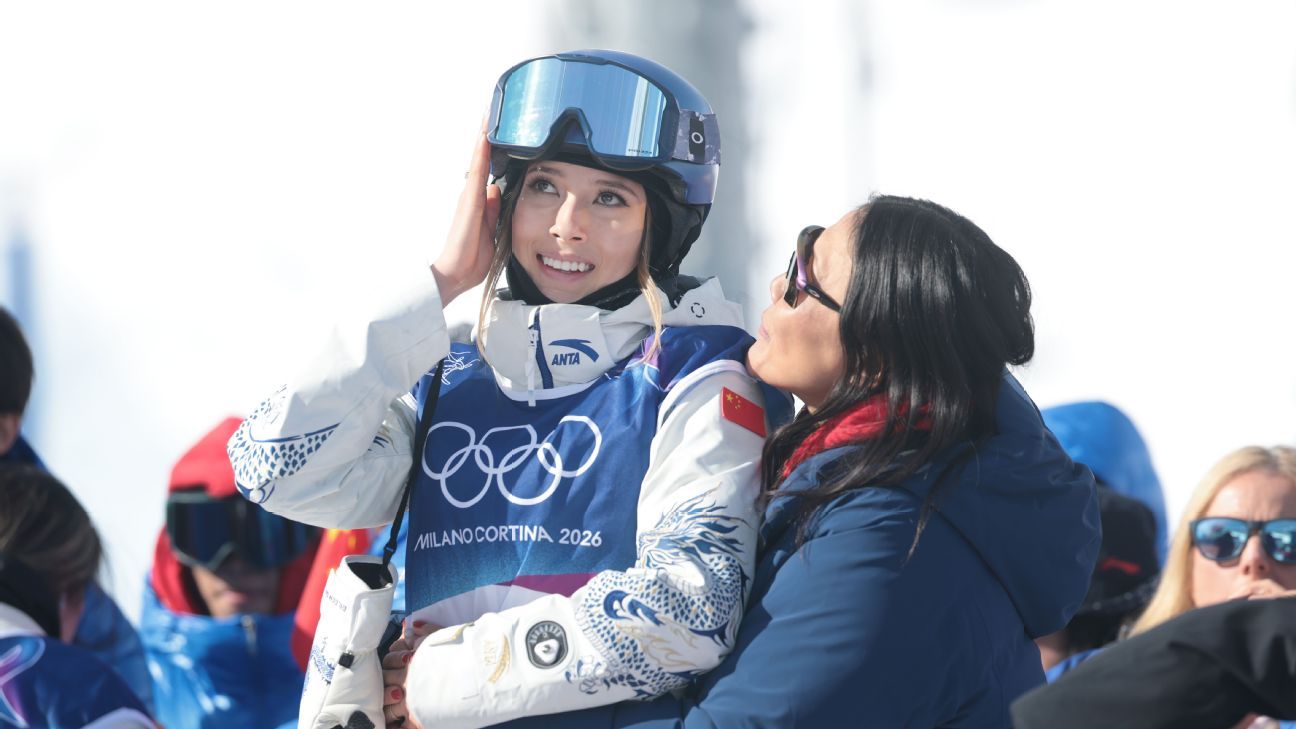
LIVIGNO, Italy — Eileen Gu is cultivating a new sport and garnering distinctions by embracing risks.
Nonetheless, on a radiant Olympic Sunday where she successfully retained her halfpipe championship, perhaps the most treasured accolade was the conviction that her grandmother would be content.
Consequently, her weeping was unrestrained.
Shortly after her triumph secured a historic third Olympic gold medal in freeskiing, Gu received news of her grandmother, Guozhen Feng’s, passing.
“She was a force of nature,” Gu stated. “This individual took charge of existence, seizing control and molding it to her desires.”
This is how Gu, the 22-year-old — who was born in America yet represents her mother’s native China — prefers to tackle skiing, academics, life, and all her endeavors.
“She greatly motivated me,” Gu remarked. “Upon my final visit with her prior to the Olympics, she was quite unwell, so I recognized this outcome as a potentiality. While I likely didn’t declare an intention to win, I did vow to her that I would be courageous. She herself has shown immense courage.”
Gu is aware of her detractors and understands how to address them
Gu has also needed to demonstrate a significant degree of valor throughout her early years.
Courage is required on the slopes, as she risks her well-being (and existence) with each leap. Furthermore, an unyielding resolve is essential for navigating her life away from competitive skiing.
Scarcely a single day has gone by at either of her pair of Olympic appearances without Gu being questioned about the nation she represents nearly as frequently as her freeskiing.
Likewise, not a day elapses without her reiterating the consistent message she has conveyed for a long time: “Should individuals hold differing opinions from mine, if they possess alternative proficiencies, which I am confident they do, then I urge them to channel their efforts elsewhere,” she stated. “To improve the global condition in their distinct manner.”
During her post-triumph press briefing, the articulate Stanford scholar addressed every inquiry — concerning geopolitics, her intellectual capacity, the trajectory of skiing — directly, yet consistently guided the dialogue back to the factor that has enthralled spectators in a discipline not typically known for such appeal.
“The challenge of participating in three competitions, reaching the finals in all three,” she explained. “I was required to contend on six occasions. I somewhat compare it to a marathon, executed at the speed of a 100-meter sprint. … I undertook a substantial gamble by relying on my own abilities, and I am pleased that I did so.”
Through self-reliance and achievement, Gu has emerged as the most lauded freeskier in the brief Olympic history of the sport.
Beyond her awards, she is expanding the discipline. She referenced a study by the Chinese government indicating that over 300 million individuals in China have engaged in snow sports for the initial time since she secured her three medals at the preceding Olympics.
“There are young females in China whose existences will be influenced by the magnificent and splendid influence of athletics,” Gu declared. “That, inherently, represents a quantifiable effect that I believe I had consistently desired.”
A post-skiing existence centered on ‘worldwide positive influence’
When inquired about the potential contents of her life following skiing, Gu adhered to the overarching concept of “global beneficial impact” but stated that her core interests currently encompass skiing, athletics, and style. She is scheduled to attend a fashion event in Milan during the present week.
Circumstances might evolve in the future.
“I believe it involves evaluating one’s particular aptitudes and striving to determine, ‘Alright, how can I, as an individual, achieve the greatest positive outcome globally?'” Gu articulated. “Currently, I am youthful. I am dynamic.”
Rivals closing the gap?
She will require it.
The precedent she established for skiing has elevated this activity. Four years prior, when Gu concluded those Olympic Games with a gold medal in the halfpipe, a hint of acceptance pervaded among the other skiers.
“An automaton,” Canada’s second-place finisher Cassie Sharpe commented at that time.
And American Carly Margulies concurred that Gu was performing at “a standard that is quite inaccessible for many of us.”
Presently, there is an impression that they are narrowing the difference. Britain’s bronze recipient Zoe Atkin, in fact, leaped further from the halfpipe than Gu. China’s Li Fanghui secured second place, and if she had attempted six maneuvers instead of five, the outcome remains uncertain.
“She is a superb skier, and she elevates the benchmark for all others,” stated Canada’s Amy Fraser, who came in fourth and is the sole skier to have surpassed Gu in the last four years. “Nevertheless, she is not invincible.”
In a certain respect, that is precisely Gu’s aspiration.
“If I were to visit a middle school and defeat everyone in freestyle, it wouldn’t be stimulating for anyone, would it?” she clarified.
Upon the conclusion of her press conference, she departed through a side exit, subsequently ascending a spectator stand for additional photographs and embraces. Her grandmother did not witness this triumph. Yet, Gu could not have achieved it without her.
“That is why I continually allude to this concept of self-reliance, valor, and embracing perils,” Gu articulated. “It genuinely traces back to the pledge I made to my grandmother. I am genuinely delighted that I managed to fulfill that, and I trust I made her content.”