
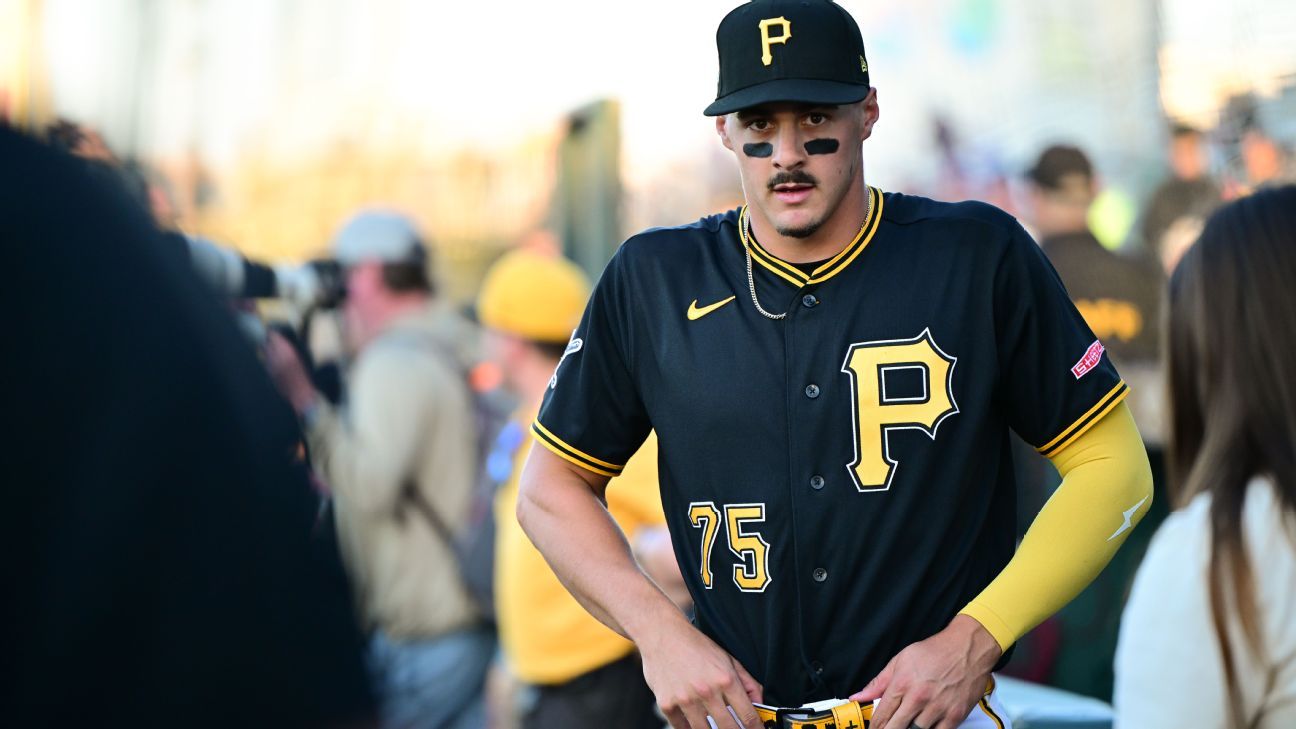
Konnor Griffin is set for the big leagues!
The Pittsburgh Pirates are elevating the premier talent in baseball prior to Friday’s inaugural home match against the Baltimore Orioles.
With just three weeks remaining in his teenage years, the 19-year-old shortstop is anticipated to be MLB’s initial adolescent field player since Juan Soto made his debut in 2018.
There has been considerable buzz encircling Griffin this spring, but what is the extent of his talent? What should supporters anticipate from him initially — and in future seasons? Furthermore, what significance does his initial appearance hold for the Pirates? Let’s delve into the details.
Griffin’s Caliber?
Griffin stands as the finest young talent baseball has witnessed in a long time.
He is an exceptional sprinter with a formidable throwing arm, and over the last year, his projection shifted from a potentially adequate fielding shortstop who might ultimately transition to the outfield to a superior fielding shortstop. He also possesses extraordinary unrefined power, propelled by astonishing bat velocity and his imposing 6-foot-3, 222-pound physique.
Prior to the 2024 MLB draft, I drew parallels between Griffin and San Diego Padres standout player Fernando Tatis Jr. — chiefly due to the prevailing idea then that Griffin might shift to the outfield, akin to Tatis’s move. Presently, it’s more frequent to hear Bobby Witt Jr.’s name cited as the main comparison. Griffin’s blend of bat velocity and productivity at his current age also brings to mind for certain observers Ronald Acuna Jr., who made his major league debut shortly after his 20th birthday.
Griffin possesses every requisite skill, physical stature, and elite background to achieve superstar status, and the roster of athletes featuring such attributes, production, and prospect status who debuted in the majors at this juncture is replete with luminaries and Hall of Fame inductees. Griffin is not a guaranteed success, as no one truly is, and nearly all these individuals faced challenges to overcome early in their major league tenures, but all the components are present to warrant considerable enthusiasm.
I developed a computational model during the offseason to evaluate performance adjusted for age, league level, and ballpark factors; exit velocity; quickness; defensive prowess; and maturity relative to league tier, to assist in sifting through the entirety of the Statcast-esque statistics for position players in the minor leagues. Griffin surpassed the runner-up prospect according to this metric (Detroit’s Kevin McGonigle, the universally recognized second-ranked prospect in baseball and a top contender for early AL Rookie of the Year) by over 25%. Second and third (St. Louis’ JJ Wetherholt) were distinguished by 3%, and third and fourth (Seattle’s Colt Emerson) by 1%. This illustrates the point.
Can the Pirates obtain an additional draft selection if Griffin is an instant sensation?
Yes. Griffin has been promoted sufficiently early to entitle the Pirates to an incentive draft choice for prospect elevation if he secures the Rookie of the Year award or places among the top three in MVP balloting prior to arbitration eligibility (presumably during Griffin’s initial three campaigns), because he will accrue a complete year of MLB service time should he remain in the majors for the entire current season. The supplementary selection would occur immediately following the initial round. Last year, the Kansas City Royals received the 28th selection owing to Witt’s MVP achievement, and in the 2024 draft, the Arizona Diamondbacks (31st pick) and Baltimore Orioles (32nd) were granted picks for Corbin Carroll’s and Gunnar Henderson’s Rookie of the Year victories, correspondingly.
Significantly, the Pirates did not become eligible for a prospect promotion incentive selection after Paul Skenes’ Rookie of the Year win because he was not elevated prematurely enough to attain a full year of service time; his triumph in the NL Rookie of the Year race, however, bestowed upon him a complete year of service. The Pittsburgh club wisely circumvented a recurrence of that scenario, yet this decision is also simpler to enact for position players, given the absence of innings restrictions to consider.
Furthermore, accounts have emerged of Griffin and the Pirates discussing a possible contract prolongation throughout the spring, and the Pirates would forfeit eligibility for a selection had he inked the agreement prior to his elevation. The principle underpinning the regulation is for clubs to promote athletes when prepared, rather than after their remuneration has been secured. Griffin might execute an agreement following his initial game, and the Pirates could still acquire the selection if Griffin achieves the requisite placements for accolades.
Griffin’s Origins?
Griffin was a consistently premier high school talent in Mississippi and the initial field player from his draft cohort to garner national attention. He fundamentally maintained that leading position right up to the draft period, despite re-designating his eligibility from the 2025 draft pool to the 2024 draft.
He was in the universally recognized upper echelon of athletes prior to the 2024 draft (it encompassed roughly 10 individuals), but required an alteration to his batting mechanics, which deterred certain clubs. I positioned Griffin seventh within that cohort, and he was selected ninth overall, securing the eighth-largest bonus and being the first high school athlete chosen.
Nick Kurtz was also in the upper echelon of athletes and was selected fourth overall, securing the sixth-largest bonus, prior to claiming the AL Rookie of the Year title last season. Further standout talents might emerge from this 2024 draft cohort: Chase Burns, Jac Caglianone, Travis Bazzana and Wetherholt also belonged to that upper echelon, while Carson Benge and Trey Yesavage were the nineteenth and twentieth overall selections, correspondingly. But Griffin and Kurtz appear to be the initial luminaries of this class.
Griffin implemented the batting mechanic modification promptly upon signing, then experienced one of the most remarkable full-season professional inaugurations in prospect annals last season, achieving a .333/.415/.527 slash line with 21 home runs and 65 stolen bases across 122 contests spanning both A-ball tiers and Double-A as a 19-year-old. Pair that with his impressive statistics over five Triple-A games to commence this season, and Griffin possesses one of the most unparalleled minor league career statistical records ever, assuming his minor league tenure has now concluded.
This detail has somewhat faded amidst all the excitement surrounding his ascent, but Griffin was also a highly promising pitching talent. Prior to the draft, I likened his pitching abilities to Jack Flaherty’s (who was likewise a distinguished two-way high school prospect), and I believe Griffin might still have commanded a minimum of $2 million had he never wielded a bat. He possesses one of those premier skill combinations that will rank among the elevated comparisons one could make for any draft prospect for the ensuing several decades, aligning with names like Bo Jackson, Josh Hamilton, Bryce Harper, and Justin Upton.
Any Reservations About Griffin’s Performance?
These are rather few, yet significant to observe. Griffin’s offensive strategy is to inflict harm, particularly by making forceful contact with the ball. The upward trajectory in his swing and his aptitude for pulling/lifting to access that power during contests are merely adequate; in contrast, he depends more on his inherent strength/bat velocity than on specific angles/loft to generate extra-base hits. This was a comparable criticism leveled at Vlad Jr. and Junior Caminero at an identical juncture; it’s more of a minor quibble, yet merits acknowledgement.
Owing to this method, his contact skills are commendable, though not exceptional, and his discernment of pitches is adequate, yet not superior. Given Griffin’s youth and his participation in merely 26 regular-season matchups beyond A-ball (and only 24 major league spring training contests), some developmental difficulties might arise in converting his considerable unrefined talents into tangible output. His nuanced abilities in managing an at-bat against seasoned pitchers are presently limited in their effectiveness. After the league compiles an assessment of his habits within a few weeks, I would anticipate periods resembling a downturn in performance.
The distinguishing factor here traces back to Griffin’s modification of his swing plane shortly after being drafted. Talent evaluators continue to lament to me that their respective clubs prematurely disregarded Griffin in 2024 due to queries about his swing, consequently, I inquired broadly to ascertain the manner and reason behind this transformation, and whether it holds relevance for other emerging talents with comparable issues. The response was a variant of this perspective: Griffin possesses exceptional skills and is likewise an exemplary diligent individual who responds favorably to instruction and rapidly incorporates recommendations. No one, not even the Pittsburgh organization or Griffin’s personal contingent, foresaw his making the alteration or accomplishing it with such celerity, yet the Pirates deemed it a calculated risk worth undertaking.
Were I to bestow a singular attribute upon a gifted, youthful athlete, enabling him to withstand the rigors of being thrust into the demanding environment of confronting contemporary major league hurlers daily for the inaugural occasion, it would unequivocally be this capacity.