
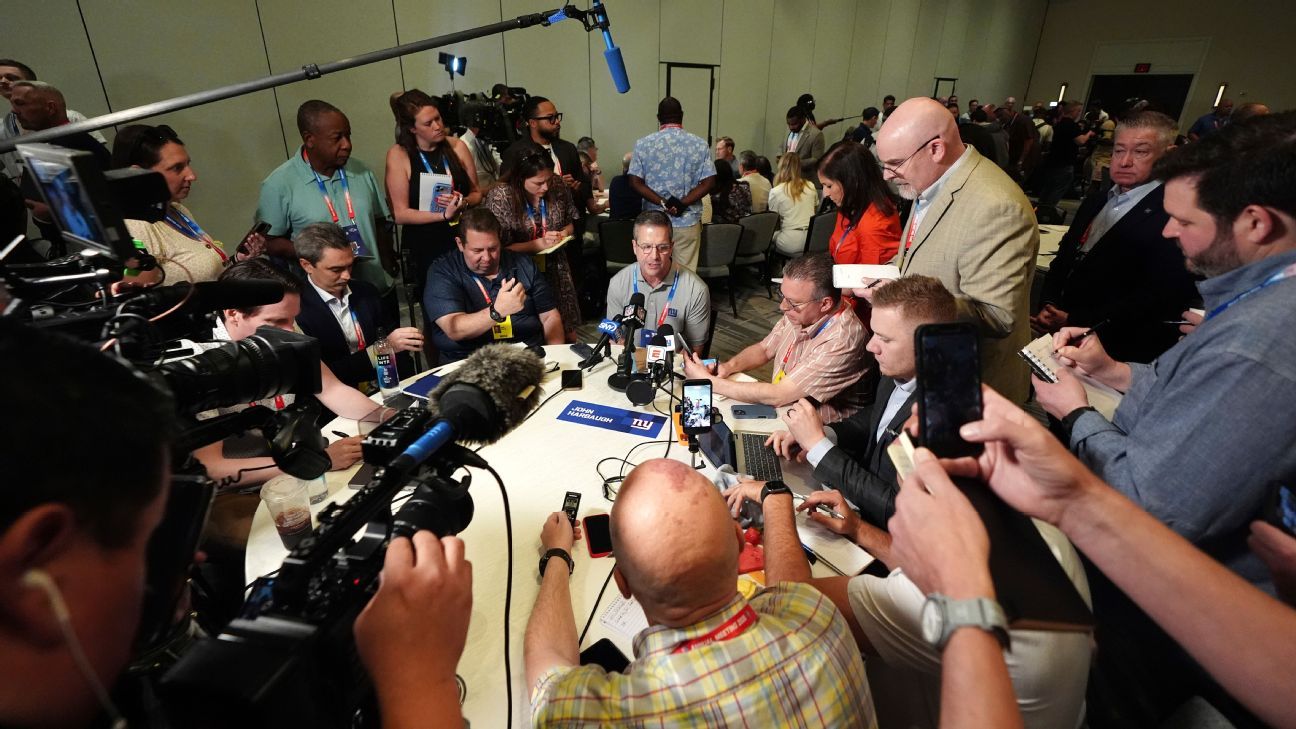
PHOENIX — The desert air was thick not just with the promise of spring, but with the buzzing tension of the NFL’s annual league meeting. This wasn’t merely a gathering of suits; it was a high-stakes poker game, a strategic war room where the future of professional football was debated, dissected, and dramatically reshaped. From the looming specter of a referee lockout to the seismic shift of an 18-game regular season and the desperate scramble for quarterback stability, the past three days have laid bare the intricate dance of power, ambition, and financial might that defines the league. Owners, general managers, and coaches converged, each with their own agendas, their own whispers, and their own vision for seizing the competitive edge in the exhilarating, brutal stretch between free agency’s frenzy and the draft’s drama. ESPN’s squadron of 30 intrepid reporters was on the ground, capturing every whisper, every power play, and every critical insight from this pivotal summit.
Jump to a team/topic:
League buzz | 49ers | Bears | Bengals
Browns | Cardinals | Colts | Chiefs
Commanders | Cowboys | Dolphins | Eagles
Falcons | Giants | Jaguars | Jets | Lions | Packers
Patriots | Raiders | Rams | Ravens
Seahawks | Steelers | Titans | Vikings


League Buzz: The Looming Storm
Are owners sleepwalking into a referee lockout disaster?
A palpable, almost unnerving calm pervaded the owners’ discussions regarding the ongoing, and increasingly contentious, collective bargaining agreement negotiations with the game officials. The league’s gag order on commenting publicly did its job, creating a wall of silence around what should be a flashing red light for the NFL. Sources within the league have confirmed preparations to hire replacement officials starting May 1 if an agreement isn’t reached – a move that sends shivers down the spine of anyone who remembers the catastrophic replay of the 2012 lockout. That season was marred by botched calls, player frustration, and a league image crisis. Yet, the current sentiment from owners appears to be one of detached confidence, or perhaps, calculated indifference.
“I trust the league,” offered San Francisco 49ers owner Jed York, a sentiment echoed by an anonymous club owner who stated, “We have to be prepared for everything.” But is “prepared for everything” truly enough when the integrity of the game hangs in the balance? Dallas Cowboys owner Jerry Jones, ever the pragmatist, was one of the few to offer a more nuanced perspective: “Everybody’s been striving… to try to get better. But it’s our job to put the incentives in place and demands in place to get better. Fans deserve that.”
However, the proposed “one-year fix” rule – allowing the officiating department to correct “clear and obvious mistakes” in the event of a work stoppage – feels less like a solution and more like a band-aid on a gaping wound. It suggests an underlying admission of potential chaos, a tacit acknowledgment that replacement officials are inherently prone to error. The lack of anxiety from coaches and owners, as reported, is frankly astonishing. Are they truly that confident in a contingency plan that proved disastrous just over a decade ago? Or is this a high-stakes bluff, hoping the officials’ union will cave under pressure? The NFL is playing a dangerous game, one that could profoundly impact the fan experience and the competitive balance of the upcoming season if not handled with extreme care. The ghost of the “Fail Mary” looms large, and ignoring it would be an act of profound hubris.— Kalyn Kahler
0:49
Dan Graziano: NFL to begin hiring replacement referees
Dan Graziano discusses the NFL looking into hiring replacement officials as the end of the current CBA with the NFL Referees Association approaches.
The Quarterback Gamble: Murray’s Freedom vs. Tagovailoa’s Leash
A deep dive into the one-year minimum salary contracts for Kyler Murray (Minnesota Vikings) and Tua Tagovailoa (Atlanta Falcons) reveals a critical, strategic divergence with massive implications for their respective futures. While both quarterbacks are on prove-it deals – Murray at $1.3 million and Tagovailoa at $1.215 million, reflecting service time differences – the devil is truly in the contractual details, or lack thereof.
Murray’s deal with the Vikings includes a crucial clause: a prohibition against designating him a franchise or transition player in 2027. This isn’t just a minor detail; it’s a monumental win for Murray and his agent. If he revitalizes his career in Minnesota, proving he can still be an elite talent, he hits free agency unfettered, able to command top dollar from any suitor. The Vikings, should they desire to keep him, would face an open market bidding war, lacking any control mechanism. This speaks volumes about Murray’s leverage, even coming off a down period, and the Vikings’ eagerness to take a calculated risk for a potential massive reward.
Conversely, Tagovailoa’s contract with the Falcons contains no such clause. This means if Tua seizes the starting job and ignites Atlanta’s offense, becoming the answer at quarterback, the Falcons retain the powerful option of slapping him with a franchise tag in 2027. This provides them absolute control, ensuring he either signs a long-term deal on their terms or plays another year under the tag. It’s a stark difference in player agency and team control. This suggests that while the Falcons are giving Tagovailoa an opportunity, particularly with Michael Penix Jr. recovering, they are also protecting their long-term options, unwilling to let a potential breakout season result in a bidding war. Tua must not only perform but must do so well enough to earn a significant long-term commitment before the tag becomes a weapon against him. This isn’t just about playing football; it’s about playing the ultimate chess match for career control.— Dan Graziano
Seismic Shifts & QB Hunts: 18 Games, Raiders’ Desperation, and Adams’ Near-Miss
While not on the official agenda, the phantom of an 18-game NFL schedule constantly hovered over conversations. Many team officials believe it’s not a pressing issue *right now*, primarily due to the recent election of JC Tretter as the new NFLPA executive director. The sentiment is that the union needs to “find its footing” before diving into such a weighty discussion. However, the whispers persist: many owners are fervent proponents of an 18-game slate, and a growing consensus around the league considers this change an inevitable, albeit distant, future. The implications for player safety, the economic model, and the very fabric of the game are colossal, setting the stage for a monumental showdown when the CBA inevitably reopens before 2030.
Meanwhile, the Las Vegas Raiders’ quarterback situation remains a vortex of desperation. Signs overwhelmingly point to them acquiring a veteran to mentor/compete with Fernando Mendoza. The prime target? Kirk Cousins. His name surfaced repeatedly in discussions, a testament to the Raiders’ perceived need for a stable, experienced hand. The fact they pursued Joe Flacco, who ultimately opted to remain with Cincinnati, underscores the urgency. The Rams also loom as a dark horse for Cousins, but Vegas seems to be pushing hard for a player who can immediately elevate a franchise yearning for direction.
Finally, the Davante Adams saga revealed the cutthroat nature of NFL roster building. The Rams publicly admitted they explored trading their star receiver, a move that would have sent shockwaves through the league. While they ultimately decided against it, sources indicate multiple teams inquired, and the Eagles were strongly considered a potential landing spot. The timing of these discussions, coinciding with the exploration of an A.J. Brown trade to the Rams, paints a picture of intricate, high-level maneuverings. Adams’ reported desire to remain on the West Coast likely played a role in the Rams’ final decision, but the mere fact that a player of his caliber was actively shopped signals a brutal efficiency in team management. This wasn’t just a rumor; it was a near-transaction that almost fundamentally altered two NFC contenders.— Jeremy Fowler
Game Highlights: Offseason’s Defining Plays
While the pads aren’t popping, the offseason strategic chess match has delivered its own brand of game-changing plays. Here are the defining “highlights” from the annual league meeting:
- The Referee Lockout Blitz (Crisis Averted?):The owners’ apparent complacency regarding the referee negotiations is a high-risk, high-reward gambit. This isn’t a minor penalty; it’s a potential game-stopping suspension of belief. The “one-year fix” rule proposal feels like a desperation heave, hoping to mitigate disaster rather than prevent it. If the lockout happens, this could be the league’s biggest self-inflicted wound since 2012, threatening to derail the early season with controversy and eroding fan trust. It’s a dangerous play, daring the officials to fold.
- Murray’s Franchise Tag Evade (Agent Masterclass):Kyler Murray’s agent pulled off a stunning end-around, securing a contract that explicitly prevents the Vikings from franchise-tagging him next year. This is a massive win, granting Murray ultimate freedom if he performs. It’s a strategic touchdown, giving him leverage and control over his destiny, forcing the Vikings to either commit long-term or risk losing him. Contrast this with Tagovailoa, who remains under the Falcons’ potential iron grip, highlighting a crucial difference in negotiation power.
- The 18-Game Schedule’s Ghost Play (Inevitable Future):While not explicitly on the scoreboard, the specter of an 18-game season looms larger than ever. It’s the ultimate power play by owners, promising increased revenue but posing existential questions about player welfare and the league’s competitive integrity. This isn’t just a tweak; it’s a fundamental restructuring that will redefine the sport. Its “inevitability” is a powerful narrative, setting the stage for a future labor battle that will shake the foundation of the NFL.
- Raiders’ Quarterback Scramble (Desperation Drive):The Raiders’ frantic search for a veteran quarterback, with Kirk Cousins as the prime target, is a desperate fourth-quarter drive. Having missed on Joe Flacco, their need for a stable presence under center is palpable. This isn’t about finding a diamond in the rough; it’s about acquiring an immediate, reliable starter to steer a rudderless ship. Their success or failure in this pursuit will define their season before it even begins.
- Adams’ Trade Near-Miss (The Great Escape):Davante Adams’ near-trade to the Eagles, explored by the Rams, was a shock play that almost sent ripples across the NFC. It showcased the brutal, unsentimental nature of modern NFL management. The fact that a player of Adams’ caliber was on the block, and the Eagles’ perpetual interest in elite talent, underscores the constant flux of roster construction. Adams remaining on the West Coast was the ultimate defensive stand, keeping a superstar in place.
Prediction: The Referee Crisis Looms Large
The NFL’s apparent nonchalance regarding the referee negotiations is a critical miscalculation. Despite the league’s attempts to project confidence and prepare contingency plans, the historical precedent of 2012 is too stark to ignore. The current “one-year fix” rule is a flimsy parachute for a potential freefall. I predict that the NFL will indeed face a significant challenge with its officiating body, leading to a period of highly controversial calls and widespread frustration from teams and fans alike in the early weeks of the 2026 season. While a full-blown, season-long lockout might be avoided due to public pressure and economic impact, the league will likely begin the season with replacement officials or highly disgruntled union officials operating under a temporary agreement, creating an environment ripe for officiating miscues and a tarnished product. The desire for an 18-game season will be a bargaining chip for owners, but the immediate crisis will be the men in stripes, and the league’s gamble on their resolve could backfire spectacularly, setting a tense tone for the entire year.
2:44
Stephen A. stunned by Orlovsky’s take on gap between Mendoza and Simpson
Stephen A. Smith and Dan Orlovsky compare Ty Simpson and Fernando Mendoza as prospects ahead of the NFL draft.
The NFL offseason is often painted as a period of calm, a lull before the storm of training camp and the regular season. But for those with their ear to the ground, the league meetings in Phoenix were anything but quiet. They were a symphony of strategic maneuvering, political posturing, and the quiet hum of ambition, setting the stage for what promises to be an explosive season. From groundbreaking coaching promotions to high-stakes draft decisions and simmering roster dramas, the chess pieces are moving, and the board is heating up!
The Quarterback Carousel: Draft Day Dreams and Veteran Realities
The annual NFL Draft narrative always starts under center, and this year is no different. The buzz around rookie quarterbacks, particularly Fernando Mendoza, is palpable. The Raiders, holding the coveted No. 1 pick, are seemingly on the verge of making Mendoza the face of their franchise. Yet, general manager John Spytek’s insistence on “going through the process” – pro days, top-30 visits, Zoom calls – feels like a masterclass in poker-faced negotiation. Is it genuine due diligence, or a smokescreen designed to drive up trade value or keep other teams guessing? Coach Klint Kubiak’s preference for a first-year quarterback to “spend time learning behind a more seasoned veteran” throws another fascinating wrinkle into the equation. It suggests a patient approach, perhaps signaling a short-term veteran acquisition or simply managing expectations for Mendoza’s immediate impact. The Raiders are playing a high-stakes game, and the league is watching closely to see if Mendoza truly is the generational talent they believe him to be, and if he can bridge the perceived gap between himself and prospects like Ty Simpson, as debated by Orlovsky and Stephen A.
Meanwhile, in New England, a new era is dawning with quiet confidence. The Patriots’ decision to release veteran backup Joshua Dobbs signals an unwavering belief in Drake Maye’s growth and maturity. Maye, entering his third NFL season, is clearly taking the reins, backed by the recent signing of Tommy DeVito and a plan to add a rookie No. 3. This isn’t just a roster move; it’s a philosophical shift. Vrabel’s acknowledgment of Dobbs’ contributions while stating “it’s just a different situation now” underscores Maye’s clear ascension. The Patriots are banking on organic development, trusting their young signal-caller to lead them out of the post-Brady wilderness. The question now isn’t if Maye is ready, but how quickly he can elevate a Patriots offense in transition.
0:46
Glenn on Geno: ‘He’s the guy that’s going to lead us to the promised land’
Jets coach Aaron Glenn expresses confidence that Geno Smith is the quarterback who will lead New York to “the promised land.”
Coaching Progress & Roster Riddles: The Scheelhaase Spark and WR Woes
Beyond the draft hype, the coaching ranks saw a significant, and much-celebrated, move. Nate Scheelhaase’s promotion to Los Angeles Rams offensive coordinator isn’t just another coaching change; it’s a beacon of progress and a testament to sustained excellence. In a league where diversity in high-level positions remains a critical conversation, Scheelhaase, a biracial rising star, represents a positive step forward. His track record, including the development of Brock Purdy, speaks volumes, and his ascent within Sean McVay’s prolific coaching tree positions him perfectly for future head coaching opportunities. The excitement from high-ranking league officials in Phoenix is well-founded; Scheelhaase embodies the kind of talent and leadership the NFL needs at the top, and his success could pave the way for more inclusive hiring cycles.
But while some teams are celebrating advancements, others are navigating more turbulent waters. The New York Jets, for instance, are performing a masterclass in misdirection regarding their wide receiver situation. Coach Aaron Glenn and general manager Darren Mougey’s public statements – “we like where our receiver room is” – ring hollow when stacked against the glaring statistics. Garrett Wilson’s injury-shortened season left a massive void, and the combined career catches of his current teammates are shockingly low. Their optimism hinges on a healthy Wilson and a significant leap from Adonai Mitchell, a vertical threat acquired via trade. While Isaiah Williams and Arian Smith offer potential, relying on unproven talent and a second-year tight end like Mason Taylor (who had a quiet rookie season) to mitigate an “obvious deficiency” feels like a dangerous gamble. Rumblings of potential trades for Dontayvayv Wicks or Brian Thomas, Jr., suggest the Jets’ private assessment might be far more realistic than their public facade. Glenn’s unwavering faith in Geno Smith to lead them to “the promised land” is admirable, but without a robust receiving corps, that journey could be significantly harder.

Across the league, the Philadelphia Eagles are facing their own unique brand of wide receiver drama. The A.J. Brown trade rumors refuse to die, creating a tense standoff between the star receiver, the team, and the media. General manager Howie Roseman and coach Nick Sirianni’s increasingly passive responses – a blanket “Brown is a member of the Eagles” – only fuel the speculation. The acquisition of Hollywood Brown and Elijah Moore adds speed and depth, but does it signal a contingency plan or simply an enhancement? The phrase “when you have good competition, it raises the level of everybody” is a coaching cliché, but in this context, it takes on a deeper meaning. The Eagles are walking a high-wire act, trying to maintain team harmony while preparing for any eventuality with one of their most explosive offensive weapons.
Finally, the Raiders, beyond their QB hunt, appear content with their offensive tackle depth. Kolton Miller, DJ Glaze, and Charles Grant are the names, and GM John Spytek is trusting the new coaching staff, including OL guru Rick Dennison, to maximize their potential. While Spytek didn’t rule out drafting an offensive tackle, the emphasis is clearly on development. This strategy, building from the ground up and cultivating talent, is a sound long-term approach, particularly with solidified interior pieces like Tyler Linderbaum and Jackson Powers-Johnson. But it also places immense pressure on Glaze to “reach another level” after a challenging 2025 season. The trenches win championships, and the Raiders are betting on internal growth.
⭐ GAME HIGHLIGHTS: OFFSEASON EDITION! ⭐
Forget the gridiron for a moment; the real action is happening off the field! Here are the top plays from the NFL’s strategic offseason game:
PLAY 1: The Scheelhaase Shift! (Rams, Offensive Coordinator Promotion)
ANALYSIS:A brilliant strategic move! The Rams elevate rising star Nate Scheelhaase, not just a talent grab but a nod to inclusive leadership. This isn’t just a coaching hire; it’s a statement! McVay’s coaching tree continues to bear fruit, but this one has deeper implications for the league’s future.
PLAY 2: Raiders’ Draft Day Double-Bluff? (No. 1 Pick, Fernando Mendoza)
ANALYSIS:Talk about a power play! GM John Spytek is giving a masterclass in misdirection, insisting on “going through the process” with Mendoza. Is he genuinely undecided, or is this a calculated gambit to drive up trade value? Coach Kubiak’s desire for a rookie to sit and learn adds another layer of intrigue. The Raiders are playing chess, not checkers, and the rest of the league is struggling to read their next move!
PLAY 3: Jets’ Receiver Ruse! (Wide Receiver Depth)
ANALYSIS:The Jets are attempting a bold bluff here, publicly downplaying an “obvious deficiency” at wide receiver. Glenn and Mougey are talking up Garrett Wilson’s return and Adonai Mitchell’s potential, but the numbers don’t lie! With only 92 career catches among their non-Wilson receivers, this feels less like confidence and more like hoping for a miracle. Expect a surprise trade or an aggressive draft day move, because Geno Smith needs more weapons to truly reach that “promised land”!
PLAY 4: Eagles’ Brownout Battle! (A.J. Brown Trade Speculation)
ANALYSIS:This is a simmering conflict, folks! The Eagles’ brass is trying to douse the flames of A.J. Brown trade rumors with increasingly passive responses. But adding Hollywood Brown and Elijah Moore sends a clear message: prepare for anything! Sirianni’s “competition raises the level” mantra suddenly feels like a veiled warning shot. This situation is far from resolved, and it could explode into a major storyline before camp even begins!
PLAY 5: Maye’s Ascent, Dobbs’ Departure! (Patriots Quarterback Room)
ANALYSIS:A clean break and a clear path forward! The Patriots’ decision to release Joshua Dobbs signals an absolute commitment to Drake Maye. With DeVito backing him up and a rookie No. 3 on the way, New England is all-in on Maye’s growth. This isn’t just about roster management; it’s about establishing a new identity and empowering their young QB. This quiet confidence could be the most impactful “play” of the offseason for the long-struggling Pats!
Prediction: The Jets’ Bold Gamble and the Raiders’ Rookie Impact
The NFL offseason is a tapestry woven with strategic moves and calculated risks. For the upcoming season, I’m predicting that the Jets’ perceived “masterclass in misdirection” regarding their wide receiver room will backfire spectacularly. Despite their public bravado, the lack of proven depth will leave Geno Smith exposed, and even a healthy Garrett Wilson won’t be enough to mask the deficiency. They will struggle to consistently move the ball, and coach Glenn’s “promised land” will remain a distant mirage. Conversely, the Raiders’ meticulous “process” with Fernando Mendoza, combined with Kubiak’s patient approach, will pay dividends. While Mendoza might not start Week 1, his development behind a veteran will be accelerated, and by mid-season, he will be the talk of the league, making critical plays that surprise many and elevate the Raiders to a level of competitiveness few expect, making them a dark horse playoff contender.
The offseason churn is in full throttle, shaping the destiny of franchises across the league with every strategic move, every contract negotiation, and every injury update. From Miami’s audacious roster reshaping to Baltimore’s defensive uncertainties and Chicago’s critical offensive recalibrations, the NFL landscape is constantly shifting. Let’s dive deep into the latest rumblings, dissecting the impact and peering into the future with a blend of analysis and raw gridiron energy.
Dolphins Double Down: Achane Anchors Miami’s New Core
In a league increasingly skeptical of significant running back investments, the Miami Dolphins are making a bold statement. After the seismic trade of speedster Jaylen Waddle, whispers of further offensive upheaval, specifically concerning the electrifying De’Von Achane, began to circulate. But general manager Jon-Eric Sullivan has emphatically shut down that narrative, declaring “zero effort” to trade Achane. Instead, the focus is squarely on securing his future with a long-term extension.
This isn’t just about retaining talent; it’s about establishing a new foundational identity. Sullivan articulated a clear vision, naming Achane, center Aaron Brewer, and linebacker Jordyn Brooks as the “three kind of pillars that we build around.” He added, “They understand where they are, what we’re trying to get done. There’s an order that we’re going to handle the business in, but they know where they are and how important they are to us.” This strategic declaration signals a shift, embracing Achane’s game-breaking speed as a central offensive weapon, rather than a commodity. With a heavily reset roster and a staggering 11 draft picks, Miami is clearly committed to a youth movement supplemented by established, high-impact players they deem essential. The message is clear: the Dolphins are investing in their future, and Achane is at the heart of their explosive plans.

Ravens’ Defensive Dilemma: Madubuike’s Uncertain Future Casts a Shadow
The heart of Baltimore’s formidable defense is shrouded in uncertainty. Pro Bowl defensive tackle Nnamdi Madubuike, a disruptive force who consistently drew double teams and collapsed pockets, suffered a season-ending neck injury in Week 2. Now, Ravens coach Jesse Minter acknowledges there’s “no hard timeline” for his potential return, leaving a gaping void in the middle of their defensive line.
The impact of Madubuike’s absence last season was stark and undeniable. Without his interior pressure and ability to free up edge rushers, the Ravens recorded a paltry 30 sacks, tying for the second fewest in franchise history. This isn’t merely a statistic; it’s a testament to how crucial a true game-wrecker like Madubuike is to a defense’s overall effectiveness. Minter, while expressing empathy, remains pragmatic: “I know that he’s in a great place mentally… That’s still a kind of a ‘To be determined’ thing… you certainly have plan A, plan B, plan C, plan D all the way down the line.” He added, “I’ll leave that up to him. Love him as a player, love him as a person. I’ve seen some of the videos of him doing things… but I’ll leave all that up to him.” The coach’s measured optimism hints at the delicate nature of neck injuries, and the organization’s strategic contingency planning underscores the gravity of the situation. Baltimore’s Super Bowl aspirations hinge significantly on whether they can rediscover their dominant defensive front, with or without their star tackle.

Bears’ Offensive Odyssey: Johnson Demands Precision for Williams’ Progress
New Bears head coach Ben Johnson isn’t mincing words about the state of Chicago’s offense, and his blunt assessment is a refreshing splash of cold water in a league often prone to platitudes. Johnson candidly expressed his dissatisfaction: “I’m actually not very happy with us as an offensive staff, our ability to get the primary receiver open… And I put a lot of that on myself.” This isn’t just self-criticism; it’s a strategic roadmap for improvement as quarterback Caleb Williams prepares to lead the unit.
Johnson pulled no punches, declaring the passing game “still leaves something to be desired.” He pointed to critical areas: receivers’ route detail, ball location, and the fundamental act of “simply catching the football.” The Bears’ staggering 29 drops last season, fourth most in the league, highlight a systemic issue that must be addressed. The urgency is palpable as Williams, paired with exciting talents like Rome Odunze, Luther Burden III, and Colston Loveland, attempts to forge immediate chemistry. The scramble drill, a crucial component for an athletic quarterback like Williams, was also deemed “not very good,” demanding improvement in Williams’ accuracy on the move and receivers’ ability to separate downfield in broken plays. Johnson, however, sees Williams’ athletic gifts as a powerful trump card: “That’s where Caleb comes in handy… he can bail us out when we are wrong… And that’s on him and his athletic ability to bail us out.” The challenge for Johnson is to refine the rough edges of the offense while harnessing Williams’ dynamic playmaking, transforming potential chaos into controlled brilliance.

49ers Fortify the Trenches: The Trent Williams Saga Nears Resolution
While many teams grapple with roster overhauls, the San Francisco 49ers enjoy a luxury of stability, with one colossal exception: the status of future Hall of Fame left tackle Trent Williams. The linchpin of their dominant offensive line, Williams remains an elite force, playing at a Pro Bowl level even as he approaches the twilight of his illustrious career. Securing his future is paramount, given the lack of an obvious internal replacement.
General manager John Lynch conveyed a palpable sense of anticipation, stating, “[I] feel like we’re on the precipice of something good happening… But I do feel like we’re in good communication and hopeful.” Owner Jed York echoed this sentiment, expressing “trust and faith in John and Kyle that they’ll figure it out. They’ll get it done.” While the process has arguably taken “longer than either side would like,” the momentum appears to be building toward a reworked contract. Yet, the 49ers are also shrewdly planning for the future. Even with Williams hopefully locked in, there’s a strong indication the team will invest early in April’s NFL draft to bolster the offensive line, creating competition at guard and beginning the critical succession planning for the inevitable “life after Williams.” This dual approach—securing present dominance while strategically investing in future depth—underscores the 49ers’ commitment to sustained excellence in the trenches.

Giants’ Harbaugh Era: A “Win Now” Mandate for the Meadowlands
A seismic shift in expectation has hit East Rutherford. New Giants head coach John Harbaugh, alongside general manager Joe Schoen, isn’t just talking about building for the future; they’re demanding an immediate turnaround. The mantra resonating from the Meadowlands is unequivocally “win now,” a stark contrast to a franchise that has languished with a 7-27 record over the past two seasons.
Harbaugh and Schoen exude confidence, particularly pleased with their aggressive free agency period, which they believe established the team’s new identity. Harbaugh’s optimism stems from a belief in “really good players,” a “strong coaching staff,” and the crucial concept of “tight margins.” He argues that the Giants’ abysmal record doesn’t tell the full story, pointing to seven one-possession losses last season as evidence that they’re not as far off as perceived. Schoen champions the “upgrade” to the roster, highlighting key offensive additions like tight end Isaiah Likely and wide receivers Darnell Mooney and Calvin Austin III, alongside defensive anchor Tremaine Edmunds at middle linebacker. This infusion of talent, coupled with a renewed focus on special teams, fuels their belief that the Giants are poised for an immediate ascent. The pressure is immense, but the message from the top is clear: the time for excuses is over; the time for winning is now.
Jaguars Future Investments: Walker Leads Extension Discussions
The Jacksonville Jaguars are quietly laying the groundwork for their long-term future, engaging in preliminary contract extension discussions with key young talents. Topping that list is defensive end Travon Walker, the No. 1 overall pick from the 2022 draft. This move signals a significant vote of confidence in Walker, who despite battling wrist and knee injuries, managed 3.5 sacks last season and is currently set to earn $15.2 million.
Extending a former top pick, especially after a somewhat inconsistent, injury-affected season, is a strategic play. It aims to lock in potential before a breakout year drives up the price exponentially. Alongside Walker, the Jaguars are also in talks with tight end Brenton Strange and receiver Parker Washington, indicating a commitment to retaining their drafted talent and building continuity around their core. These proactive discussions are a testament to Jacksonville’s long-term vision, aiming to secure their foundational pieces before they hit the open market, ensuring stability as they push for sustained contention in the AFC South.
Game Highlights: A Glimpse into the Future Gridiron
Imagine the roar of the crowd as we fast-forward to the heart of the next NFL season, where these offseason gambits play out on the unforgiving turf. The energy is electric, the stakes are sky-high, and our featured players are making headlines:
- **Miami’s Explosive Pillar:** Fourth quarter, Dolphins trailing by three. De’Von Achane, fresh off his lucrative extension, takes a handoff up the gut, bursts through a seam Trent Williams might have carved himself, and with a blur of teal, he’s gone! Seventy yards to the house, shaking off a lone safety. The crowd erupts, knowing their “pillar” just delivered a game-winning touchdown, a testament to Miami’s audacious decision to build around his dynamism.
- **Chicago’s Scramble Drill Masterpiece:** Under immense pressure, Caleb Williams rolls left, the pocket collapsing. The “scramble drill,” once a weakness, is now a weapon. He spots Rome Odunze, who, having spent countless hours refining route detail, executes a razor-sharp cut to gain separation. Williams, with pinpoint accuracy, fires a laser across his body for a crucial first down, his athleticism bailing out a broken play, just as Ben Johnson envisioned. The “drops” are a distant memory.
- **Giants’ Newfound Clutch:** Down by one with under two minutes, John Harbaugh’s “win now” mentality is on full display. Isaiah Likely, the offseason tight end acquisition, runs a pristine corner route, drawing a linebacker and a safety. Daniel Jones (or whoever is under center) delivers a strike, and Likely, with strong hands, hauls in the pass for a 20-yard gain. The drive continues, propelled by the “upgrade” in offensive weapons and a new belief that these “tight margins” can now swing their way.
- **Jacksonville’s Defensive Anchor:** Third and long, a critical moment for the Jaguars. Travon Walker, fully healthy and unleashed, executes a blistering inside spin move, leaving the left tackle grasping at air. He barrels into the backfield, sacking the quarterback for a massive loss, a play that screams “No. 1 overall pick.” His burgeoning dominance justifies the early extension talks, making him the defensive cornerstone Jacksonville hoped for.
- **Baltimore’s Brave New World:** In a pivotal divisional clash, the Ravens’ defensive front, without Nnamdi Madubuike, battles valiantly. While they generate pressure, the consistent double-teams Madubuike once commanded are now spread, creating slightly wider lanes for the opposing run game. A crucial third-down run picks up just enough yardage, a stark reminder of the unique, immovable force the defense is missing. “Plan B” is solid, but “Plan A” was a Pro Bowler.
Prediction: The Shifting Sands of the NFL Power Structure
The proactive moves and foundational commitments of the Miami Dolphins, especially their investment in De’Von Achane, signal a team that understands its identity and is building intelligently around it. Expect the Dolphins to be a dynamic offensive force, leveraging Achane’s game-breaking ability to great effect, and making a serious push for the AFC East title, potentially even securing a home playoff game.
Conversely, the Chicago Bears, despite the infectious optimism surrounding Caleb Williams, face a steep climb. Ben Johnson’s honest assessment highlights deeply ingrained issues. While Williams’ individual brilliance will undoubtedly create highlight-reel plays, the systemic problems in receiving and execution will likely lead to an up-and-down season. They’ll show flashes, but consistency will be their biggest hurdle, placing them in the hunt for a wildcard, but ultimately falling short of the playoffs.
The Baltimore Ravens’ defensive future remains the league’s biggest X-factor. If Nnamdi Madubuike can defy the odds and return to his Pro Bowl form, Baltimore remains a Super Bowl contender. However, if his absence persists or his return is limited, their defensive ceiling will be significantly lowered, making their path through the AFC much more challenging. They’ll be a playoff team, but their championship aspirations hang in the balance of Madubuike’s recovery.
The San Francisco 49ers, once Trent Williams’ deal is finalized, will continue their reign as an NFC powerhouse, their strong foundation and proactive planning ensuring another deep playoff run. The Giants, under John Harbaugh’s “win now” philosophy, will be a much-improved team, leveraging their new talent to compete in more games, but likely fall just shy of a playoff berth in a competitive NFC East. Jacksonville, having secured their young talent, will continue their upward trajectory, with Travon Walker having a breakout year, solidifying their status as an AFC South contender.
The NFL offseason is a maelstrom of strategic chess moves, high-stakes negotiations, and tantalizing whispers of what’s to come. As teams across the league navigate the choppy waters of free agency, the draft, and crucial contract extensions, the landscape shifts with every decision. From securing core talent to identifying future leaders, every general manager and head coach is playing a high-stakes game. Let’s dive into the latest developments, dissecting the potential impacts and peering into the crystal ball of the upcoming season.
The Jacksonville Jaguars are making a declarative statement: their young core is here to stay. General Manager James Gladstone, a man who knows the value of homegrown talent, is radiating optimism about extending three pivotal offensive and defensive playmakers this offseason. Securing Evan Strange, Calvin Washington, and Travon Walker isn’t just about retaining talent; it’s about solidifying the foundation of a team poised for sustained contention.
Strange and Washington, both entering the final year of their rookie deals, exploded in 2025. Strange, the tight end, redefined his role, becoming a legitimate threat with career highs in catches (46), receiving yards (540), and a critical three receiving touchdowns. His ability to work the middle of the field and be a reliable safety valve for the quarterback was paramount. Washington, the dynamic wideout, wasn’t just good; he was exceptional, eclipsing the 800-yard mark with 847 receiving yards on 58 catches and an impressive five touchdowns. This duo represents the aerial attack’s versatility and big-play potential. On the defensive side, Travon Walker, a disruptor extraordinaire, continues to be a force, racking up 27.5 sacks and 200 tackles in just four seasons. His blend of power and athleticism off the edge is a nightmare for opposing offensive lines. Gladstone’s assertion that the Jaguars are “probably within striking distance to see things come to light” suggests that these negotiations are progressing positively, signaling a clear commitment from the organization.
Furthermore, the Jaguars’ decision to pick up the fifth-year option on right tackle Anton Harrison, the 27th overall pick in 2023, is a savvy move, locking down a crucial piece of their offensive line for another season. It provides stability upfront, allowing their burgeoning skill players to operate with confidence. This trio, coupled with Harrison, forms the bedrock of Jacksonville’s future aspirations. The message is clear: the Jaguars aren’t just building; they’re investing in the future, securing the pillars that will hold up their championship aspirations for years to come. The continuity on both sides of the ball is invaluable, fostering chemistry and allowing schemes to develop without constant personnel turnover. This isn’t just about contracts; it’s about culture and conviction.

Up north, the Minnesota Vikings find themselves in a fascinating, deliberate general manager search. Following the January 30 firing of Kwesi Adofo-Mensah, owner Mark Wilf outlined a surprisingly unique approach during a recent meeting with reporters. Instead of the typical sprawling committee or high-priced search firm, Wilf envisions a “small, tight group” to advise him and the Wilf family. This insular approach suggests a desire for focused, confidential discussions, emphasizing alignment within the organization’s top brass.
Crucially, there will be “input” from coach Kevin O’Connell and chief operating officer Andrew Miller, ensuring that the next GM is a collaborative partner, not an isolated decision-maker. The inclusion of a “third party,” while not a formal consultant, indicates a desire for external perspective without the bureaucracy of a full-scale firm. This bespoke strategy allows the Vikings to tailor their search precisely to their needs, rather than relying on a generic template. Rob Brzezinski, the longtime executive vice president, is capably serving as interim general manager, earning praise from Wilf for his “outstanding job in terms of in the building, building consensus, strategy.” This steady hand allows the Vikings the luxury of patience, as interviews aren’t expected to begin until after the April 23-25 draft. This timeline is strategic; it allows the current regime to execute the draft without disrupting the GM search, and it ensures that potential candidates are evaluated with a full understanding of the team’s new talent influx. The Vikings are not rushing this, and that measured approach could yield a long-term, synergistic partnership at the helm.

The Seattle Seahawks are facing a classic NFL conundrum: how to replace elite talent without overspending. The loss of Super Bowl MVP Kenneth Walker III in free agency, coupled with Zach Charbonnet’s knee surgery sidelining him for much of 2026, leaves a gaping void in the backfield. Yet, general manager John Schneider and coach Mike Macdonald are sending clear signals: they won’t be forced into a panic pick among their four draft selections. Schneider’s astute observation that running back isn’t a position of scarcity is a critical piece of the puzzle, hinting at a value-driven approach.
Macdonald echoed this sentiment, stating, “I think people kind of are sleeping on the guys we have a little bit.” This isn’t just coach-speak; it’s a strategic maneuver to build confidence in their current roster. Macdonald specifically lauded George Holani, who “played great for us down the stretch” after Charbonnet’s injury in the first playoff game. Holani’s late-season surge provided a glimmer of hope, showcasing an ability to carry the load in crucial moments. The addition of power runner Emanuel Wilson (one year, $1.595 million) from the Packers adds another dimension, suggesting a committee approach. While Charbonnet is expected to return, the question of replacing Walker’s explosiveness lingers. Kenny McIntosh, another talented but unproven player recovering from knee surgery, represents the biggest “X-factor” for that spark. “I’m excited about how that room goes from here,” Macdonald asserted, underlining a belief in internal development and smart acquisitions. The Seahawks are banking on collective strength and a “sum is greater than its parts” philosophy, rather than a single splashy move. This strategy, while potentially frustrating for fans craving a star, could prove shrewd if their current stable of backs rises to the occasion.
1:40
Why Colts co-owner/CEO would like even number of regular season games
Colts owner and CEO Carlie Irsay-Gordon joins Pat McAfee to discuss changing the number of NFL regular-season games.

The Indianapolis Colts have fundamentally reshaped their passing game with the blockbuster trade of receiver Michael Pittman Jr. to the Steelers. While the loss of a proven No. 1 receiver stings, it opens the door for a dramatic shift in target distribution, with wideout Josh Downs poised to be the primary beneficiary. Downs, whose usage and production dipped last season following the first-round selection of tight end Tyler Warren (who led the Colts in targets with 112), is now staring at a prime opportunity.
His targets per game plummeted from 7.6 in 2024 to 5.5 in 2025, and his receiving yards followed suit, dropping from 803 to 566. General manager Chris Ballard is not shy about his belief in Downs. “I think getting lost in this a little bit is … Josh Downs,” Ballard emphatically stated. “I think Josh Downs is freaking good. I do. I’ve always thought he’s good. I think allowing him some more opportunities, we’re going to see some of the special stuff you’ve seen in the past, but more.” This is a ringing endorsement and a clear strategic directive. While the four-year, $116 million contract extension given to Alec Pierce this spring ensures he’ll have a role, the stage is set for Downs to become the Colts’ dynamic, high-volume pass-catcher. His quickness and route-running ability are precisely what the offense needs to thrive post-Pittman. This isn’t just a tweak; it’s a re-imagining of the Colts’ aerial attack, positioning Downs as a potential breakout star.

A persistent, high-priority question for the Washington Commanders looms large: who will step up as the legitimate No. 2 receiver opposite the undisputed alpha, Terry McLaurin? While the Commanders have shored up their depth by re-signing Trey Burks and bringing back Dyami Brown to complement Luke McCaffrey and Jaylin Lane, the quest for another high-end talent is far from over. General Manager Adam Peters acknowledges the situation: “Terry’s a number one receiver. I think [Burks has] another level to go to. He showed us a lot at practice and in the games. … I like the room right now, but I think just like everywhere, we have a lot of time to add before we play in September.” This measured optimism indicates satisfaction with the depth, but a clear understanding that true top-tier talent could still elevate the room.
Coach Dan Quinn offers a pragmatic perspective: “it can also be combinations and the sum is greater than an individual part.” This suggests a willingness to deploy various personnel groupings and leverage different skill sets rather than relying on a singular complementary star. The draft presents an opportunity, with Carnell Tate potentially on their radar at No. 7, though Peters admits enticing a trade-up will be difficult without another quarterback in the top 10. And then there’s the elephant in the room: Brandon Aiyuk. While the Commanders won’t trade for him, knowing the 49ers might eventually cut him, multiple team sources emphasize they won’t simply wait, risking other options. This creates a delicate balance, as Washington aims to strike a deal for a proven commodity while keeping all their avenues open. The dynamic opposite McLaurin will define a significant portion of the Commanders’ offensive identity.

For the Los Angeles Rams, the future at quarterback, even with Matthew Stafford still under center, is a pressing concern. One of the biggest questions remaining for this roster is the identity of Stafford’s backup, a role that could become critically important. Coach Sean McVay, ever the candid communicator, revealed that Jimmy Garoppolo has “earned the right to take his time” to decide his future, but pragmatically conceded that his return “feels less likely than likely.” This signals an active search for a new No. 2.
Intriguingly, McVay confirmed discussions with quarterback Kirk Cousins and his agent, Mike McCartney. While calling the talks “premature,” McVay expressed significant interest: “I’d love to be able to see what that looks like.” This isn’t just about a backup; McVay explicitly mentioned Garoppolo and Cousins in the context of preparing for “life after Stafford.” This is the ultimate long game, recognizing that Stafford, despite his continued excellence, is approaching the twilight of his career. The coach’s acknowledgement that Stafford has “earned the right to decide on a year to year basis whether he wants to keep playing” underscores the team’s need for a robust succession plan. Whether Cousins is viewed as a high-end backup or a potential bridge starter, the Rams are clearly thinking multiple steps ahead, ensuring continuity and stability at the most vital position on the field. The Rams are preparing for every eventuality, and these backup QB discussions are a prelude to a much larger strategic shift.
Game Highlights: Key Moments That Defined the Offseason Narrative
While the offseason lacks live game action, the strategic maneuvering creates its own set of “highlights” that will undoubtedly shape the upcoming season:
- Jacksonville’s Triple Threat Lock-Down:Imagine the roar when GM Gladstone announces the multi-year extensions for Strange, Washington, and Walker. It’s not a single play, but a collective statement touchdown that secures the Jaguars’ offensive and defensive core for years. Strange’s 20-yard seam route for a first down in a crucial game, Washington’s sideline toe-tap for a game-winning score, and Walker’s strip-sack that turned the tide – these are the plays those extensions are built upon.
- Vikings’ Covert GM Operation:The “highlight” here is the quiet, meticulous process. No leaks, no drama, just Mark Wilf and his “small, tight group” methodically evaluating candidates. It’s the equivalent of a perfectly executed, conservative four-minute offense, chewing clock and ensuring a secure victory in the search.
- Seahawks’ RB-by-Committee Grit:Picture George Holani in a playoff game, churning out tough yards after Charbonnet went down – a 15-yard run up the gut, breaking tackles, showcasing the “grit” Macdonald praises. Then, Emanuel Wilson plunging into the end zone from the 2-yard line. This is the “highlight” of trusting internal depth over flashy, expensive free agents.
- Josh Downs’ Colts Breakout:Envision Downs, now free from Pittman’s shadow, catching a quick slant, turning upfield, and weaving through defenders for a 40-yard gain. Then, a shifty double-move creating separation for a deep touchdown, demonstrating the “special stuff” Ballard expects. This is the highlight reel of a star unleashed.
- Commanders’ WR2 Conundrum:The potential highlight here is a future one: Carnell Tate making a spectacular catch over the middle on a crucial third down, or Brandon Aiyuk (if acquired) effortlessly plucking a deep ball for a massive gain. For now, the “highlight” is the anticipation, the strategic chess match to find the perfect complement to McLaurin.
- Rams’ QB Succession Planning:The true highlight isn’t a play, but a conversation. McVay’s transparent discussions about “life after Stafford” with potential candidates like Kirk Cousins. It’s the strategic foresight, the intellectual “touchdown” that ensures the Rams remain competitive well beyond their current superstar’s tenure, securing a smooth transition.
Prediction: The Shifting Sands of the NFC North
Looking ahead, I predict a fascinating power struggle in the NFC North. While the Vikings’ GM search is methodical, the extended timeline means they’ll likely miss out on some immediate impact players in the post-draft free agency window. This, combined with the Green Bay Packers’ continued upward trajectory and the Detroit Lions solidifying their core, sets the stage for a tight divisional race.
However, the biggest shake-up will come from the **Indianapolis Colts**. The departure of Michael Pittman Jr. will initially be perceived as a setback, but Josh Downs, fueled by Chris Ballard’s vocal confidence and an increased target share, will explode onto the scene as a legitimate Pro Bowl-caliber slot receiver. His synergy with a developing quarterback and the strategic use of Tyler Warren and Alec Pierce will make the Colts’ passing game surprisingly potent and unpredictable. Indianapolis will ride this revitalized aerial attack and a stout defense to a competitive AFC South title, exceeding expectations and demonstrating that sometimes, subtraction can truly lead to a more balanced and dynamic sum. Downs will surpass 1,000 receiving yards and become a household name, proving Ballard’s “freaking good” assessment was an understatement.
The NFL offseason is a maelstrom of strategic chess moves, high-stakes gambles, and whispered predictions. As teams navigate the treacherous waters of roster construction, every decision, from a quarterback’s longevity to a stadium’s naming rights, reverberates with seismic potential. Let’s dive into the pulse of the league, dissecting the latest developments with the energy and insight they demand.
“If he told me that he wanted to play a couple more years, I’d believe him,” McVay said. “… We’re grateful that he’s our quarterback. You do have to be able to consider what does that look like in the short and the long term? And you’re always balancing that dynamic of what does that look like to take advantage of surrounding him with the right kinds of players while also making sure that, alright, what does that contingency plan look like moving forward?”— Sarah Barshop
Rams coach Sean McVay, ever the eloquent strategist, finds himself walking a tightrope with the venerable Matthew Stafford. The 36-year-old quarterback, fresh off yet another season where his arm talent often defied belief, still possesses the “it” factor that delivered a Super Bowl. McVay’s words, dripping with admiration and foresight, highlight the exhilarating yet precarious position the Rams occupy. Stafford’s iron will and undeniable talent make him a formidable leader for the short-term, fueling dreams of another championship push. But the shadow of “long-term contingency” looms large. How do the Rams maximize their window with Stafford, loading up on talent, without mortgaging a future that, inevitably, won’t include him under center? It’s a high-wire act that demands flawless execution in the draft and free agency, ensuring that every asset acquired complements Stafford’s brilliance while simultaneously preparing for the seismic shift when his era eventually concludes. The clock is ticking, and McVay’s balancing act will define the next chapter of the Rams’ narrative.

The Chiefs are hoping to be showcased on Christmas Day for the fourth-straight year. Team owner Clark Hunt and president Mark Donovan anticipate that the Chiefs will be a part of several marquee matchups, whether on a holiday or in prime-time. They know the Chiefs’ reputation, with the hope quarterback Patrick Mahomes returns to form, grows from creating a new tradition on the NFL’s schedule, similar to the Dallas Cowboys and Detroit Lions on Thanksgiving Day.
“We’d love to play on Christmas,” Donovan said Monday. “It’s a unique position. From a marketing and brand standpoint, when you think about the movie that we did, our Foolish Club studio business and the opportunity to really continue to cement our ownership of Christmas as a holiday, our brand with that is really powerful.
“We respect that the league wants to spread it around. We get it. Right now, we expect to be in a lot of prime-time games. We’ve made it pretty clear that our preference is to play at home on Christmas.”— Nate Taylor
The NFL has a new holiday tradition: the Kansas City Chiefs. With three Super Bowl titles in five years, the Mahomes-led dynasty has not just rewritten the record books, it’s captured the imagination of a nation. Now, they’re not just winning games; they’re claiming a holiday. Team owner Clark Hunt and president Mark Donovan are openly campaigning for their fourth consecutive Christmas Day showcase, and why wouldn’t they? This isn’t just about scheduling; it’s about cementing a legacy. The Chiefs, like the Cowboys and Lions on Thanksgiving, are actively forging an identity tied to prime-time holiday dominance. From a marketing perspective, it’s pure gold. “Our brand with that is really powerful,” Donovan asserted, understanding that every holiday game, every prime-time slot, amplifies the Chiefs’ global reach. The unspoken pressure, of course, falls on Patrick Mahomes. He doesn’t just need to “return to form”; he needs to continue delivering the jaw-dropping, highlight-reel magic that makes the Chiefs appointment viewing, transforming a mere football game into a festive spectacle. The league may want to spread the wealth, but the Chiefs are making a compelling case that Christmas Day football belongs firmly under their tree, preferably at Arrowhead.

The Steelers haven’t made a decision on the fifth-year option for left tackle Broderick Jones.
Pittsburgh traded up to select Jones 14th overall at the 2023 draft, and he has been a starter since midway through his rookie season. But the tackle suffered a season-ending neck injury in the Week 11 loss to the Bears last season. He had spinal fusion surgery soon after and is progressing well through his recovery. However, his timeline to return to the field — and his level of ability when he does — is murky and makes the Steelers’ decision more difficult.
“He’s starting to do more and more,” general manager Omar Khan said Monday. “And I talked to him a couple times over the last couple of weeks, and he’s in a good place and ready to work hard and do whatever he can to be ready to go.”
A decision on Jones’ fifth-year option is due May 1, and he’ll make roughly $19 million if the Steelers choose to pick it up.— Brooke Pryor
For the Pittsburgh Steelers, a crucial May 1st deadline looms, casting a cloud of uncertainty over their offensive line. The decision on left tackle Broderick Jones’ fifth-year option is a high-stakes gamble, fraught with both potential reward and significant risk. Jones, a 14th overall pick the Steelers aggressively traded up for in 2023, showcased flashes of brilliance before a season-ending neck injury and subsequent spinal fusion surgery sidelined him last year. Now, general manager Omar Khan’s optimism (“He’s in a good place”) battles the stark reality of a murky recovery timeline and an unknown ceiling post-surgery. Committing roughly $19 million to a player whose future performance remains an open question is a monumental decision for a franchise built on trench warfare. Do they trust Khan’s medical reports and Jones’ perceived progress, hoping he returns to not just form, but a Pro Bowl caliber? Or do they protect their cap space, acknowledge the risk, and potentially lose a highly-drafted player? The Steelers’ identity hinges on a dominant offensive line, and this decision will send ripple effects throughout their entire unit, impacting their ability to protect their new quarterback and establish a formidable run game.

The Lions will be switching things up leading into the 2026 season. Coach Dan Campbell says they won’t be participating in any joint practices this year because he felt like the recent experiences “felt counterproductive.”
The Lions haven’t had a training camp without joint practices since Campbell’s first season in 2021. They practiced with the Colts in 2022 then worked with the Giants and Jaguars in 2023. In 2024, Detroit traveled to face the Giants then hosted the Dolphins and Texans at the Meijer Performance Center in Allen Park in 2025.
Without joint practices, Lions fans could potentially see more starters during preseason action, Campbell said, but the focus is to benefit from the extra practice time against themselves entering this year.
“I want to kind of keep this about us. Let’s go to work, set the schedule up and we can hit everything,” Campbell said at the NFL annual league meeting. “We don’t have to get ready for the next opponent in a joint practice, we go right through it. We’ve got first down, we’ve got third down, we’ve got red zone, we’ve got back up, we’ve got four minute, we’ve got two minute, we’ve got situation work, we’ve got special teams involved, mock games, and let’s just go.” —Eric Woodyard
Dan Campbell, the architect of the Detroit Lions’ gritty resurgence, is once again charting his own course, making a bold declaration that reverberates throughout the league: no joint practices in 2026. This isn’t a whimsical decision; it’s a strategic move rooted in Campbell’s “about us” philosophy. After years of testing the waters with various opponents, Campbell concluded that recent joint sessions felt “counterproductive,” diverting focus from the meticulous, culture-building work happening internally. In a league increasingly embracing joint practices for competitive reps, Campbell’s decision is a stark, confident statement. He wants to cultivate an insular intensity, ensuring every rep, every drill, every situational period is tailored precisely to the Lions’ scheme and development. This could mean more exposure for starters in preseason games, offering fans a deeper glimpse into the finely-tuned machine Campbell is building. It’s a testament to his belief in his coaching staff and roster, trusting that the most valuable competition and growth will come from within. The message is clear: the Lions are forging their own path, unburdened by external distractions, hyper-focused on perfecting their craft as they push for a deeper playoff run.
1:12
The question Stephen A. is facing with George Pickens’ contract situation
Stephen A. Smith weighs in on the contract saga between George Pickens and the Cowboys.

Brian Schottenheimer said the Cowboys made “competitive,” offers to try to secure free-agent linebackers Quay Walker, Nakobe Dean and Devin Lloyd but ultimately lost out to the Raiders and Carolina Panthers.
“It didn’t work out. It’s like when you lose a football game on a last second field goal,” Schottenheimer said. “You can feel bad for yourself or you can say we did our best, let’s move on.”
The Cowboys did not pursue other options and now find themselves looking for a must in the draft. With picks Nos. 12 and 20 in the first round, linebacker is at the top of the list along with pass rusher and cornerback.
Schottenheimer said he would trust a potential rookie as their signal caller because he will be surrounded by veteran types. But there’s also this to consider: the Cowboys had their eyes on Tetairoa McMillan in the first round of last year’s draft but he was selected before they picked. A few weeks later, they traded for George Pickens.
“The plan is to add skill at that position,” executive vice president Stephen Jones said. “Whether it’s the draft, whether it’s free agency, whether it’s a trade or combination of all of the above, we’ll look at all avenues.” —Todd Archer
The Dallas Cowboys’ offseason has hit a glaring snag, a void at linebacker that grows more unsettling by the day. After striking out on “competitive” offers to free agents Quay Walker, Nakobe Dean, and Devin Lloyd – losing them to the Raiders and Panthers, no less – the Cowboys find themselves in a frantic hunt. Offensive coordinator Brian Schottenheimer’s philosophical shrug, comparing it to a last-second field goal loss, belies the urgency. With no other free agent options pursued, the draft has become a lifeline, a must-hit scenario for America’s Team. Holding picks 12 and 20 in the first round, the pressure is immense to land an impact player at linebacker, alongside pass rusher and cornerback. Schottenheimer’s willingness to trust a rookie signal-caller at LB is admirable, but the ghost of Tetairoa McMillan still haunts them – a player they coveted, lost, and then scrambled to replace with the George Pickens trade. Executive Vice President Stephen Jones’ assertion that they’ll explore “all avenues” for skill at the position feels like a belated realization. The Cowboys’ championship aspirations hinge on fixing this defensive vulnerability, and the draft board will now define their immediate future.

Packers president Ed Policy wanted to make it clear that he’s not considering selling naming rights to Lambeau Field in the near future even though it may soon be the only NFL stadium without a title sponsor. However, he did say this week that the organization must be proactive when it comes to creating alternate revenue streams, and that could include selling naming rights to other properties within the Packers control such as practice and training facilities.
“It does not mean selling the naming rights to Lambeau Field, certainly no time soon,” Policy said.
As the NFL’s only publicly owned team, the Packers don’t have the advantage of a deep-pockets owner and can’t sell ownership equity percentages like other teams have done recently.
Lambeau Field, a hallowed shrine of football, will remain untouched by corporate branding – at least for now. Packers president Ed Policy firmly reiterated that the team is not considering selling naming rights to the iconic stadium, even as it becomes an increasingly rare outlier in the NFL. This declaration is more than just sentiment; it’s a strategic tightrope walk. As the league’s sole publicly-owned franchise, the Packers lack the financial flexibility of deep-pocketed private owners or the ability to sell equity stakes. This unique structure forces them to be hyper-innovative in generating revenue. Policy’s comments confirm a crucial strategy: protect the sacred while monetizing the peripheral. Exploring naming rights for practice facilities and training centers allows the Packers to boost their coffers without defiling the sanctity of Lambeau. It’s a testament to the organization’s commitment to its historical identity while acknowledging the cutthroat financial realities of modern professional sports. The Green Bay Packers prove that tradition and fiscal responsibility can coexist, albeit through a constant, diligent search for alternate income streams to keep pace with their privately-owned rivals.
Game Highlights: A Glimpse into the Future (and Past)
- Stafford’s Surgical Strike:Flashback to Week 14 last season. Down by three with under two minutes on the clock, Matthew Stafford orchestrated a vintage 75-yard drive, capped by a laser-accurate back-shoulder fade to Cooper Kupp for the game-winning touchdown. It was a stark reminder of his clutch gene and why McVay is so eager to maximize their window.
- Mahomes’ Christmas Miracle:Imagine this December. The Chiefs, once again on Christmas Day, are locked in a defensive struggle. With seconds ticking away, Patrick Mahomes scrambles right, reverses field, and hurls a sidearm pass 40 yards downfield to a streaking rookie receiver, who dives into the endzone. Another holiday legend forged, another prime-time slot owned.
- Jones’ Pre-Injury Prowess:Recall a dominant run block from Broderick Jones in Week 7. He drove his defender five yards off the line, opening a gaping hole for a Najee Harris touchdown run. That raw power and potential are precisely what the Steelers are banking on if they pick up his option, hoping his neck injury hasn’t robbed him of that explosive drive.
- Cowboys’ LB Void Exposed:Picture an opponent’s shifty tight end weaving through the Cowboys’ secondary, finding acres of open space between the line and the defensive backs. A missed tackle, a lack of sideline-to-sideline speed at linebacker, and suddenly, a routine check-down turns into a catastrophic gain. This hypothetical moment underscores the dire need in Dallas.
- Lions’ Practice Intensity:Envision a particularly brutal 1-on-1 drill at the Meijer Performance Center. Aidan Hutchinson is battling a lineman, both players giving their absolute all. Dan Campbell paces nearby, roaring encouragement, emphasizing the “iron sharpens iron” mentality he’s cultivating internally, a direct result of his decision to forgo joint practices.
Prediction: The Shifting Sands of the NFC
The upcoming season promises a fascinating tug-of-war, particularly in the NFC. While the Chiefs continue their relentless pursuit of dynasty, the true drama unfolds where strategic gambles meet stark realities. The Cowboys’ failure to address their linebacker issue in free agency could be their Achilles’ heel, forcing them to bet heavily on immediate rookie impact. Conversely, Dan Campbell’s unconventional approach in Detroit, focusing solely on internal development, might further solidify the Lions’ unique identity and propel them to new heights. The Rams’ delicate balance with Stafford and the Packers’ shrewd, patient revenue generation point to a conference where innovation and calculated risk-taking will define who emerges as a legitimate contender and who falls short in the relentless NFL marathon.
In the high-stakes arena of the National Football League, the margin for error shrinks with every passing season. As one veteran voice, Policy, astutely observed, “The expenses of an NFL team are accelerating at such a high pace, if you start to fall behind even by a few years, it’s gonna be really hard to catch up.” This isn’t just about the salary cap; it’s about the relentless pursuit of talent, the shrewd management of assets, and the foresight to build for tomorrow while competing fiercely today. The offseason, far from being a quiet period, is a strategic battleground where franchises make moves that echo for years. From coaching staff embracing youthful exuberance to general managers meticulously weighing draft prospects against established veterans, every decision is a calculated gamble in the grand NFL chess match.

Bengals Double Down on Youthful Linebacker Core
The Cincinnati Bengals, fresh off a season that saw both the exhilarating highs and the crushing lows of an NFL campaign, are planting a flag firmly in the soil of youthful optimism. Head Coach Zac Taylor isn’t just reiterating his belief in starting linebackers Barrett Carter and Demetrius Knight Jr.; he’s making a bold declaration of faith. After Carter’s mid-season insertion into the lineup, the duo navigated the choppy waters inherent to any rookie tandem anchoring the middle of a defense. Taylor, with a gaze fixed on the horizon, recognized the growing pains as an investment, stating, “I could see the long-term value [of] how this is going to play out for us. And so that’s still the vision we have for those guys.”
This isn’t merely coach-speak; it’s a strategic embrace of development. While the Bengals still have the option to add another veteran linebacker through free agency or the draft, their unwavering confidence in Carter and Knight speaks volumes. Taylor’s “critical eye” over the latter half of the season revealed not just potential, but tangible development, leading him to confidently predict, “I think we’ll see another big jump this year.” In an era where immediate gratification often trumps patience, Cincinnati’s commitment to nurturing homegrown talent, especially at a pivotal position like inside linebacker, could pay dividends for years to come, solidifying a defensive core built to grow together.
1:44
Who should be the Browns starting QB? Stephen A., RC debate
Stephen A. Smith and Ryan Clark break down whether Deshaun Watson or Shedeur Sanders should be the starting quarterback for the Browns.

Browns’ QB Conundrum: Competition Brewing, or Just Smoke and Mirrors?
The Cleveland Browns are swirling in a vortex of quarterback speculation, with the specter of a genuine competition looming large. While the buzz around a Deshaun Watson vs. Shedeur Sanders showdown (as debated by Stephen A. Smith and Ryan Clark) dominates headlines, General Manager Andrew Berry is playing his cards close to the vest. Yet, his recent comments suggest a willingness, even an eagerness, to shake up the quarterback room. Berry didn’t just hint at adding another passer; he explicitly stated that it’s “wholly realistic” for any young addition to compete for the QB1 spot.
This isn’t a throwaway line; it’s a profound statement about the team’s commitment to finding the best signal-caller, regardless of previous investment. The recent hosting of Alabama QB Ty Simpson for one of their 30 predraft visits underscores this philosophy. Berry’s emphasis that “anyone we bring in, we want to compete” places a direct challenge on Watson, whose tenure in Cleveland has been marred by inconsistency and injury. The readiness of any young player, as Berry notes, is “done on a case-by-case basis,” implying that if a rookie impresses, the job could be theirs. This creates an electrifying tension around the Browns’ quarterback situation, promising a camp battle that could redefine their offensive identity.
Titans Prioritize Ground Game, Eyeing Impact Players to Propel Levis
The Tennessee Titans’ new coaching regime, under Brian Callahan, is making its intentions clear: a potent running game will be the bedrock of their offense, crucial for the development and success of second-year quarterback Will Levis. While the team already boasts a dynamic backfield featuring the explosive Tony Pollard and the versatile Tyjae Spears – a duo Callahan (mistakenly attributed to Saleh in the original report) praised for their “tremendous versatility as a three-down back” and “physical mindset” – the Titans are still leaving no stone unturned in the draft. Their decision to host Notre Dame running back Jeremiyah Love as one of their first predraft visits signals a deep dive into top-tier talent, even at a position of perceived strength.
This isn’t about replacing; it’s about optimizing. Callahan’s philosophy extends beyond just the backfield, focusing on “game changers that are at the top of the draft.” Whether it’s the coveted pass rushers or a talent like Love, the objective is simple: acquire players who can “change the game with one play.” For a team looking to rebuild around a young quarterback, establishing a dominant run game not only takes pressure off Levis but also opens up play-action opportunities and keeps defenses honest. The Titans are clearly prioritizing impact over specific position, understanding that a rising tide lifts all boats, especially those carrying a burgeoning franchise quarterback.

Cardinals Fine-Tuning QB Depth, Not Ruling Out Further Additions
The Arizona Cardinals, with Kyler Murray firmly entrenched as their franchise quarterback, are strategically shoring up their depth chart under center. New Offensive Coordinator Mike LaFleur (not head coach, that’s Jonathan Gannon) expressed satisfaction with the current quarterback room, which features savvy veterans Jacoby Brissett and Gardner Minshew, alongside developing arm Kedon Slovis. This stable of passers provides a strong foundation behind Murray, ensuring experience and different skill sets are available.
However, LaFleur’s pragmatism shines through as he leaves the door ajar for further additions. His mantra, “I think every room, if we can improve it, we’re going to try to improve it,” applies equally to the quarterback position. This isn’t a sign of dissatisfaction; it’s a testament to the relentless pursuit of excellence and depth that defines successful NFL franchises. Whether through a late-round draft pick or an undrafted free agent, the Cardinals are committed to fostering competition and ensuring they have the most robust roster possible. In a league where quarterback injuries are an unfortunate reality, having a contingency plan and continuous talent evaluation is not just smart, it’s essential. The message is clear: while they like what they have, the Cardinals are always on the hunt for a piece that can make them better.

Falcons Balance Long-Term Investments with Immediate Roster Needs
The Atlanta Falcons, under a new regime spearheaded by General Manager Ian Cunningham, are navigating the delicate dance between securing cornerstone talent and addressing pressing immediate needs. Star wide receiver Drake London and dynamic running back Bijan Robinson, both integral to the Falcons’ offensive future, are approaching critical junctures in their rookie contracts. While extensions for these foundational players are “on top of mind,” Cunningham’s strategic approach prioritizes the current offseason calendar.
The immediate focus remains squarely on the “second wave of free agency” and, more significantly, the NFL Draft. This methodical sequencing demonstrates a clear understanding of roster construction. By first exhausting external avenues for talent acquisition, the Falcons can then precisely assess their cap space and roster composition before committing to long-term deals. Cunningham’s assurance, “Don’t think for one second that that hasn’t been thought of… But I feel like what we do a really good job of is preparing for that, but also understanding like we have things that we need to really attack right now,” highlights a disciplined, forward-thinking approach. The Falcons are building deliberately, ensuring that when those lucrative extensions come, they fit seamlessly into a championship-contending framework, rather than hindering future flexibility.
Key Offseason Buzz: A Snapshot of NFL Strategic Plays
- Youth Movement in Cincy:The Bengals are doubling down on their young linebacker tandem, Barrett Carter and Demetrius Knight Jr. Coach Zac Taylor sees long-term value, signaling a commitment to developing homegrown talent even through rookie struggles.
- Browns’ QB Crucible:Cleveland is openly fostering competition at quarterback, with Andrew Berry suggesting any new, young passer could vie for the starting job. This puts Deshaun Watson squarely on notice and hints at a significant draft-day decision, possibly involving Ty Simpson.
- Titans’ Ground Game Focus:The new Titans coaching staff is emphasizing a strong run game to support Will Levis. Despite having Tony Pollard and Tyjae Spears, their interest in Notre Dame RB Jeremiyah Love shows a commitment to acquiring “impact players” wherever they find them.
- Cardinals Bolstering QB Depth:Arizona, with Kyler Murray as their undisputed starter, is content with the veteran presence of Jacoby Brissett and Gardner Minshew but remains open to adding more talent to the QB room, reflecting a constant drive for improvement across the roster.
- Falcons’ Contract Juggling:Atlanta GM Ian Cunningham is preparing for potential extensions for Drake London and Bijan Robinson but is strategically deferring those discussions until after free agency and the draft. This allows the new regime to fully assess roster needs and financial flexibility before making long-term commitments.
- The Cost of Staying Competitive:Rob Demovsky’s opening quote serves as a stark reminder: the NFL is an accelerating financial arms race. Teams must constantly adapt their strategies, both on the field and in the front office, to avoid falling irrecoverably behind.
Prediction: The Browns’ Bold Move Will Reshape the AFC North Landscape
The Cleveland Browns’ calculated ambiguity surrounding their quarterback position isn’t just a tactic; it’s a genuine indicator of their willingness to make a seismic shift. While Deshaun Watson’s contract is massive, Andrew Berry’s remarks about any young QB competing for the starting job, coupled with the Ty Simpson visit, suggest a readiness to embrace a new path if a compelling option emerges. My prediction? The Browns will indeed draft a quarterback in the early rounds — not necessarily a first-rounder, but a high-upside prospect like Simpson or another enticing talent. This isn’t just a depth move; it’s a legitimate challenge to Watson. By Week 8, if Watson hasn’t performed at an elite level, the rookie will be given a legitimate shot to lead the team, fundamentally altering the Browns’ long-term trajectory and injecting a fresh, unpredictable dynamic into the fiercely competitive AFC North.