
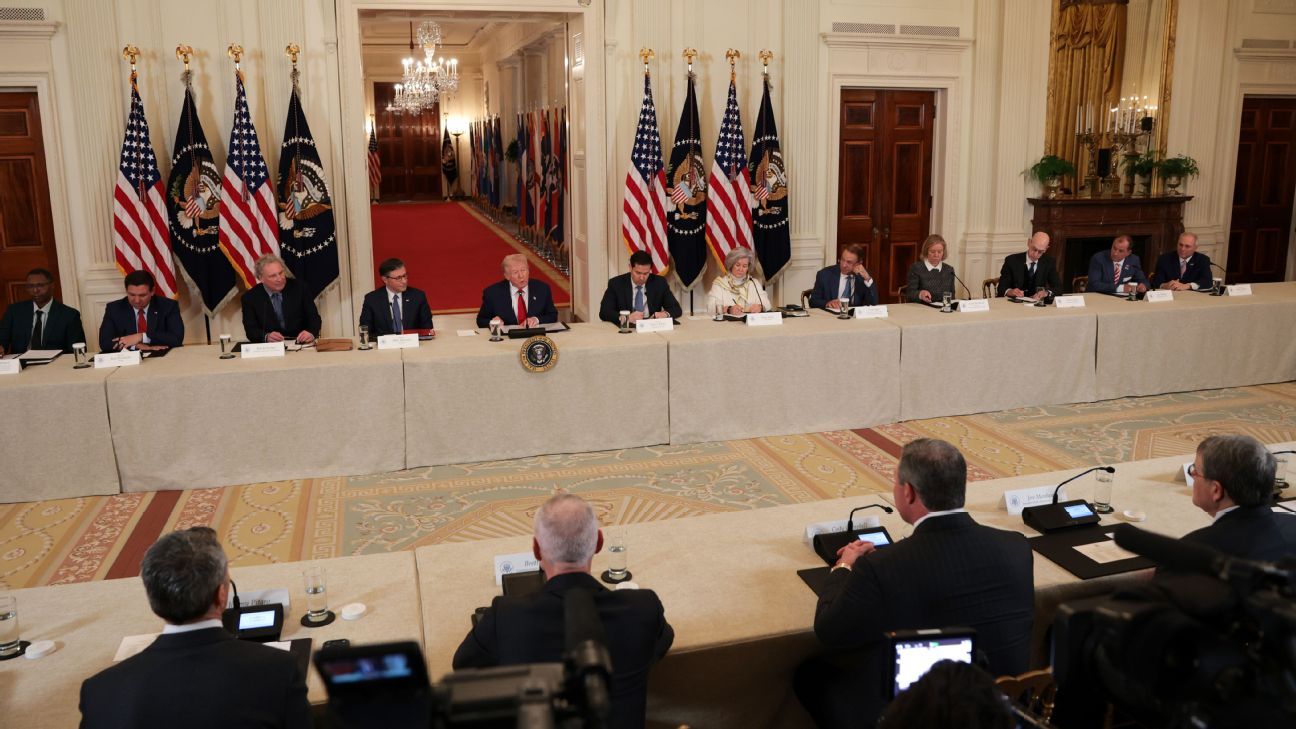
WASHINGTON — Following an appeal for assistance from the highest echelons of university athletics, President Donald Trump declared on Friday his intent to draft an executive directive within seven days. This order, he stated, would “rectify every issue” presented during an unprecedented gathering at the White House aimed at addressing the future of collegiate sports.
Trump, accompanied in the East Room by approximately 50 individuals from diverse backgrounds, presided over the inaugural “Safeguarding College Sports” discussion panel. Serving as vice chairs were Secretary of State Marco Rubio, New York Yankees president Randy Levine, and Florida Governor Ron DeSantis.
The assembly encompassed various politicians, sports icons, media executives, conference commissioners, university presidents and chancellors, and athletic directors. Those who spoke conveyed a consistent message: federal legislation is imperative for college sports to re-establish order within the NIL (Name, Image, and Likeness) domain and its overall financial framework.
“I will issue an executive decree within a single week, and it will be exceedingly comprehensive,” Trump asserted. “We will put it forth, and we will face legal challenges, and we’ll observe how it unfolds, alright, but I’ll have an executive order that will resolve every dilemma in this chamber, every conceivable problem, within one week, and we’ll present it. We will certainly be sued. That is the sole certainty I possess.”
NCAA president Charlie Baker was present, alongside ACC commissioner Jim Phillips, SEC commissioner Greg Sankey, Big 12 commissioner Brett Yormark, Big Ten commissioner Tony Petitti, American Conference commissioner Tim Pernetti, and Notre Dame athletic director Pete Bevacqua.
The meeting was scheduled for an hour but extended to nearly two, with attending reporters permitted to remain at the back of the room for its entirety. Former Alabama coach Nick Saban, seated two positions to the left of the president, was the first individual to speak representing the collegiate sector.
Saban conveyed that his objective was to prepare players for life’s successes and to cultivate an environment supporting their personal growth and academic assistance – a task that became “impossible to achieve within this current framework.”
“I believe we need to devise a system, and we obviously must do so with the President’s leadership and also Congress, perhaps through antitrust legislation or other means, to enable student-athletes in all sports, including women’s and Olympic sports, to improve their quality of life while attending college. This must still provide opportunities for them to advance beyond their athletic careers, which has always been the fundamental principle of college athletics and pursuing a college education,” Saban articulated. “And how much does anyone discuss obtaining an education anymore? No one mentions it at all, yet it is the most vital pursuit any of these student-athletes can undertake to enhance their future.”
Former Ohio State coach Urban Meyer suggested that a partial remedy involves “eliminating the collectives.”
“That constitutes deception,” he declared. “Benefactors contribute funds into a pool. This money is then distributed to players via coaches and managers. This practice is prohibited. It’s not supposed to occur. That’s a system of payment for play.”
Legislators and other attendees in the room expressed optimism for the passage of the SCORE Act, Congress’s primary Republican-backed initiative to establish a nationwide regulatory framework for NIL and collegiate athletics. Senator Ted Cruz noted that 60 Senate votes are required, including seven from Democrats, and currently, zero are prepared to vote in favor.
Texas Tech billionaire benefactor Cody Campbell, who has dedicated months to this matter, cautioned that as it progresses to the Senate, “certain dynamics will undergo transformation.”
“Many of the aspirations in this room and beyond will become unattainable,” he remarked. “The truth is, no one will obtain everything. If we are to reach a resolution on this, we must discover a common ground where we are all equally discontent, much like any other business transaction.”
Phillips communicated to the president, “We require your assistance,” and affirmed that none of the commissioners present had been informed by any players that they wished to be classified as employees.
“They possess sufficient intelligence to grasp the implications,” Phillips stated.
Sankey, too, conveyed a sense of urgency.
“We will fragment further if we neglect to act,” he warned.
“I will issue an executive decree within a single week, and it will be exceedingly comprehensive. We will put it forth, and we will face legal challenges, and we’ll observe how it unfolds, alright, but I’ll have an executive order that will resolve every dilemma in this chamber, every conceivable problem, within one week, and we’ll present it. We will certainly be sued. That is the sole certainty I possess.”
President Donald Trump
Sarah Hirshland, CEO of the United States Olympic and Paralympic Committee, noted that the college feeder system has “served as the cornerstone of Team USA for generations.”
At the Paris Games, she mentioned, athletes represented 231 distinct colleges and 71 conferences, with medalists hailing from 90 different institutions. She urged against taking these collegiate-level sports for granted.
“And while the United States has led the gold medal count in eight of the past 10 Summer Games, I am here to inform you that the margin is diminishing,” she stated. “Globally, nations are extensively investing in sports, constructing centralized training systems, expanding financial support, and prioritizing athlete development in novel ways. This increasing global rivalry coincides with a period when US colleges must enhance their investments in football to maintain competitiveness. The financial strains are unsustainable…”
“We are aware of the consequences when such investments are reduced or vanish,” she asserted. “It impedes the future talent pool for Team USA, and frankly, it jeopardizes the long-term vitality of sport in our nation. We cannot await for economic pressure to instigate this crisis.”
Notably, no student-athletes were present.
“They are very well represented,” Trump asserted. “Do you know why? Because individuals like Nick Saban and Urban Meyer, all the people I recognize in this room – and those I likely do not – they all genuinely care about the student-athlete far more than they care about themselves, so I believe they are truly here. In that sense, they are very ably represented here.”