
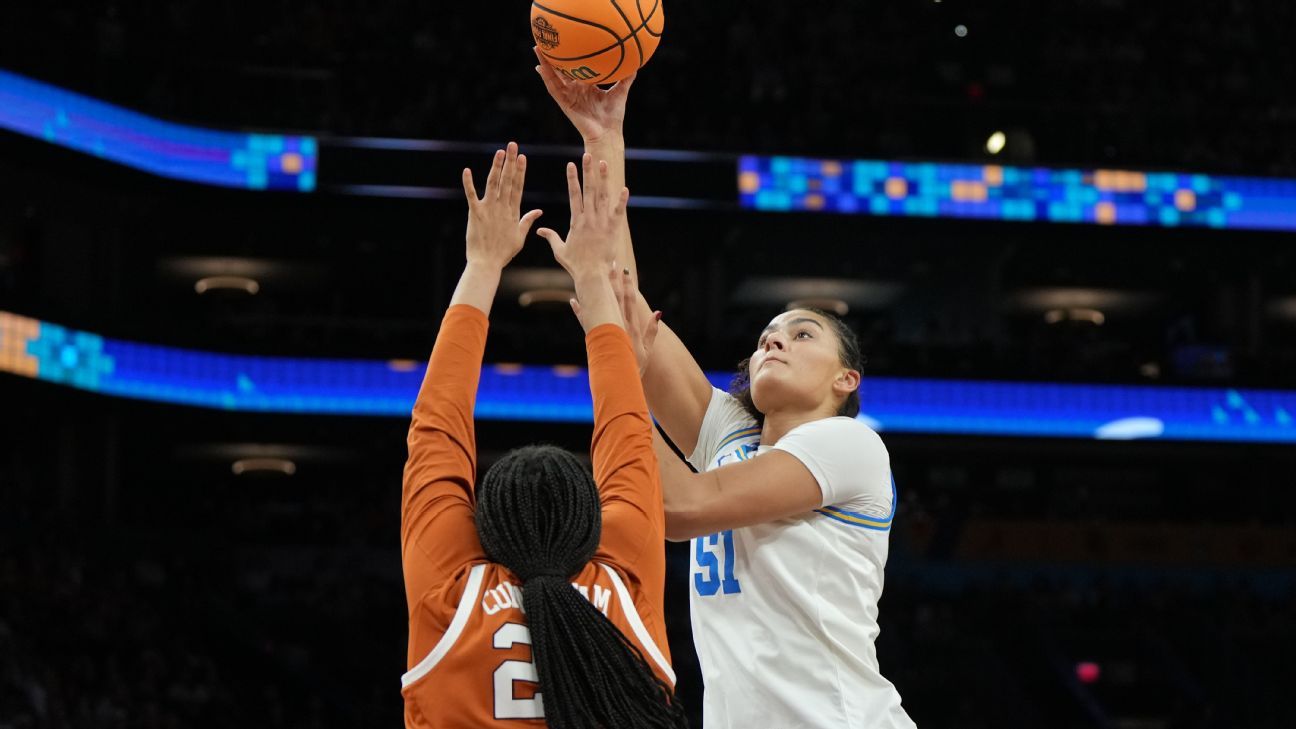
PHOENIX — A high-scoring spectacle between UCLA and Texas was not to be on Friday evening, a grueling contest that ultimately became one of the least productive offensively in Women’s Final Four annals. The Bruins managed precisely what was needed to secure an opportunity to clinch their inaugural NCAA title for the institution.
Anchored by Lauren Betts and a formidable defensive effort that suppressed Madison Booker and the Longhorns, UCLA repelled a final surge from Texas and retaliated for their sole defeat of the year, winning 51-44 in the semifinals. This victory established a championship clash against South Carolina on Sunday afternoon.
UCLA, participating in the championship match for the inaugural time in the team’s annals, has secured 30 consecutive victories following its defeat to Texas on Nov. 26.
For the Bruins, the outcome resembled a form of vindication, stemming not solely from their 76-65 loss to Texas in November, but also because their previous Final Four appearance last year, as the top overall seed, culminated in an 85-51 decisive defeat to UConn. UCLA coach Cori Close informed journalists prior to Friday’s contest that she believed she had done a “crappy job as a leader.” The athletes pledged to enhance their performance.
They did, but the triumph was by no means aesthetically pleasing. UCLA, which typically achieves 85.1 points per game, encountered considerable difficulties generating points against the smothering Texas defense. UCLA recorded 23 turnovers, the highest number in a Final Four contest since April 8, 2008, when Stanford had 24 against Tennessee.
However, Texas performed more poorly, appearing utterly unlike the squad that had amassed 12 consecutive victories following a November loss to Vanderbilt, during which coach Vic Schaefer challenged his team’s resilience.
Texas failed to convert uncontested attempts for extended periods, and Booker encountered difficulties, concluding with merely six points from a 3-of-23 shooting performance from the field. This represented a pronounced divergence from their triumph over the Bruins in November, when Booker had tallied 16 points and Rori Harmon 26.
In that prior game, Betts registered a mere eight points. She was resolute in altering that outcome in Friday’s rematch, and in a contest where scoring opportunities were scarce, she managed sufficient impact to establish her dominance in the lane, thus becoming a pivotal contributor. Betts spearheaded UCLA’s offense with 16 points on 7-of-10 shooting.
Considering the offensive struggles for both teams, the match remained closely contested throughout the initial three periods. UCLA held a 31-28 advantage heading into the final quarter, but a 7-0 scoring surge created separation, instigated by a three-point shot from Kiki Rice at the 9:04 mark and subsequently a layup by Gabriela Jaquez, to provide the Bruins with a lead of ten points or more.
UCLA held a 13-point advantage with 4:36 left in the game, but Texas reduced that advantage to 47-44 with 55.8 seconds remaining, as its ardent defensive pressure compelled UCLA to commit turnovers and misfire on attempts. Following a missed jumper by Angela Dugalic with 30 seconds left, Madison Booker attempted a layup, but Betts rejected the attempt with 20 seconds remaining. Rice converted two free throws with 13.3 seconds remaining to secure the win.
UCLA established a formidable defensive posture from the outset of the game, challenging almost every attempt and limiting Texas to a mere six points in the opening quarter — equaling the second-lowest point total for a quarter in the Final Four since quarters were adopted in 2016. However, in the second quarter, the Bruins themselves managed only six points, also matching the record.
Cumulatively, this marked only the third instance in Final Four history where the teams amassed less than 100 points in total during a game.
But what significance does that hold when one is poised at the precipice of institutional legacy?