
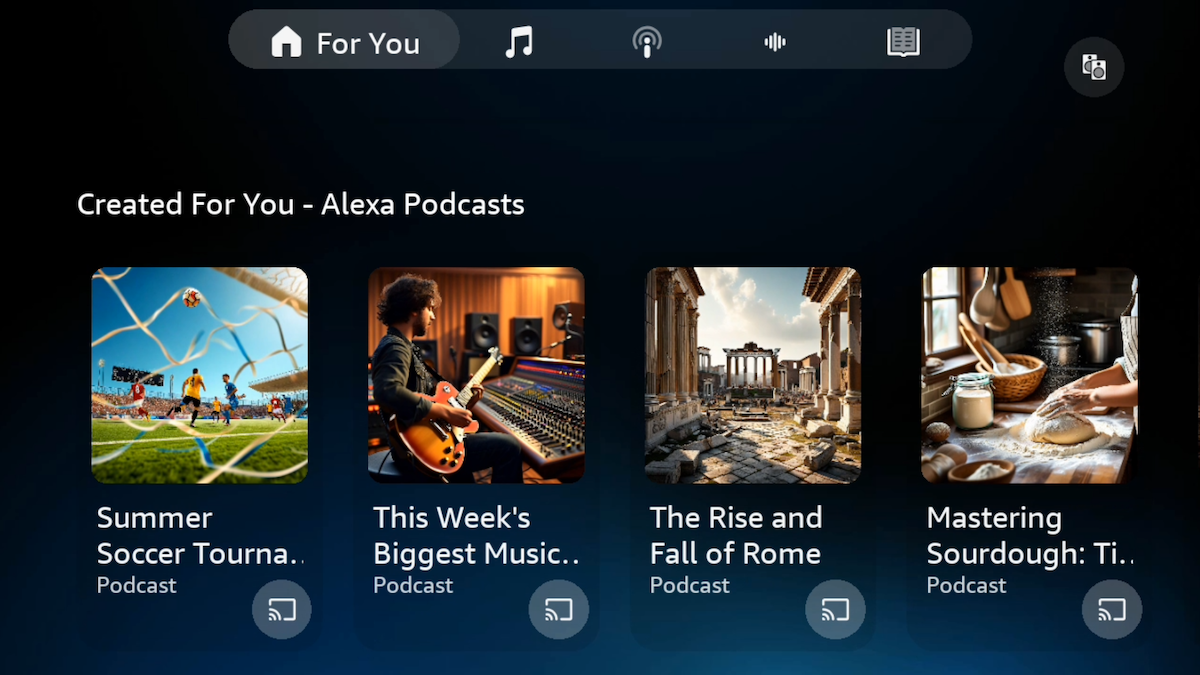
Alexa’s Next Act: Amazon Unleashes AI-Powered On-Demand Podcasts
Amazon is pushing the boundaries of generative AI, transforming its ubiquitous voice assistant into a personalized content creation engine.
Key Takeaways
- Personalized Podcast Generation:Amazon’s “Alexa Podcasts” feature allows users to generate on-demand podcast episodes on any topic, crafted by AI in minutes, marking a significant leap for the voice assistant into generative content.
- Strategic Shift for Alexa+:This launch signifies Amazon’s ambition to evolve Alexa+ beyond a simple smart home controller into a sophisticated AI content creator, positioning it firmly in the generative AI race alongside competitors like Google and OpenAI.
- Ethical & Accuracy Concerns:While innovative, the feature raises important questions regarding the reliability and ethics of AI-generated content, especially for news and complex subjects, prompting Amazon to highlight extensive partnerships with major news organizations to ensure accuracy.
The Dawn of On-Demand Audio: Alexa Podcasts Arrives
In a move that could fundamentally redefine how we consume audio content, Amazon officially announced the latest update to Alexa+: the groundbreaking ability to generate podcast episodes on demand. Dubbed “Alexa Podcasts,” this innovative feature is now rolling out to customers across the U.S., promising to transform any user’s curiosity into a fully narrated podcast episode in mere minutes. The announcement, made Monday, places Amazon squarely at the forefront of personalized generative AI applications for everyday consumers.
The premise behind “Alexa Podcasts” is elegantly simple and strikingly powerful: users merely need to vocalize their desired topic to Alexa+. The beauty of the system lies in its minimal user input requirement – there’s no need for pre-written scripts, tedious document uploads, or any prior planning. Instead, Alexa+ takes the helm, autonomously researching the requested subject across its vast information access points, gathering pertinent information, and then crafting a concise overview of what the forthcoming episode will cover. This initial blueprint isn’t set in stone; users retain the power to fine-tune various aspects, including the episode’s length, the overall tone (e.g., informative, casual, academic), and the specific focus points, ensuring the output aligns with their precise interests and needs.
Once the user is satisfied with the structural outline and content parameters, Alexa+ leverages sophisticated AI-generated host voices to narrate the podcast. These voices are designed to sound natural and engaging, enhancing the listening experience. The entire process, from initial request to final production, is designed for unparalleled speed and convenience. Upon completion, users receive an instant notification through their Echo Show device and within the Alexa app, alerting them that their personalized episode is ready. For future listening, all generated episodes are automatically saved within the app’s “Music” and “More” sections, allowing for easy replay, sharing, and access at any time, transforming Alexa+ into a personal audio library curator.
Beyond the Assistant: Alexa’s Strategic Evolution into Generative AI
This launch represents far more than just a new feature for Amazon’s ubiquitous voice assistant; it signifies a pivotal strategic shift for the company, pushing Alexa+ beyond its traditional roles of answering simple questions or controlling smart home devices. With “Alexa Podcasts,” Amazon is explicitly positioning Alexa+ as a personalized AI content creator, a powerful generative tool capable of producing unique, on-demand media on the fly. This move places Amazon squarely in the increasingly competitive landscape of generative artificial intelligence, alongside tech giants like Google with Bard and OpenAI with ChatGPT, all vying to define the future of AI interaction and content creation for the masses.
The underlying ambition is clear: to make Alexa+ an indispensable partner in content discovery and creation, offering a level of personalization previously unattainable through traditional media channels. By enabling on-demand, tailored audio content, Amazon aims to deepen user engagement and cement Alexa+’s role as a central hub for information and entertainment, not just in the home but across various aspects of daily life. This expansion into content generation is a natural progression for a platform that has long focused on voice-first interactions, now marrying that capability with the transformative power of large language models and advanced text-to-speech synthesis, hinting at a future where our devices don’t just respond, but actively create.
Navigating the AI Minefield: Ethics, Accuracy, and the Future of Creators
While the innovation behind “Alexa Podcasts” is undeniable and exciting, its launch is poised to ignite significant debate across the tech, media, and ethical communities. The proliferation of AI-generated voices and automated content continues to raise complex questions around ethics, content accuracy, and the long-term implications for traditional human creators. Concerns range from the potential for misinformation and the propagation of biases inherent in training data, especially when AI-generated podcasts cover sensitive or rapidly evolving news topics, to the existential impact on the livelihoods of human podcasters, journalists, and content producers who dedicate their careers to crafting compelling audio narratives and delivering nuanced perspectives.
A primary point of contention will undoubtedly be the reliability and factual integrity of AI-generated content. How will Alexa+ discern credible sources from unreliable ones during its rapid research phase? What robust safeguards are in place to prevent the spread of biased, incomplete, or erroneous information, particularly when dealing with complex or controversial subjects that require critical human judgment? These are critical questions that Amazon must address transparently and continuously as the feature gains wider adoption. The company is clearly aware of these challenges, emphasizing its proactive approach to bolstering content accuracy and reliability through extensive partnerships. Alexa+ can reportedly access real-time information via agreements with a robust roster of major news organizations, including the Associated Press, Reuters, The Washington Post, Time, Forbes, Business Insider, Politico, USA Today, Condé Nast, Hearst, and Vox Media. Furthermore, Amazon highlights collaborations with over 200 local newspapers across the U.S., aiming to provide a broad and verified information base for its AI-generated content.
However, even with these impressive partnerships, the debate over AI’s role in journalism and content creation is far from settled. Critics may argue that simply drawing from established news sources doesn’t guarantee the nuance, context, or the critical human judgment essential for responsible reporting and storytelling. The “voice” of the AI, while customizable, might still lack the genuine empathy, unique perspective, and inherent trust that human hosts cultivate with their audience over time. This feature presents a fascinating tension between the undeniable convenience of instant, personalized content and the deeply ingrained human desire for authentic, trustworthy narratives, pushing the boundaries of what consumers expect from their information sources.
The Road Ahead: Personalized Audio’s Expanding Horizon
“Alexa Podcasts” is seemingly just the tip of the iceberg for Amazon’s ambitious plans in personalized AI audio. The company has explicitly stated its exploration of additional forms of AI-powered sonic experiences, hinting at a broader vision for Alexa+’s generative capabilities. This includes future possibilities like custom news briefings, where users could potentially receive hyper-tailored news updates based on their highly specific interests, geographic location, and even their unique consumption habits, delivered in a preferred voice and format. Imagine waking up to a personalized audio digest of only the news that matters most to you, curated by an AI.
Even more intriguing is the prospect of content generated directly from users’ own documents and shared information, opening up unprecedented possibilities for personalized summaries, audiobooks created from personal notes or research papers, or even narrated family histories from scanned documents and photos. Such advancements could fundamentally alter how individuals interact with personal data and information, transforming static text into dynamic, listenable narratives that are always accessible. The deep integration of generative AI into everyday devices like the Echo Show and the Alexa app indicates a future where personalized audio content is not just an option but a seamless, integrated part of our digital lives, constantly adapting to our evolving needs and preferences. This aggressive push positions Amazon as a key player in shaping the auditory future, where AI doesn’t just respond to commands but actively creates and curates unique content for each user.
The Bottom Line
Amazon’s “Alexa Podcasts” is a bold, forward-thinking leap into the generative AI landscape, marking a significant evolution for its voice assistant and setting a new precedent for personalized audio content. While offering unparalleled convenience, accessibility, and a compelling glimpse into the future of on-demand information, the feature simultaneously amplifies critical conversations around AI ethics, accuracy, and the future role of human creators in a rapidly automating world. Amazon’s emphasis on extensive news partnerships is a crucial first step in addressing these inherent concerns, yet the true test of this powerful technology will be in its ongoing development, transparent governance, and the thoughtful navigation of its societal impact as it reshapes how we listen, learn, and create. The era of the personal AI content producer has officially begun.
When you purchase through links in our articles, we may earn a small commission. This doesn’t affect our editorial independence.
{content}
Source:{feed_title}