
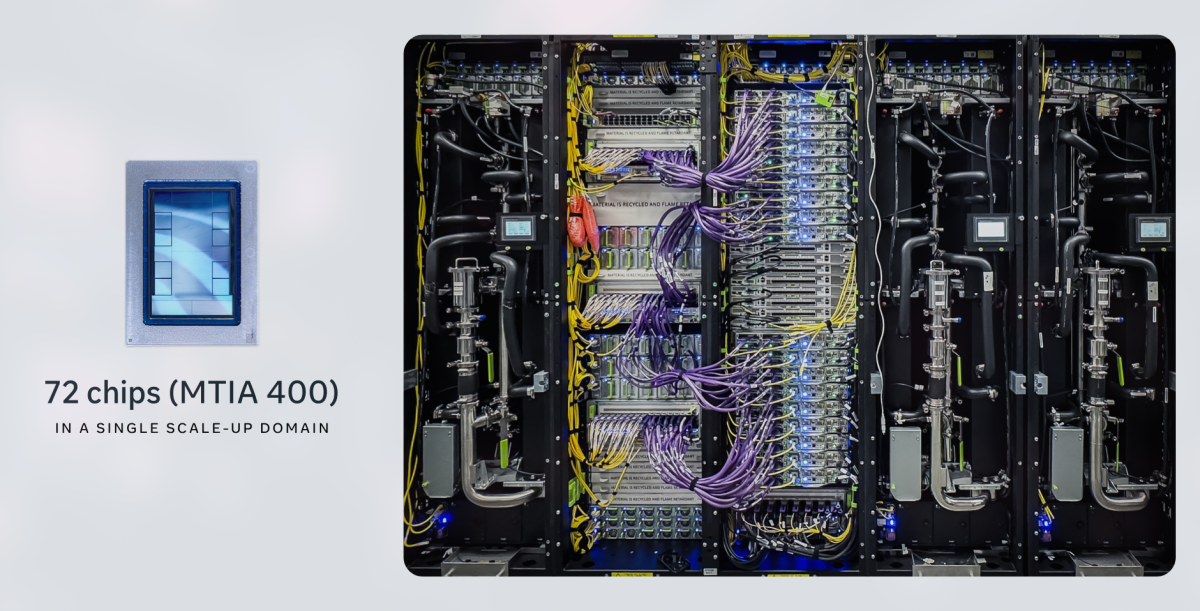
Meta is aggressively moving to reduce its reliance on external GPU providers, aiming to kickstart the production of its latest AI-specific chips, known as MTIA, as early as September. This strategic pivot, driven by a confluence of rising costs and component shortages, signals a broader industry trend towards in-house hardware innovation.
Key Takeaways
- Strategic Independence:Meta’s acceleration of its custom AI chip production (MTIA) in September is a critical move to mitigate soaring GPU costs and foster greater self-sufficiency in its rapidly expanding AI infrastructure.
- Industry-Wide Vertical Integration:This initiative mirrors a growing trend among tech giants like Amazon, Google, and even OpenAI, to design their own silicon, optimizing performance for proprietary AI workloads and reducing dependence on dominant chipmakers like Nvidia.
- Massive Investment in AI Foundation:The MTIA program is a cornerstone of Meta’s staggering capital expenditure plans, earmarking tens of billions for data centers, power deals, and custom hardware, all aimed at securing the foundational compute capacity for its ambitious AI future.
Meta Accelerates In-House AI Chip Production to Counter Costs and Bolster Autonomy
In a significant strategic maneuver to rein in escalating GPU expenses and navigate persistent component shortages, Meta is poised to commence manufacturing the newest iterations of its proprietary AI-specific chip in September. This development, first reported by Reuters citing an internal memo, underscores the social media behemoth’s intensified efforts to exert greater control over its foundational artificial intelligence infrastructure.
The internal memo revealed promising progress, noting that at least one of these custom chips successfully cleared its rigorous testing phase in approximately six weeks. This rapid turnaround highlights Meta’s agile development cycle for its hardware. For the crucial design phase, Meta has partnered with chip design specialist Broadcom, while the actual fabrication will be handled by Taiwan’s world-leading semiconductor manufacturer, TSMC. Beyond the core chip, Meta is also diversifying its supply chain for essential components, sourcing RAM from Samsung, storage solutions from Sandisk, and fiber optic equipment from Sumitomo Electric. This multi-vendor approach aims to build resilience and reduce vulnerabilities in its complex manufacturing ecosystem.
The MTIA Program: Tailored Silicon for Meta’s AI Ambitions
The chips in question fall under Meta’s ambitious Meta Training and Inference Accelerator (MTIA) program. The company formally unveiled four new chips developed under this initiative in March, some of which are already being deployed, with others slated for rollout later this year or in 2025. A key tenet of the MTIA program is its modular design philosophy. This approach anticipates the dynamic and rapidly evolving landscape of AI, allowing Meta to adapt its hardware needs as new models and workloads emerge.
“Each MTIA generation builds on the last, using modular chiplets, incorporating the latest AI workload insights and hardware technologies, and deploying on a shorter cadence,” Meta articulated at the time, emphasizing its commitment to iterative innovation and rapid deployment.
The primary objective of these MTIA chips is to significantly reduce Meta’s expenditure on high-performance GPUs from market leaders like Nvidia and AMD. While Meta still anticipates substantial investments with these external providers for general-purpose AI tasks, the MTIA chips are specifically engineered for more tailored workloads. These include training models for Meta’s highly critical ranking and recommendation algorithms – the engines that drive content consumption across Facebook and Instagram – as well as broader AI applications and inference tasks crucial for its various platforms. Meta’s journey into producing its own AI chips is not new; the company has been developing custom silicon since 2023, steadily building its expertise and capacity.
The Financial Imperative: Billions Poured into AI Infrastructure
Meta’s foray into custom chip production is intrinsically linked to its colossal spending on securing adequate computing capacity to fuel its multifaceted AI endeavors. The company projected its capital expenditures for this year to fall between an eye-watering $125 billion and $145 billion, with a substantial portion of this budget directly allocated to its AI initiatives. This financial commitment underscores the sheer scale and strategic importance Meta places on its AI future.
To support its ambitious plans, which include the deployment of its new Muse Spark series of AI models, Meta has been aggressively pursuing data center and power deals across the globe. These investments amount to tens of billions, all aimed at securing the necessary computational grunt. According to the internal memo cited by Reuters, Meta intends to deploy 7 gigawatts of compute capacity this year, with plans to double that figure in 2025. Such immense power requirements necessitate not just advanced chips, but also a robust and expansive physical infrastructure.
Beyond its custom MTIA chips, Meta has also diversified its compute strategy through a series of significant partnerships. Last year, it inked a deal with ARM to secure compute for its recommendation systems. This was complemented by a multi-billion dollar agreement with AMD for its powerful Instinct GPUs, and another multi-billion dollar pact with Amazon to leverage the cloud giant’s homegrown CPUs for specific AI-related needs. This multi-pronged approach demonstrates Meta’s commitment to building a resilient and diverse AI hardware ecosystem.
A Broader Industry Shift: The Race for Custom AI Silicon
Meta’s drive for custom AI silicon is not an isolated incident; it reflects a burgeoning trend across the technology industry. A growing number of major players are actively developing their own chips to mitigate reliance on external vendors, primarily Nvidia, which currently dominates the high-performance GPU market. OpenAI, for instance, recently unveiled an inference processor it is co-developing with Broadcom, signaling its intent to optimize its own AI models with custom hardware. Similarly, Anthropic is reportedly exploring the development of its own chips in collaboration with Samsung.
Cloud computing giants Amazon and Google have been at the forefront of this movement for years, with both companies designing and deploying their own chips for AI training and inference within their vast data centers. Furthermore, a vibrant ecosystem of startups is emerging, all focused on building specialized AI hardware to meet the skyrocketing global demand for efficient and powerful AI computation. This collective shift suggests a future where AI hardware becomes increasingly specialized and vertically integrated, moving away from a one-size-fits-all approach.
Meta declined to comment on the specifics of the Reuters report.
The Bottom Line
Meta’s aggressive acceleration of its MTIA chip production marks a pivotal moment in its AI strategy, signifying a deeper commitment to self-sufficiency and cost optimization in the fiercely competitive AI landscape. By bringing more hardware development in-house, Meta aims to tailor performance precisely to its unique workloads, reduce colossal expenditures on external GPUs, and fortify its supply chain against future disruptions. This move not only positions Meta for greater control over its technological destiny but also underscores a broader industry pivot towards specialized, vertically integrated AI hardware, reshaping the foundational infrastructure that powers the next generation of artificial intelligence.
When you purchase through links in our articles, we may earn a small commission. This doesn’t affect our editorial independence.
Source:{feed_title}