
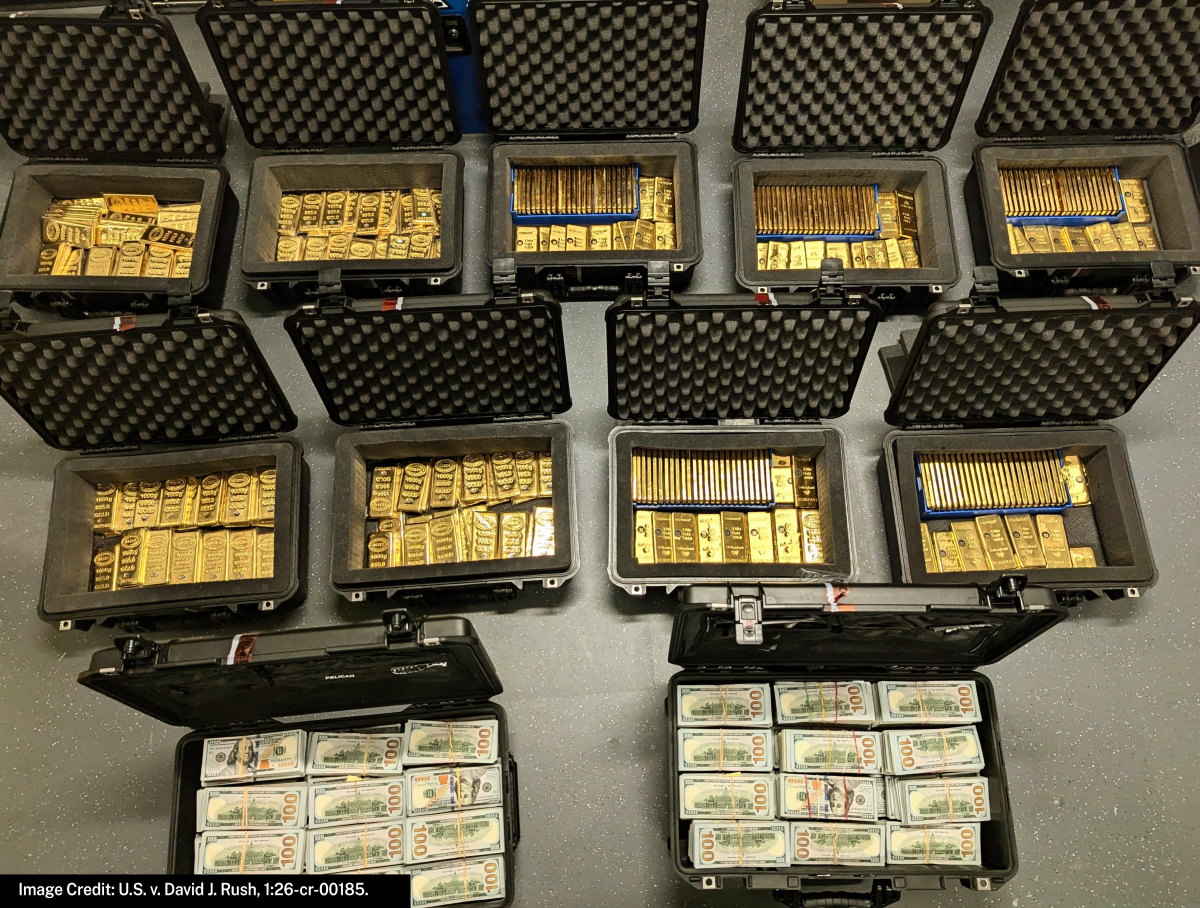
A now-former officer with the Central Intelligence Agency has pleaded guilty to stealing almost $200 million, including hundreds of gold bars, as part of a fraudulent scheme masquerading as a top secret government program.
Key Takeaways
- Audacious Insider Fraud:Former CIA officer David J. Rush confessed to orchestrating a sophisticated wire fraud, siphoning nearly $200 million, largely in gold, by fabricating a highly classified “special access program.”
- Systemic Vulnerabilities Exposed:Rush exploited deep-seated flaws in governmental oversight, leveraging his high-level clearance and the inherent secrecy of compartmentalized programs to operate undetected for an extended period.
- Critical Questions on Vetting & Oversight:The case highlights severe deficiencies in vetting processes for intelligence personnel and the structural challenges of auditing black-box operations, raising urgent concerns for national security and public trust.
The Golden Heist: Ex-CIA Officer Exploits Top-Secret Black Ops for $200M Fraud, Exposing Systemic Flaws
In a stunning revelation that peels back layers of secrecy within the U.S. intelligence community, a former Central Intelligence Agency (CIA) officer has admitted to a colossal act of fraud, pilfering nearly $200 million in a scheme as audacious as it was meticulously planned. David J. Rush, a Virginia resident, pleaded guilty to one count of wire fraud, a confession that not only ends a potentially explosive trial but also casts a harsh spotlight on the inherent vulnerabilities within the nation’s most sensitive operational frameworks.
The U.S. Department of Justice confirmed on Tuesday that Rush masterminded a fabricated operation, disguised as a top-secret government program, to funnel U.S. government funds directly into his pockets. This wasn’t merely a lapse in judgment; it was a calculated exploit of trust, access, and the very architecture designed to protect national security secrets.
The Architect of Deception: Who is David J. Rush?
According to prosecutors, Rush’s journey into the CIA itself was built on a foundation of lies. He reportedly fabricated his educational background and military experience to secure a position, a critical failure in the initial vetting process that would have profound consequences. Once inside, Rush leveraged his access as an employee, climbing the ranks to become a senior officer in a division reportedly responsible for developing hacking tools and espionage techniques. Joining the agency around 2010, his role granted him significant authority over classified government intelligence programs and their associated spending, essentially placing him in a position of immense, largely unsupervised power.
This backstory paints a chilling picture: an individual who manipulated his way into the heart of national security, not with foreign allegiances, but with a singular focus on personal enrichment, exploiting the very systems designed to keep the country safe.
The Grand Deception: Fabricating a “Special Access Program”
The core of Rush’s scheme revolved around the creation of a fraudulent “special access program” (SAP). SAPs are the intelligence community’s most highly classified initiatives – operations so sensitive and compartmentalized that even individuals with top-secret clearances are often denied access without specific, additional authorization. They are the ‘black boxes’ of national security, necessary for protecting critical methods and sources, but inherently difficult to audit or oversee.
Over the course of 2025, Rush meticulously constructed this phantom SAP. According to The Washington Post, he framed it as a “continuity of government” plan – a critical, highly sensitive initiative designed to ensure governmental function in the face of catastrophic events like war or natural disaster. By embedding his fraud within such a vital, plausible framework, Rush provided a compelling, unassailable narrative for its existence and its urgent need for funding.
Under the guise of this fake program and its associated (also fake) government contract, Rush tricked an unnamed defense contractor into purchasing vast quantities of gold. This gold, ostensibly for the “continuity of government” plan, was instead diverted directly into Rush’s possession. The sheer scale and sophistication of this operation – manipulating the acquisition process of a defense contractor to acquire physical assets worth hundreds of millions – underscores a profound exploitation of procurement protocols and trust within the defense industrial base.
The Loot and the Law: Discovery and Aftermath
When law enforcement finally moved in, the extent of Rush’s illicit gains became undeniably clear. Investigators uncovered over $46 million worth of gold bars within his residence, directly linked to the long-running fraud. This staggering haul was complemented by a collection of luxury cars, expensive watches, and more than $2 million in cash – a tangible testament to the nearly $200 million he had siphoned from the U.S. government.
His guilty plea allows Rush to avoid a public trial, a scenario that would have undoubtedly forced the U.S. government to publicly account for how a senior officer evaded multiple layers of security scrutiny, and how such an extensive operation went undetected for over a year within one of its most secretive agencies. The fact that Rush’s duties involved working with one of the government’s “most sensitive intelligence-gathering programs” – details of which remain undisclosed due to ongoing operational concerns – only amplifies the gravity of his betrayal and the potential exposure of critical national security information.
A Breach of Trust: Systemic Vulnerabilities Uncovered
The Rush case is more than just a tale of personal greed; it’s a stark illustration of systemic vulnerabilities within the very architecture of national security. Court filings explicitly state that Rush “effectively acted as his own approving official, enabling him to expend substantial amounts of United States government money without meaningful scrutiny.” This highlights a critical flaw in the oversight mechanisms for highly classified programs.
Compartmentalization, while essential for protecting sensitive intelligence, inadvertently creates ‘blind spots’ that can be exploited by malicious insiders. When only a handful of individuals are “read into” a program, the traditional checks and balances of auditing and peer review are severely diminished. The reliance on trust, while fundamental in intelligence operations, becomes a single point of failure when that trust is breached by someone who has mastered the internal protocols and leverage their position.
Furthermore, the revelation that Rush lied about his background to join the CIA points to significant gaps in the initial vetting process. For an agency entrusted with protecting the nation’s most vital secrets, a failure at the gatekeeping stage is profoundly troubling. It suggests that human intelligence, psychological profiles, and background checks, despite their intensity, can be circumvented by determined and deceptive individuals, creating a Trojan horse within the intelligence community.
This incident compels a re-evaluation of how special access programs are designed, funded, and audited. It demands innovative solutions for oversight that do not compromise operational security but prevent individuals from operating as unchecked authorities with access to vast public funds. The challenge lies in developing robust, yet discreet, verification protocols that can detect anomalies without inadvertently exposing the very secrets they are meant to protect.
The Road Ahead
David J. Rush is scheduled to be sentenced in late January 2027 and faces a maximum penalty of 20 years in federal prison. While the legal process will bring a measure of justice, the questions raised by his actions will linger, prompting an urgent need for the intelligence community to fortify its defenses against insider threats and re-evaluate the integrity of its most sacred operational spaces.
Bottom Line
The David J. Rush fraud case is a chilling exposé of how a highly-placed insider exploited the very mechanisms designed for national security to orchestrate a near $200 million theft. It’s a wake-up call for intelligence agencies to critically examine their vetting processes, the oversight of compartmentalized programs, and the delicate balance between necessary secrecy and essential accountability. The incident underscores a pressing need for enhanced digital and human safeguards to protect against insider threats that compromise not just finances, but the foundational trust in government operations.
When you purchase through links in our articles, we may earn a small commission. This doesn’t affect our editorial independence.
{content}
Source:{feed_title}