
I loathe launchingthe Microsoft Store. Its loading is sluggish, its navigation perplexing, and it’s replete with advertisements for items of no interest to me. Fortuitously, due to a novel functionality, I am no longer obligated to access the Microsoft Store at any point.
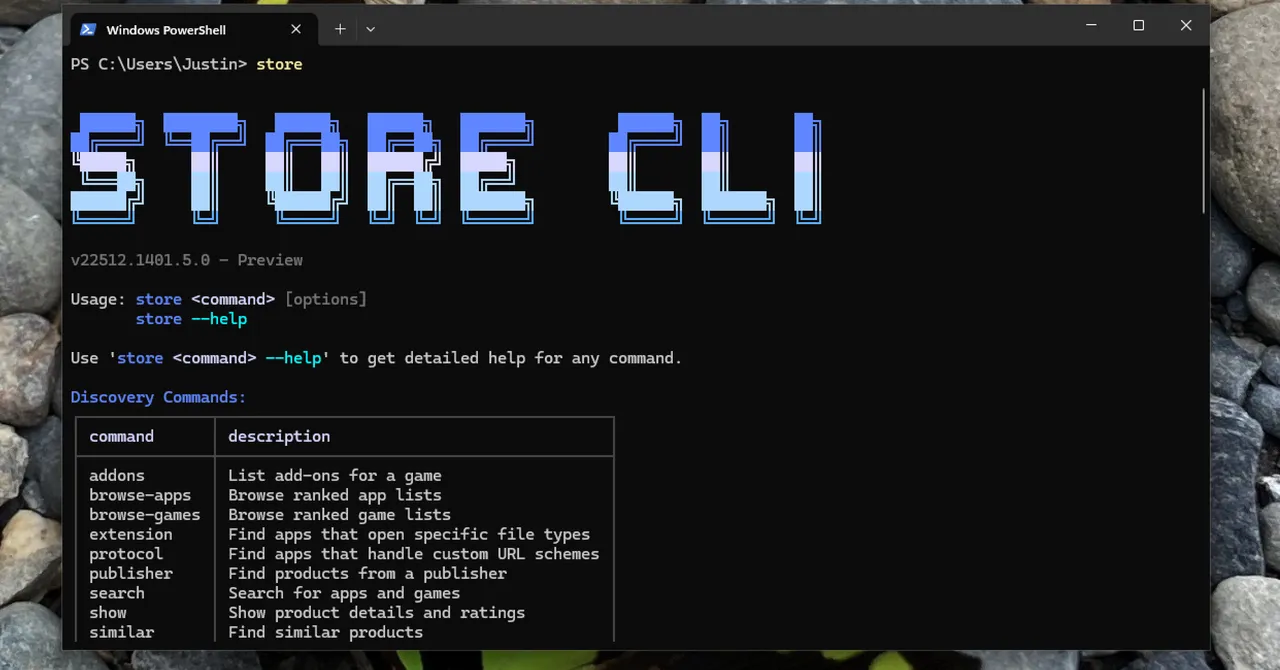
Just last week, Microsoft unveiled a completely fresh command-line interface for its Store, which users can immediately reach by initiating PowerShell and inputting “store.” Should the command prove ineffective, ensure that all recent Windows 11 updates have been applied.
If successful, users will be presented with an ornate piece of ASCII art, accompanied by a compilation of sub-commands. This display elucidates the process of locating, installing, and even upgrading software through merely a handful of key presses.
Individuals who utilize Linux are accustomed to deploying software via the command line, while Mac users are adept at discovering third-party utilities for this purpose, such as MAS for the Mac App Store. I cannot recollect any prominent commercial operating system that has incorporated a method to navigate and acquire software from a commercial application store solely through commands.
Microsoft’s execution of this feature is notably impressive. For instance, knowledge of the application’s precise designation is not requisite to install an item. During my evaluation of this novel interface, I input “store install firefox,” uncertain if the operation would succeed. The utility scanned the store, identified the application most probable to correspond with “firefox,” disclosed its developer (Mozilla, in this instance), and inquired whether that was indeed my intended installation.
It is impossible to exaggerate the simplicity this brings to software installation. Comparable services I’ve examined do not function in this manner—one typically must be aware of the precise name employed by the package manager, failing which an error will occur. It is genuinely remarkable to witness such an exemplary implementation.
However, certain disadvantages exist. The utility is restricted to installing only those applications available within the Microsoft Store, a limitation by its very nature. Several exceptionally common applications, such as Google Chrome and Paint.net, are not accessible through this method. Nonetheless, numerous applications are present, and users may be unaware of what is or isn’t offered. By inputting “store search” followed by a query, one can conduct a search within the store. Further particulars can be obtained by entering “store show” followed by the application’s designation, allowing for additional information to be reviewed.
Furthermore, one can navigate the Microsoft Store. The command “store browse-apps” will furnish information regarding several categories for exploration, among them the bestseller rankings. Collectively, these commands enable nearly every action achievable within the Microsoft Store, yet with increased speed.
{content}
Source:{feed_title}