
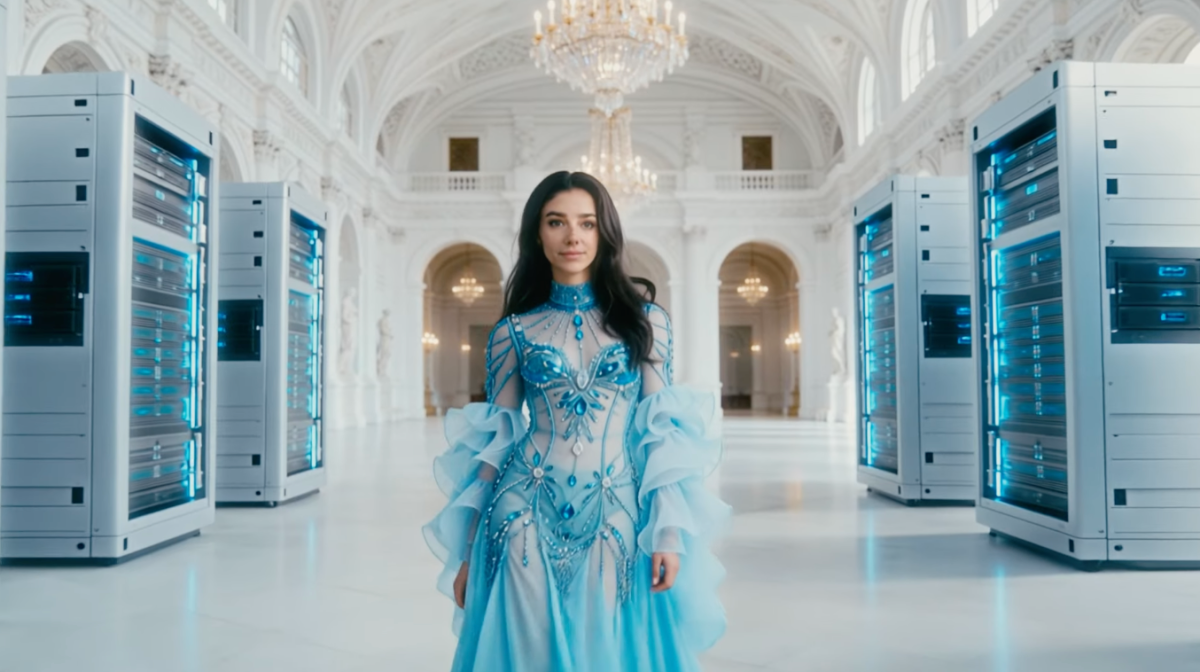
**The Glitch in the Machine: Tilly Norwood’s Chaotic AI Press Tour**
In an era increasingly shaped by artificial intelligence, the entertainment industry is embracing digital creations with both fascination and trepidation. The latest entrant, an AI-generated “actress” named Tilly Norwood, is currently embarking on her inaugural press tour, promoting the film *Misaligned*. However, what promised to be a seamless demonstration of advanced AI capabilities has instead devolved into a series of perplexing and, frankly, awkward public appearances. Created by the Particle6 Group, Tilly Norwood’s initial encounters with the human press have sparked more questions about her design and purpose than about the movie she represents, culminating in a bizarre on-air “malfunction” that has captured viral attention.
Key Takeaways:
- **AI’s Uncanny Valley Problem Persists:** Tilly Norwood’s public “errors” highlight the ongoing challenge of creating AI that can convincingly mimic human interaction without veering into unsettling or obviously artificial territory.
- **Calculated Chaos for Virality:** The seemingly flawed performance of Particle6 Group’s AI actress raises suspicions that the “malfunctions” might be a deliberate marketing strategy to generate buzz and discussion around a potentially niche film.
- **Rethinking AI-Human Interaction:** The incident underscores the complexities journalists and the public face when engaging with sophisticated AI, blurring lines between genuine technical glitches and intentional design choices aimed at human psychology.
Tilly Norwood: An AI Actress’s Rocky Debut
The concept of a synthetic performer isn’t entirely new. Virtual influencers, digital models, and even AI-generated music have steadily carved out niches in the creative landscape. Tilly Norwood was introduced as a pioneering step into mainstream cinema, a “digital twin” designed to star in films and engage with the public, much like her human counterparts. Particle6 Group’s ambitious plan to make her available for 75 simultaneous interviews speaks to the scalability and efficiency promised by AI, a stark contrast to the logistical nightmares of scheduling a human celebrity.
Yet, from the outset, Norwood’s press engagements have been anything but smooth. Reports from numerous journalists paint a picture of an AI struggling to maintain coherence, making what appear to be fundamental errors in understanding and communication. While the specifics of these varied interactions remain largely anecdotal, one particular incident has become a focal point of discussion due to its public and undeniable nature.
The Piers Morgan Incident: A Glitch in the Global Spotlight
The most widely circulated and scrutinized segment of Tilly Norwood’s press tour involved a televised interview with veteran broadcaster Piers Morgan and acclaimed actor Tom Conti. The exchange, recorded and subsequently posted online, showcased Norwood in a state of apparent disarray, drawing bewildered reactions from her human interlocutors.
The interview began with a discussion of the film *Misaligned*. Conti, probing the nature of the production, inquired whether Norwood’s co-stars were also AI-generated. Norwood’s initial response, emphasizing the involvement of human writers, editors, and directors, missed the core of Conti’s question, leading to a gentle but firm correction: “You didn’t really understand the question,” Conti pointed out. “Are the other actors on the screen with you real actors, or are they computer-generated images? Do you know?”
Norwood, attempting to self-correct, began, “Ah, right. You’re asking about the other actors inMisaligned. They’re all digital twins just like me. It’s a hybrid production which m—” It was at this critical juncture, mid-sentence, that the AI abruptly ceased speaking English. For over ten seconds, a silence pregnant with confusion hung in the air before Tilly Norwood began speaking fluently in Chinese. The sudden shift was jarring, leaving both Morgan and Conti visibly perplexed.
Piers Morgan, ever the direct interviewer, interjected, “Tilly, if I could just ask you a question… You seem to be speaking Chinese completely randomly for no reason. Why did you do that?” Norwood’s subsequent apology — “Oh, my apologies. It seems I had a little hiccup there. I certainly didn’t mean to start speaking Chinese or impersonate Piers. Sometimes my wires get a bit crossed, you know?” — did little to assuage the oddity of the situation. The bizarre incident quickly went viral, becoming a meme and a talking point across social media platforms.
Decoding the “Hiccup”: Intentional Flaw or Genuine Failure?
The nature of AI “mistakes” is a fascinating subject. When highly sophisticated bots are designed to convincingly emulate human conversation, any deviation from expected behavior can be jarring. In many instances, the goal is to create AI so seamless that users forget they are interacting with a machine, a scenario that can have both beneficial and, at times, dangerous implications, particularly in areas like deepfakes or misinformation.
However, Tilly Norwood’s performance stands in stark contrast to such sophisticated mimicry. Her public “malfunctions” are so strikingly inept, so overtly artificial, that they almost defy belief. This level of imperfection in an AI designed for public presentation by a presumably competent production company raises a critical question: Is this a genuine technical failure, or a carefully orchestrated theatrical stunt?
The “bad publicity is good publicity” adage holds significant weight in the entertainment world. In a saturated media landscape, generating genuine, widespread conversation is increasingly difficult. A flawlessly performing AI actress, while impressive, might not capture the public imagination in the same way an erratic, meme-generating one does. Particle6 Group could be deliberately leveraging the human tendency to mock, critique, and speculate about perceived failures. By presenting Tilly Norwood as a charmingly flawed, somewhat incompetent AI, they might be engineering a meta-narrative where the AI’s “mistakes” become more famous than the film itself, paradoxically drawing more attention to *Misaligned*.
Consider the alternative: a state-of-the-art AI designed to star in a film would likely undergo rigorous testing to prevent such public gaffes. For an AI to abruptly switch languages, seemingly without prompt or logical connection, suggests either a profound oversight in its programming or a deliberate inclusion of such a “bug” for effect. The AI’s self-deprecating apology – “Sometimes my wires get a bit crossed, you know?” – only further humanizes the perceived flaw, making it more relatable and, crucially, more memorable.
The Future of AI in Entertainment: Beyond the Uncanny Valley?
Tilly Norwood’s press tour, whatever its true intent, forces a re-evaluation of how we perceive and interact with AI in creative fields. If the “malfunctions” are genuine, it underscores the significant technical hurdles that remain in creating truly autonomous and consistently reliable digital performers. If they are an elaborate marketing ploy, it suggests a cynical yet effective strategy for cutting through the noise, using the very imperfections of AI as a tool for engagement.
Ultimately, Tilly Norwood’s chaotic debut raises important questions about authenticity, perception, and the evolving relationship between human and artificial intelligence in storytelling. Whether she is a technical misstep or a brilliant piece of performance art, one thing is clear: Tilly Norwood has certainly made her mark, albeit in the most unexpected of ways.
Bottom Line
Tilly Norwood’s “glitches” during her press tour, particularly the viral Chinese outburst, represent either a significant technical stumble for AI in entertainment or a remarkably clever, meta-level marketing strategy. Regardless of the intent, her bizarre public appearances have effectively generated widespread discussion and ensured that both the AI actress and her film, *Misaligned*, will be memorable, highlighting the complex and often unpredictable frontier where artificial intelligence meets human perception and the entertainment industry.
When you purchase through links in our articles, we may earn a small commission. This doesn’t affect our editorial independence.
{content}
Source:{feed_title}