
Upon Elon Musk’s emergence with his modest Tesla Roadster, it appeared inevitable that electric power would soon render gasoline-fueled sports vehicles antiquated.
However, this outcome hasn’t materialized. Car manufacturers have faced difficulties introducing exclusively electric two-door models. Those few that did surface were unequivocally dismissed by buyers. Porsche has rescinded its intentions for a fully electric range of Boxster and Cayman vehicles, apparently daunted by engineering challenges and a lukewarm reception from its devoted clientele. Last week, Lamborghini abandoned proposals for its inaugural all-electric vehicle, as its CEO stated that the brand’s patrons exhibit virtually “no enthusiasm” for an automobile lacking a petrol engine.
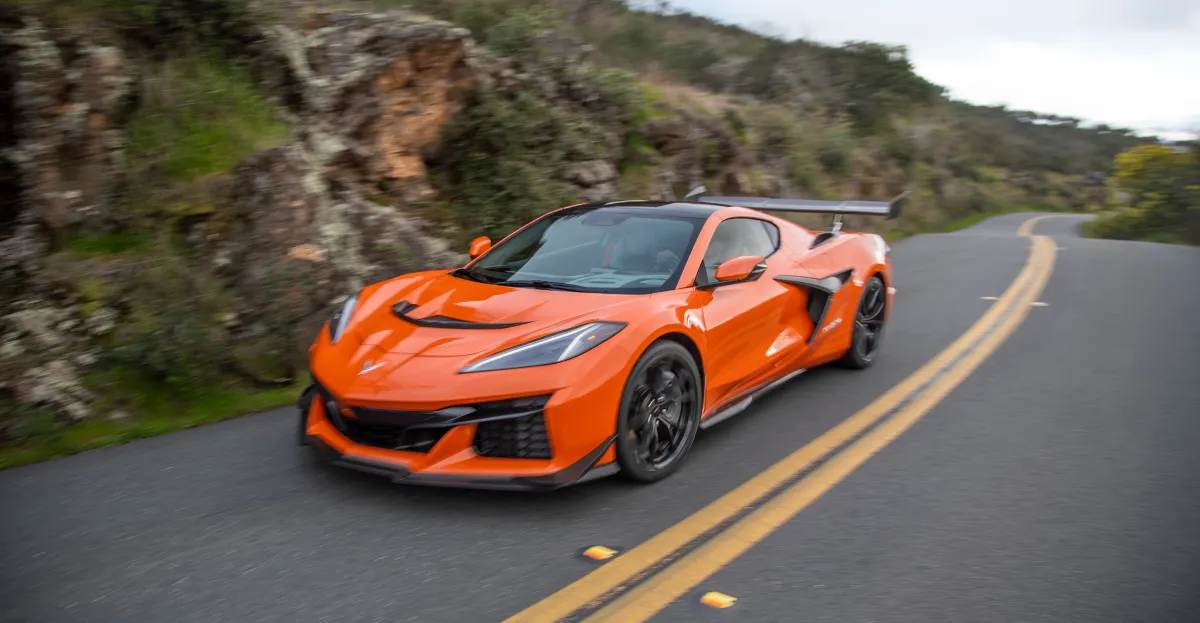
Nevertheless, the Corvette ZR1X hybrid – an astonishing, magnificent, and incredibly cost-effective option compared to its competitors – illustrates how electric propulsion is transforming elite performance categories, though not precisely as anticipated. This phenomenon extends to Formula 1 racing, with half of this season’s power derived from hybrid electricity. Particularly among supercars and hypercars, the absence of a hybrid enhancement means you are no longer competitive.
My evaluation of the ZR1X, conducted at Sonoma Raceway and throughout Napa Valley’s roadways, highlights the undeniable necessity of such electric assistance. Consider these figures, which might well bring tears to your eyes: 1,250 hybrid horsepower, a significant increase from the 1,064 of the purely gasoline-powered ZR1. An astonishing sprint from 0–60mph in merely 1.67 seconds, directly rivaling a $2.5 million Rimac Nevera R EV, and surpassing any Tesla or Lucid model.
An incredibly fast circuit of Germany’s renowned Nürburgring was completed in 6 minutes, 49 seconds, plus a little extra. This established a fresh American production-car benchmark, surpassed the Rimac by a notable 16 seconds, and narrowly edged out Porsche’s dedicated track model, the 911 GT3 RS. Furthermore, it decisively outpaced the Yangwang U9 extreme, a 3,000-horsepower, approximately $235,000 Chinese EV, which is arguably more a concept vehicle than a genuine “production car,” given that no more than 30 units will ever be constructed. The Yangwang registered an impressive 6 minute, 59-second lap, marking it as the first EV ever to complete a sub-seven-minute run at the ‘ring.
However, this is where Corvette’s extensive 73-year heritage in racing, culture, and engineering becomes crucial, encompassing nine production-class victories at the 24 Hours of Le Mans since 2020: The ZR1X, possessing less than half the Yangwang’s power, decisively defeated the globe’s quickest EV by a full 10 seconds, which is an immense duration in competitive racing. Moreover, Corvette’s dedicated, swift engineers – among them chassis engineer Drew Cattell, whom I found myself pursuing on Sonoma Raceway – have personally piloted the ZR1X to establish track records throughout North America and Europe, unlike the common practice of employing professional racing drivers by other vehicle manufacturers.
Although maximum velocities often serve more as boasts than practical daily applications, the Corvette’s 233mph maximum also surpasses numerous hybrid hypercars, be it the upcoming $3.7 million, 1,184hp Ferrari F80 or a $2.1 million, 1,258hp McLaren W1. Even the Lamborghini Temerario hybrid I recently experienced in Italy, featuring its potent 10,000rpm V8, exceeded $500,000 including optional extras. Furthermore, while many exceptionally rare models demand both considerable affluence and privileged access for purchase, this particular vehicle is available directly from your local Chevy dealership, with a starting price of $207,395, or an additional $10,000 for a ZR1X convertible.
Undoubtedly, it’s a significant sum for a Corvette, yet it represents a remarkable value when contrasted with the typical ultra-luxury vehicles favored by the super-rich. At less than half that cost, a Corvette E-Ray hybrid begins at $110,195, offering a robust 655 horsepower. A conventional Corvette C8 coupe, boasting 495 horsepower, commences at $71,995. Nevertheless, certain individuals will invariably desire the premium variant, whether for its superior performance or unique appeal.
During the challenging circuit at Sonoma Raceway, the ZR1X’s immense power and gravitational forces felt as though they could reconfigure my very molecules. Should this level of performance appear somewhat fantastical, I possess evidence: a memory card from the Corvette’s clever Performance Data Recorder, laden with video footage, lap durations, and various other telemetry details which I can scrutinize to enhance my subsequent attempts.
During the challenging circuit at Sonoma Raceway, the ZR1X’s immense power and gravitational forces felt as though they could reconfigure my very molecules
The ZR1X incorporates the 5.5-liter power plant found in the non-hybrid ZR1, coupled with an eight-speed, dual-clutch automatic transmission featuring elegantly formed carbon-fiber paddle shifters. This “Gemini” V8 represents the zenith of internal combustion engines, boasting a Ferrari-like flat crankshaft, titanium connecting rods, 1,064 horsepower, and a resonant 8,000-rpm redline. The meticulously assembled, twin-turbocharged engine is positioned directly behind my helmet-protected head and HANS device. This racing V8 is showcased beneath a ventilated, translucent cover, honoring the legendary split-window Sting Ray from 1963.
Located at the front, an enhanced electric motor delivers additional bursts of up to 186 horsepower and 145 pound-feet of torque, an increase of 26 horsepower and 20 pound-feet compared to the E-Ray. Similar to the E-Ray, no direct mechanical link exists between the petrol and electric propulsion systems. Rather, sophisticated software and an array of sensors continuously monitor vehicle metrics and driver actions. These systems manage and synchronize power delivery and traction between the internal combustion-driven rear wheels and the autonomous front axle, working seamlessly with the Corvette’s superb electronic limited-slip differential.
Another impressive feature involves the torque-vectoring systems, which enable the Corvette to accelerate out of Sonoma’s bends with an almost unparalleled quickness and precision, something no rear-wheel-drive automobile — not even the conventional ZR1 — could replicate. I don’t find myself perpetually attempting to straighten out corners, as was the case with the ZR1 I piloted at Circuit of the Americas in Austin, rushing to straighten the steering wheel to facilitate
unleash that immense force. Ultimately, the ZR1X proves to be more poised and agile through turns.
Even the Corvette’s expert engineers have been discussing the superior vehicle: the rear-wheel-drive ZR1 or the AWD hybrid ZR1X? However, they emphasize that driver confidence constitutes a vital component in achieving high speeds. Hesitation prevents peak velocity.
“The ZR1X exhibits a certain tractability, but advantageously so,” states Aaron Link, Chevy’s worldwide performance director. “One can achieve identical speeds without reaching the absolute limit or gripping the wheel intensely at all times.”
The motor delivers electric boosts resembling nitrous oxide at velocities reaching 160mph, surpassing the E-Ray’s 150mph. This increased speed limit enhances its drag-racing credentials, as the ZR1X can accelerate to almost 160mph over a quarter-mile distance. Automated launch control enables operators to fine-tune both the engine’s RPM and wheel slippage to optimize propulsion.
On a specially prepared, high-grip dragstrip next to Sonoma’s circuit, I activate the Corvette’s tire-warming sequence, generating plumes of rubber smoke while nearing the starting line to clear debris from the wide Michelin tires. My quarter-mile run concluded in 9.1 seconds—a respectable outcome. However, engineers in Michigan recorded an astounding 8.65-second quarter-mile time at 159.5mph.
A lithium-ion battery pack supplies the power, positioned low and centrally within the vehicle’s stiff aluminum chassis. At the track, an intriguing full-scale cross-section model illustrated the battery’s placement inside the center console, alongside other technological features. This compact unit possesses a capacity of 1.9 kilowatts, offering approximately 1.6 kilowatt-hours of usable energy, representing a 25 percent increase over the E-Ray. A total of eighteen radiators ensure optimal operational temperatures.
Similar to a typical Toyota Prius, no external charging cable is necessary. However, the primary objective here is excitement, not fuel economy or solely electric propulsion. The battery and motor are engineered for a singular purpose: to absorb significant amounts of regenerative braking energy, subsequently releasing it in bursts of 188 horsepower.
Energy recovery from kinetic motion is considerably more substantial on racing circuits, where the braking system undergoes extreme exertion. In addition to the electrical assistance, enormous conventional brakes—the largest ever installed on a GM vehicle, featuring custom 10-piston calipers and carbon-ceramic rotors—retard the ZR1X from immense velocities. The Corvette is capable of generating 1.9 Gs of intense deceleration, slowing from 180 to 120mph.
Despite its 495-horsepower V8 engine, a conventional Corvette can nearly achieve 30mpg during a relaxed highway journey. During an enthusiastic drive through Napa Valley’s verdant, rolling hills, the ZR1X registered 11mpg, with its overall average for the past 1,800 miles standing at 15.5mpg. However, efficiency figures are hardly the primary concern here. On the track, fuel consumption nears 4mpg, as the Corvette is capable of burning two gallons of fuel per minute at maximum throttle. (A larger fuel tank would genuinely benefit the ZR1X).
When operating on public thoroughfares, the swiftly responding battery’s charge level cannot be depleted below approximately 50 percent, irrespective of driving intensity. Activating a “Charge +” button on the steering wheel—an element of the intelligently enhanced interior present across all 2026 Corvette models—allows the ZR1X to swiftly rejuvenate its battery capacity within merely a few miles of typical driving.
Various specialized energy management tactics optimize the hybrid technology’s performance. An “Endurance” mode meticulously tracks and adapts energy reserves, guaranteeing that the electrified front wheels maintain steady power output and all-wheel-drive capability throughout an entire tank of fuel; losing either mid-lap or in a challenging turn would be undesirable. Conversely, a “Qualifying” mode unleashes a combined, maximum-effort surge from both conventional and electric power sources to achieve the quickest single-lap time.
“The ZR1X exhibits a certain tractability, but advantageously so.”
— Aaron Link, Chevy’s global performance manager
The refined cabin now incorporates three high-definition displays, including a fresh screen positioned to the left of the hexagonal, carbon-fiber-accented steering wheel. The prior “waterfall” arrangement of switches separating the driver and passenger, often considered the C8 Corvette’s most ostentatious element, has been supplanted by a carbon-fiber grab handle, which anxious co-pilots will surely value. The left-side touchscreen provides straightforward access to launch control, various performance metrics, and the advanced Performance Traction Management (PTM) system. This is fundamentally a gamified configuration that modifies stability and safety supervision according to the operator’s proficiency and boldness. The system cycles through “Wet,” “Dry,” “Sport,” “Race 1,” “Race 2,” and introduces a new “PTM Pro” mode, promising the most unadulterated and direct driving sensation. While PTM Pro deactivates all stability and traction controls, it preserves brake-derived energy regeneration, electric torque vectoring, and automated application of the inside front brakes to optimize traction upon corner exit.
Aerodynamic efficiency and thermal management are crucial for achieving high velocity and endurance, ranging from its eighteen heat exchangers to its various scoops, vents, and towering rear spoiler. This spoiler, a component of the optional ZTK Performance Package, is capable of producing 1,200 pounds of downforce at maximum speed, effectively adhering the Corvette to the road surface.
And while I’ve never particularly favored red Corvettes, I would make an allowance for the “red mist” paint finish, a stunning hue that evokes Sonoma pinot noir rather than a conventional fire-truck red.
Beyond the realm of exotic, dream vehicles, owners of more accessible performance automobiles have displayed scant enthusiasm for electric vehicles. Inquire of a characteristic Mazda Miata pilot whether they’d exchange their modest-powered but exhilarating roadster for a swifter Tesla; be ready for a robust retort. Proponents of EVs often dismiss or even downplay these concerns, yet devotees of sports cars recognize their validity: Substantial EV power packs and excessive unladen masses impede nimbleness. Compact, low-profile sports cars lack ample space for battery integration, necessitating a compromise between adequate travel distance and maneuverability. Furthermore, the lack of authentic auditory feedback and/or tactile experiences persists, prompting EV manufacturers to mimic engine noises and, at present, even simulated gear shifts.
Electric vehicle power units and systems that swiftly deplete their energy during vigorous operation — or become excessively hot and cease functioning completely after a few circuits — represent a distinct engineering hurdle. These difficulties will be progressively resolved, though we haven’t reached full resolution currently. Conversely, high-performance hybrid vehicles, spanning from these Corvettes to the newest Porsche 911, Lamborghini Temerario, and Ferrari 296 GTB, are commencing to sway even those doubtful of electric propulsion. These automobiles can perform robustly throughout the day on circuits or secluded mountain passes, refill their fuel reservoirs within a couple of minutes, and continue their journey.
Regarding the ZR1X, its ultimate electrifying advantage manifests as an F1-inspired ‘push-to-pass’ control, which coalesces every unit of energy and electrical output into a surging burst of might. This electrifying boost will prove beneficial should particular rivals draw alongside at a traffic signal or in a neighboring thoroughfare. Once those more arrogant high-performance vehicles eventually manage to keep pace, ZR1 proprietors can administer the decisive blow: Simply disclose the acquisition cost.
{content}
Source:{feed_title}