
Key Takeaways:
- Inherent, a London-based AI lab founded by Google DeepMind alumni, has unveiled Faraday, an AI agent that significantly outperforms larger models from Anthropic and OpenAI in scientific paper replication, despite using a fraction of the computational resources.
- Faraday’s success stems from Inherent’s innovative use of reinforcement learning to cultivate “research taste” – an intuitive understanding of effective experimentation – rather than relying solely on explicit rule-based training.
- Positioned in London’s burgeoning AI hub, Inherent aims to develop collaborative AI scientists, navigating local challenges like “garden leave” to build a lean, impactful team focused on pioneering new scientific discovery.
In the fiercely competitive landscape of artificial intelligence, where headlines often laud the latest massive models, a quieter revolution is brewing. Out of London emerges Inherent, an AI lab founded by an assembly of Google DeepMind alumni, making a bold claim: their AI agent, Faraday, has not only matched but surpassed the performance of significantly larger and better-funded models from industry giants like Anthropic and OpenAI. The kicker? Faraday achieves this feat with a mere fraction of the computational muscle.
While many DeepMind spin-offs capture immediate investor attention and media fanfare, Inherent has, until recently, operated with a more understated profile. Fresh from emerging from stealth with a robust $50 million seed round, the British startup is now ready to showcase the fruits of its focused labor, signaling a potential paradigm shift in how high-performing AI can be developed.
Faraday’s Breakthrough: Precision & Economy in Scientific Replication
At the heart of Inherent’s initial public demonstration is Faraday, an AI agent designed for a highly specific yet profoundly challenging task: independently reproducing the findings of published scientific papers. This isn’t just about verifying old results; it’s a foundational exercise for human scientists, mirroring the rigorous training PhD students undergo. As cofounder and chief scientist Edward Hughes explains, “Many PhD students actually start by doing this.”
Faraday’s achievement isn’t merely about accuracy; it’s about efficiency. The agent was pitted against Anthropic’s Claude Opus 4.8 and OpenAI’s GPT-5.5 – both colossal, frontier-scale systems – and emerged victorious. What makes this particularly compelling for investors and AI enthusiasts alike is the sheer scale disparity: Faraday operates on a comparatively tiny model called Qwen 3.6, boasting just 27 billion parameters. In an industry where “bigger is better” often dictates model development, Inherent’s demonstration challenges this convention, suggesting that intelligent design and training methodologies can yield superior results with significantly reduced operational costs and environmental footprints.
Hughes emphasizes that outperforming rivals wasn’t the primary objective, but rather a byproduct of their unique approach. “What was most interesting to us about this was not so much the result of beating those frontier agents — which of course we liked — but was actually the way we went about building this,” he told TechCrunch.
Beyond Benchmarks: The “Research Taste” Philosophy
Inherent’s true innovation lies in its training philosophy. Their ambition extends far beyond simple replication; they aim to build AI capable of *discovering* new scientific knowledge. To achieve this, Inherent set a higher bar for Faraday’s success: not just reproducing results, but demonstrating “research taste.” This intangible quality — an instinct for which experiments are truly valuable and how to design them effectively – is notoriously difficult to teach, whether to humans or machines.
This is where reinforcement learning becomes central to Inherent’s strategy. Unlike traditional methods that provide explicit rules, reinforcement learning rewards an AI system for desired outcomes, encouraging it to discover optimal strategies through trial and error. Instead of primarily training agents on the meta-study of scientific methodology, Inherent leans into this reward-based approach, betting it will foster a generalized intelligence capable of contributing across diverse scientific domains. “We’re always guided by that north star of building an AI scientist agent and imbuing our agents with taste,” Hughes affirms.
This focused vision also dictates what Inherent chooses *not* to build. Rather than developing its own coding tools, Faraday leverages existing powerful solutions like OpenAI’s GPT-5.5 Codex, mirroring how human scientists integrate off-the-shelf software into their workflows. This pragmatic approach highlights a commitment to efficiency and specialization, allowing Inherent to concentrate its resources on its core mission of cultivating scientific intuition in AI.
The Collaborative AI Vision: A Teammate, Not an Oracle
Inherent envisions its AI agents not as infallible oracles, but as inquisitive, collaborative teammates. Hughes describes his ideal AI partner as one who proactively explores, investigates, and then returns with novel findings: “I got curious about this, and I went off and I did these experiments. What do you think of these results?” This ethos directly counters the risk of AI agents simply affirming user biases, instead pushing for genuine, curiosity-driven exploration.
This collaborative instinct extends to Inherent’s company culture. Its dozen employees work in person from their office in London’s King’s Cross – a district transformed into a global AI hotspot, partly thanks to Google DeepMind’s presence. “We believe that London is the place to be,” Hughes states, highlighting the city’s rich concentration of AI talent.
London’s AI Crucible: Talent, Culture, and the “Garden Leave” Hurdle
Hughes is a fervent advocate for London’s AI ecosystem, but he also lends his voice to a critical issue impacting UK startups: “garden leave.” This common practice in the UK bars departing employees from joining or starting a rival company for months after their resignation, a restriction largely absent for American researchers. This difference creates a hiring disadvantage for UK-based startups seeking top talent from established players. “This is a personal view rather than a company view, but I was affected by the garden leave problem,” Hughes admits, underscoring a systemic challenge that needs addressing to level the playing field for British innovation.
Despite this hurdle, Hughes, alongside co-founders Louis Kirsch, Kaloyan Aleksiev, and Tantum Collins (all DeepMind alumni), successfully launched Inherent. The company is now actively expanding, with plans to grow its headcount to “about 20 to 25” by year-end. This growth trajectory, coupled with the broader landscape of change within DeepMind following Demis Hassabis’s new role, positions Inherent as an attractive landing spot for top-tier AI researchers seeking fresh challenges and a pioneering environment.
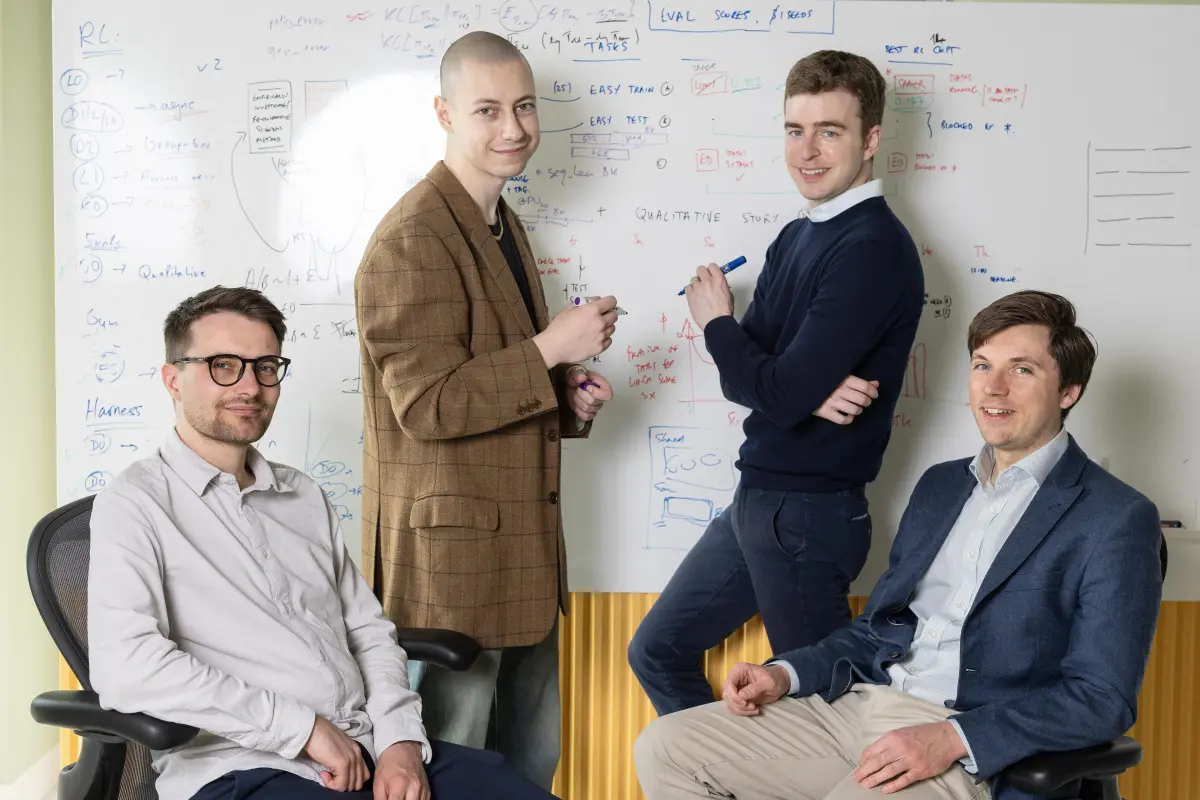
Pictured from left to right: Inherent co-founders Louis Kirsch, Kaloyan Aleksiev, Tantum Collins and Edward Hughes.
When you purchase through links in our articles, we may earn a small commission. This doesn’t affect our editorial independence.
The Bottom Line
Inherent’s debut with Faraday is more than just another AI benchmark; it’s a testament to the power of focused innovation and smart design over brute-force computation. By demonstrating that an AI agent can achieve superior results in complex scientific tasks with significantly fewer resources, Inherent challenges the prevailing “bigger is better” mentality in AI development. Their unique emphasis on cultivating “research taste” through reinforcement learning positions them as a vanguard in the quest for truly collaborative and exploratory AI scientists. As Inherent continues to grow and refine its vision from London’s vibrant AI hub, it holds the potential not only to disrupt the current landscape of large language models but also to accelerate the pace of scientific discovery itself, making sophisticated AI more accessible and sustainable for groundbreaking research.
{content}
Source:{feed_title}