
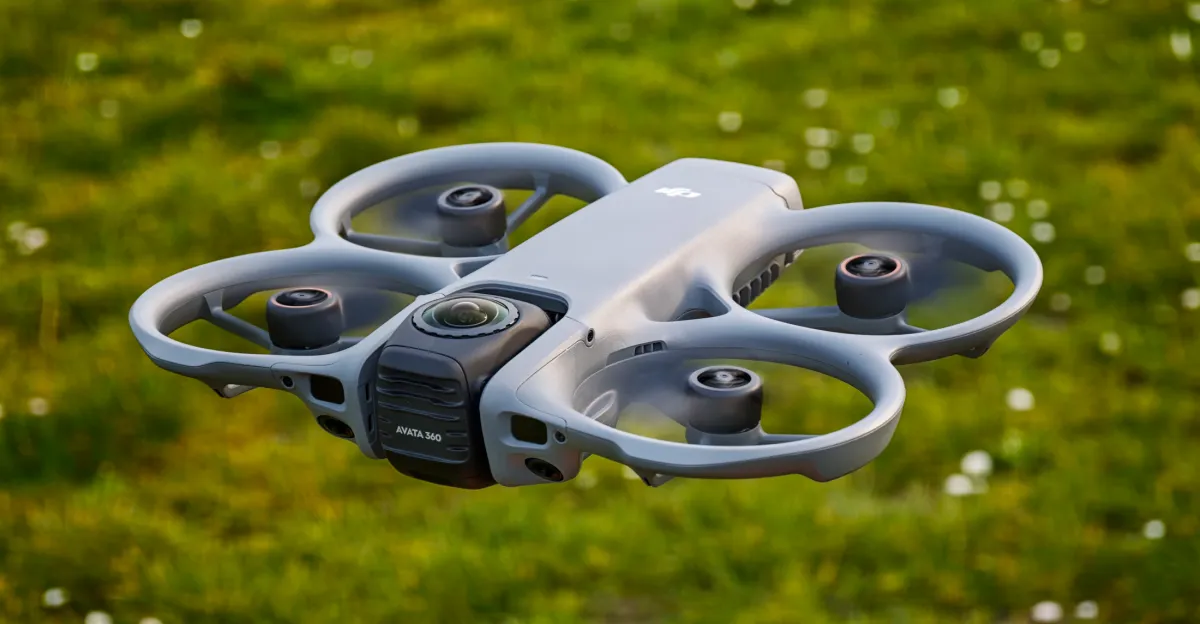
The introduction of DJI’s Avata 360 places the corporation at a peculiar juncture. For starters, it was preceded – newcomer Antigravity’s A1 emerged as the inaugural 360-degree unmanned aerial vehicle upon its debut last December, leaving DJI to strive to bridge the gap (and pursue legal actions). Furthermore, this drone might represent the final DJI model one can lawfully acquire in the United States, given the FCC’s practical embargo, and despite this, a formal launch within the nation is not anticipated.
Consequently, for individuals residing in the US, the Antigravity A1 continues to be the leading (and singular) choice for an aerial 360-degree imaging device. However, across the globe, the Avata 360 articulates a strong case: it boasts greater speed than the A1, functions dually as both a 360-degree drone and a customary FPV model, and presents control options via goggles and a motion controller, a familiar twin-stick layout, or a smartphone display. When factoring in that both of its primary lenses are (effortlessly) user-exchangeable, I anticipate that most pilots will gravitate towards DJI’s approach to this technology over Antigravity’s effort.
The Avata 360 is currently procurable in China, with dispatch to other locales anticipated to begin sometime in April. Its cost initiates at a mere £409 / €459 (roughly $540) for the drone by itself, a sum significantly below the $1,599 price tag of Antigravity’s most basic package, though that particular bundle does include a headset and a motion controller. DJI’s Motion Fly More Combo offers the nearest comparable option, featuring the Goggles N3, an RC Motion 3 controller, and supplementary batteries; even at £829 / €939 (approximately $1,100), it remains considerably more budget-friendly than the Antigravity. Nevertheless, the caliber of the head-mounted displays is a contributing element here: an official bundle incorporating DJI’s Goggles 3, which are a more direct equivalent to the Antigravity headset, is absent, and integrating those would bring the overall expenditure into closer alignment.
This entire discussion could prove an irrelevant consideration for residents of the US, where DJI harbors no intentions for a formal introduction of the product via its proprietary platform. This situation persists notwithstanding that the Avata 360 secured FCC authorization in December — making it the ultimate DJI drone to do so. Consequently, it will be permissible, and probably feasible, to procure the Avata 360 from international vendors and operate it within the US, a scenario likely not to repeat for any of DJI’s forthcoming drone releases. However, much like the recent Neo 2 and other contemporary drones, DJI itself will refrain from direct sales.


Expressed concisely, the Avata 360 bears considerable resemblance to the A1, the introductory drone from Insta360’s affiliated brand, Antigravity. It is a relatively compact, featherlight unmanned aerial vehicle, outfitted with twin lenses that coalesce to yield 8K, panoramic images and videos. These can be observed in their original state, or one may utilize the accompanying application to refine the recordings into conventional formats, thereby permitting the selection of any specific portion of the frame at will. It effectively serves as the aerial equivalent of ‘fixing it in post-production,’ allowing pilots to operate with less forethought and to deliberate on the captured material retrospectively.
Beyond this fundamental similarity, the two drones diverge considerably, prompting me to pilot both units concurrently for a direct comparison. The Avata 360 is more substantial, weighing 455g, a factor critically placing it significantly above the 250g threshold that influences aeronautical statutes in numerous nations. It is also larger, possessing a rigid frame, in contrast to the collapsible A1. This, however, confers certain benefits: integrated rotor protectors, for instance, which render this a more resilient unmanned aerial vehicle should mishaps occur. It is also capable of traversing greater distances (reaching up to 20km / 12 miles under optimal circumstances, twice the A1’s maximum operational radius) and is more rapid (achieving a peak velocity in sport mode of 18m/s or 40mph, an additional 2m/s or 5mph, which assists in mitigating the A1’s somewhat buoyant, sluggish flight sensation). Power cell endurance is largely comparable, with a stated 23 minutes of aerial operation for the 360, and 24 for the A1.
1/4
DJI’s drone holds a minor advantage regarding its video fidelity, featuring more substantial
camera sensors, broader aperture optics, and the capacity to leverage its complete 8K definition at 60 frames per second. In contrast, the Antigravity’s 8K capture is limited to 30fps, diminishing to 5.2K if 60fps is desired. However, the primary benefit of the Avata 360 lies in its versatility. While the A1 canexclusivelybe employed for 360-degree filming due to its stationary dual cameras, the Avata 360’s imaging devices revolve on a rotating stabilizer. This enables the drone to point a single optical component forward for a more conventional first-person view encounter. When operating with one lens, the A1 records at a maximum of 4K and 60fps, trimming the view to provide visuals in common 4:3 or 16:9 aspect ratios, thereby preventing any optical aberrations at the periphery of the picture caused by the exceptionally broad lens. I have not sufficiently tested DJI’s more adept single-lens drones to ascertain how precisely the visual fidelity compares, though I speculate they will still outperform it. Nonetheless, at first blush, the Avata 360’s single-optic alternative does not feel like a diminished experience.
To fully utilize the FPV mode, the 360 also harmonizes with a variety of operational approaches: you can employ the DJI mobile application on your smartphone, a proprietary remote control (the RC 2 is included in some bundles), or a headset and gesture-based control configuration. Novices may particularly appreciate the Antigravity-style 360-degree, enveloping journey with motion controls, where one can mostly navigate freely through the air. You can gaze in one direction while the unmanned aerial vehicle proceeds in an alternative path, facilitated by straightforward tap-and-select commands. This provides assurance that you will have captured everything and can select and review afterward. Piloting either UAV in this manner seems remarkably simple and instinctive, with no requirement to master intricate commands — you can essentially ascend and operate (albeit after a slight struggle with initiating and linking each component of the configuration individually, which persists as an annoyance). However, DJI’s UAV also permits you to acquire a dual-joystick remote and transition to single-optic operation for more sophisticated piloting and complete command of the imaging device — Antigravity’s aerial vehicle has been consistently pledged compatibility with a dual-stick gamepad, but it has not yet appeared.


The Avata 360 additionally presents another notable enhancement: optics that can be swapped by the user. The external component of each of the drone’s two principal lenses can be extracted and substituted in the event of harm, a procedure I managed to accomplish in under five minutes. It requires only the fundamental implements provided in DJI’s £25 / €25 (approximately $30) kit, and though it might be slightly intricate, it is not technologically complex whatsoever. This represents a rather substantial improvement for the maintainability of the UAV, and one we’ll hopefully expect to observe again in future DJI aerial vehicles.

Panoramic video content can be post-processed within DJI’s application, which provides a reasonably user-friendly, novice-oriented method to navigate rapidly and generate brief segments and standout moments, though it will evidently demand some expertise to yield more refined output. After multiple years, DJI’s application overall continues to be a problematic aspect, at least specifically on Android: it is inaccessible in the Play Store, appears to arbitrarily alternate between portrait and landscape orientation, and has crashed each instance I’ve engaged the screen on the Oppo foldable phone I’m currently evaluating. Given that Antigravity has only launched a single UAV, it is somewhat shameful that its software appears more refined than the other’s.
Nevertheless, in nearly all other aspects DJI currently holds the upper hand — at least beyond American borders. Unless you steadfastly
{content}
If one requires a more compact, agile unmanned aerial vehicle weighing under the 250g threshold, it becomes challenging to vindicate expending additional funds for Antigravity’s product. While its associated application is marginally superior, and its head-mounted display more ergonomic and comprehensive in features, the DJI model’s blend of robust capabilities, adaptability, and ease of maintenance will likely counterbalance these benefits for the majority of users. However, do not anticipate this particular item appearing readily on the displays of your nearby Best Buy retail outlet.
Imagery captured by Dominic Preston for The Verge publication