
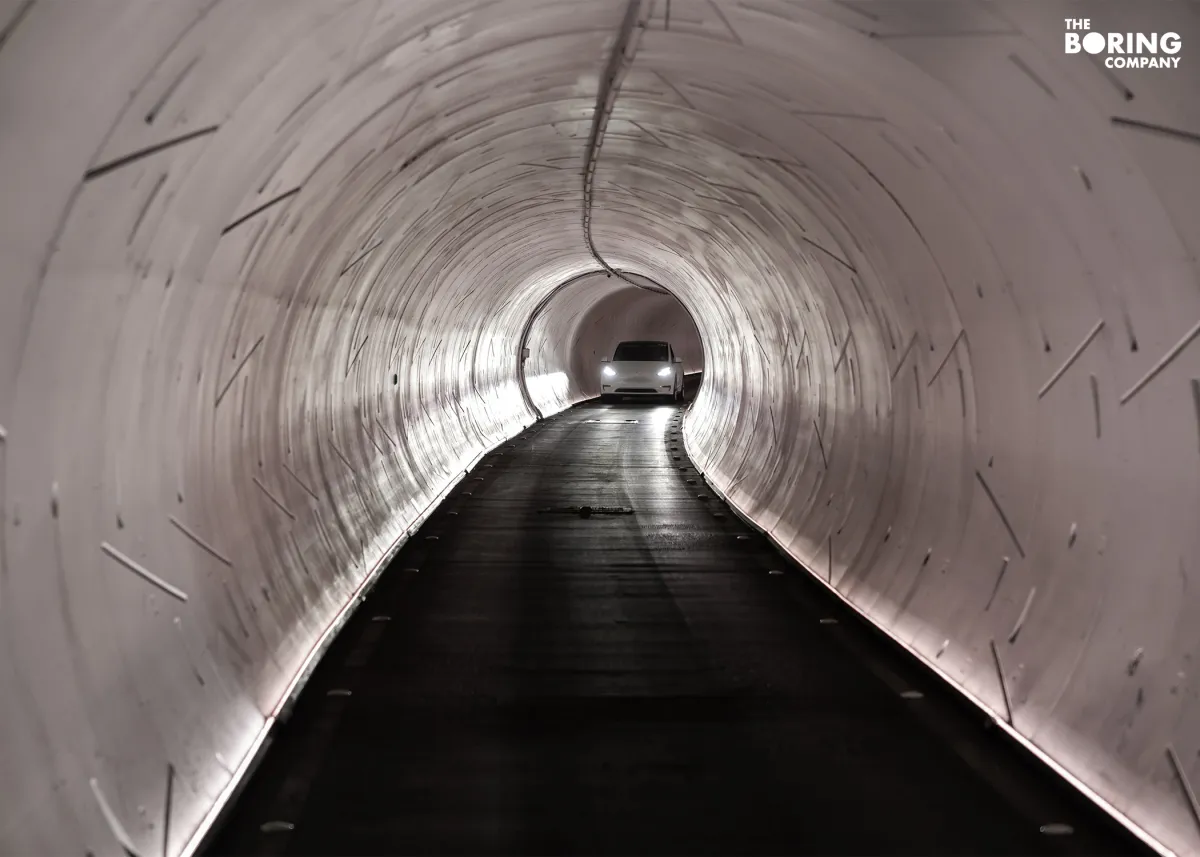
Elon Musk’s tunneling startup The Boring Company is in talks to raise a $4 billion funding round at a valuation of $20 billion, according to The Wall Street Journal.
The deal hasn’t closed and the terms could change, the WSJ says. At $20 billion, the valuation would be a significant increase from The Boring Company’s $5.7 billion valuation in 2022.
The startup has already built a network of tunnels under Las Vegas, through which Teslas shuttle customers to different stations. But tunnel workers have suffered serious injuries, and Nevada regulators said last year that The Boring Company violated environmental regulations nearly 800 times.
The Boring Company has announced plans to build tunnel networks under Nashville and Dubai. The WSJ says the startup has also pitched projects in Baltimore, Chicago, and Los Angeles.
The startup spun out of SpaceX in 2018. SpaceX recently had the largest IPO ever, but its stock price has taken a significant dip since then.
{content}
Key Takeaways:
- **Valuation Soars Amidst Challenges:** The Boring Company is reportedly seeking a $4 billion funding round, potentially valuing the startup at $20 billion – a nearly four-fold increase since 2022, despite documented operational setbacks and regulatory issues.
- **Operational Hurdles in Vegas Loop:** While the Las Vegas tunnel network is functional, the company faces scrutiny over serious worker injuries and nearly 800 environmental violations, raising questions about safety and compliance standards.
- **Ambitious Global Expansion Plans:** With projects planned for Nashville and Dubai, and pitches in major U.S. cities, The Boring Company continues to pursue its vision of transforming urban transport, though each new venture will likely face intense regulatory and public scrutiny.
The Boring Company Eyes $20 Billion Valuation Amidst Tunnel Vision and Turbulence
Elon Musk’s ambitious tunneling venture, The Boring Company (TBC), is reportedly on the cusp of a major financial milestone, with talks underway for a $4 billion funding round that could skyrocket its valuation to an astounding $20 billion. This potential infusion of capital, first reported by The Wall Street Journal, would mark a nearly four-fold increase from its $5.7 billion valuation in 2022, signaling a robust investor appetite for Musk’s vision of underground transportation – even as the company navigates significant operational hurdles and regulatory controversies.
A Valuation Surge for a Subterranean Dream
The reported $20 billion valuation, if finalized, places The Boring Company firmly among the most valuable private infrastructure and tech startups globally. This figure reflects an extraordinary belief in the long-term potential of TBC’s technology and its promise to revolutionize urban mobility by alleviating surface-level traffic congestion through a network of high-speed underground tunnels. Such a valuation leap, particularly in a landscape often cautious of capital-intensive infrastructure projects, underscores the “Musk premium” – the willingness of investors to back ventures associated with the visionary, albeit controversial, entrepreneur.
The funds raised would undoubtedly fuel TBC’s ongoing research and development into more efficient tunneling technologies, alongside accelerating its expansion plans. Faster, cheaper tunnel boring is the company’s core technological promise, aiming to drastically reduce the cost and time traditionally associated with underground construction. This capital would be crucial for scaling up operations, securing permits for new projects, and navigating the complex engineering challenges inherent in subterranean development.
The Las Vegas Loop: A Glimpse into the Future, and Its Faults
The Boring Company’s most tangible achievement to date is the operational network of tunnels beneath Las Vegas. Dubbed the Vegas Loop, this system utilizes modified Tesla vehicles to shuttle passengers between convention centers and hotel properties, offering a glimpse into TBC’s proposed solution for urban gridlock. While the system functions as a proof-of-concept, demonstrating the viability of moving people underground, its deployment has not been without significant challenges and criticisms.
Reports have surfaced detailing serious injuries sustained by tunnel workers during construction. The inherent dangers of underground excavation, coupled with the rapid pace of TBC’s operations, raise pressing questions about workplace safety protocols and the company’s adherence to industry best practices. These concerns are further exacerbated by allegations from Nevada regulators last year, which accused The Boring Company of nearly 800 violations of environmental regulations. Such a high number of infractions points to potential issues with waste management, groundwater protection, and other critical environmental safeguards, impacting both public perception and the company’s ability to secure future project approvals.
These operational and regulatory challenges in its flagship project highlight the significant gap that often exists between ambitious technological visions and the ground-level realities of execution. While the Vegas Loop demonstrates technical capability, the reported issues underscore the critical importance of safety, environmental stewardship, and regulatory compliance in large-scale infrastructure development.
Tunneling Towards Global Expansion
Despite the headwinds, The Boring Company remains undeterred in its global ambitions. The company has already announced concrete plans to develop tunnel networks in Nashville, Tennessee, and Dubai in the United Arab Emirates. These projects signify TBC’s intent to expand its footprint beyond the relatively contained environment of the Las Vegas Convention Center, tackling more complex urban landscapes and regulatory frameworks.
Beyond these announced ventures, the WSJ report indicates that TBC has actively pitched projects in major U.S. metropolitan areas, including Baltimore, Chicago, and Los Angeles. Each of these cities presents unique geological, logistical, and political challenges that would test the limits of TBC’s technology and project management capabilities. Securing permits, navigating local opposition, and integrating with existing public transportation infrastructure will be monumental tasks, requiring not just engineering prowess but also significant community engagement and political savvy.
The Broader Musk Ecosystem and Investor Sentiment
The Boring Company’s journey is intrinsically linked to the broader ecosystem of Elon Musk’s ventures. Spun out of SpaceX in 2018, TBC benefits from shared engineering talent and a similar culture of audacious innovation. However, the fortunes of one Musk company can sometimes ripple through the others. While SpaceX recently commanded significant headlines for its record-breaking private valuation, its stock price has reportedly experienced a significant dip since its peak, reflecting the volatile nature of even the most successful private enterprises in the current economic climate.
This broader context is crucial for understanding investor sentiment towards TBC. While the reported $20 billion valuation suggests strong confidence, the long-term sustainability of such high valuations for capital-intensive, infrastructure-focused companies will depend not only on technological breakthroughs but also on consistent operational excellence, robust safety records, and seamless regulatory compliance. Investors are betting not just on tunnels, but on Musk’s ability to overcome seemingly insurmountable obstacles.
Bottom Line:
The potential $20 billion valuation for The Boring Company reflects an extraordinary faith in Elon Musk’s vision to fundamentally alter urban transportation through subterranean networks. While the capital injection would undoubtedly accelerate its ambitious global expansion, the company’s journey is fraught with significant practical challenges, including documented worker safety incidents and environmental violations in its existing operations. This proposed funding round represents a high-stakes gamble on the future of infrastructure, where the promise of a traffic-free tomorrow must contend with the complex realities of building it safely, sustainably, and within regulatory bounds. The ultimate success of The Boring Company will hinge on its ability to bridge this gap, proving that its tunnels can deliver not just speed and efficiency, but also responsibility and reliability.
Source:{feed_title}