
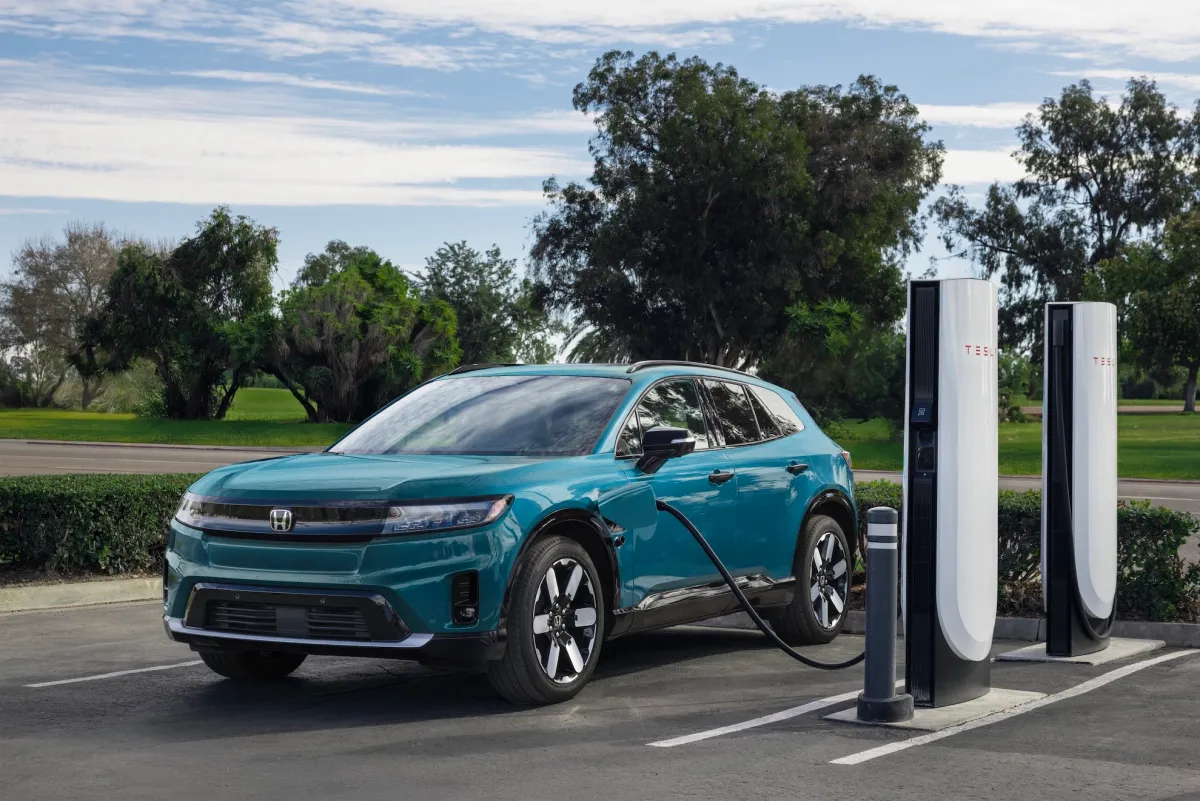
The U.S. electric vehicle market is witnessing a notable contraction, with several models exiting or failing to launch, a stark contrast to global EV growth. This trend, spearheaded by the confirmed end of the Honda Prologue, signals a complex interplay of economic headwinds, policy shifts, and evolving consumer sentiment. Automakers are recalibrating their strategies, often prioritizing localized production and higher-margin offerings amid fierce competition and geopolitical pressures.
Key Takeaways:
- U.S. EV Market Retreat:The confirmed discontinuation of the Honda Prologue, alongside other model exits, underscores a significant backpedaling of EV offerings in the U.S., setting it apart from more robust global EV markets.
- Multi-Factorial Pressures:This contraction is driven by a confluence of factors including the expiration of the $7,500 federal tax credit, rising tariffs, shifting consumer preferences, high production costs, and critical company strategic realignments.
- Strategic Recalibration:Automakers are increasingly focusing on local production (e.g., Hyundai’s Ioniq 5/9 vs. 6), higher-end niche markets (Hyundai N-model), or are being forced out by geopolitical/regulatory hurdles (Polestar), indicating a more cautious and localized approach to the U.S. EV landscape.
The Great American EV Exodus: Why Models Are Retreating from U.S. Shores
The news landed like a muffled thud in the burgeoning world of electric vehicles: The Honda Prologue, once a beacon of the Japanese automaker’s renewed EV ambitions, is officially dead. Honda confirmed the decision to TechCrunch, effectively removing the last remaining all-electric vehicle from its U.S. portfolio. But the Prologue’s quiet departure is more than just a corporate pivot; it’s a potent symbol of a broader, more concerning trend: a significant retreat of electric vehicle options from the U.S. market, charting a course conspicuously distinct from the surging EV adoption seen in many other parts of the world.
This phenomenon compels us to ask: What exactly is driving this winnowing of choices? Why, at a time when climate concerns are paramount and technological advancements are accelerating, are so many promising — and even established — EV models packing up their chargers and leaving American showrooms?
The Shifting Sands of the U.S. EV Market
The U.S. EV market is proving to be a unique beast, evolving under a distinct set of pressures that differ significantly from those impacting Europe or China. While global EV sales continue their upward trajectory, the American landscape is characterized by a more hesitant consumer base, volatile policy support, and intricate geopolitical forces.
Policy Whiplash and Economic Headwinds
One of the most immediate and impactful catalysts for the recent slowdown has been the cessation of the $7,500 federal tax credit in Fall 2025. This incentive, while effective in stimulating early adoption, left a void that exposed the underlying price sensitivity of American consumers. For many, the premium commanded by EVs, even with long-term fuel savings, remains a significant barrier without direct financial encouragement.
Beyond policy, a complex web of economic factors is at play. Tariffs, particularly those impacting vehicles and components from certain regions, have inflated costs for imported EVs, making them less competitive. Changing consumer tastes also contribute; while early adopters embraced new tech, the mainstream buyer often demands comparable range, faster charging infrastructure, and a price point competitive with traditional internal combustion engine (ICE) vehicles. Furthermore, the sheer cost of developing and manufacturing EVs, combined with intense competition and company-specific priorities, forces automakers to make tough strategic decisions about which models to prioritize and where to sell them. Regulatory actions, both domestic and international, further complicate the landscape, sometimes creating barriers to market entry or sustained sales.
Data Dives and Discrepancies
The numbers paint a clear, albeit nuanced, picture of this challenging environment. According to data published in July by Kelley Blue Book and Cox Automotive, 247,226 EVs were sold in the second quarter of 2026, representing about 5.8% of the total market. While this indicates a growth in sales between the first and second quarters of 2026, it’s crucial to note that these figures are still significantly down from the same period last year – and critically, from before the federal tax credit ended in late 2025.
The market’s sensitivity to incentives is starkly revealed by past performance. Fourth-quarter 2025 sales were a concerning 36% lower than the same period in 2024. While there are signs of a slow recovery – with the gap narrowing in 2026 – the market has yet to regain its previous momentum. For example, EV sales in Q2 2026 were still 20.5% lower than the same period in 2025, suggesting that while the steepest declines might be over, a full rebound is far from guaranteed. Even amidst this cautious recovery, many automakers are opting to pull the plug on specific EV models, deeming them unviable in the current U.S. climate.
The Departing Class of 2026: A Roll Call of Retreats
The list of EVs that have left or are leaving the U.S. market in 2026 is growing, reflecting a diverse set of reasons from unfulfilled promises to geopolitical trade-offs. TechCrunch will periodically update this list, but for now, here are the notable departures:
Afeela: The Vision That Never Was
Ah, Afeela. We barely knew ye. The brand itself became a ubiquitous presence at tech shows and marketing events, yet never materialized into a tangible product for consumers. It began its life as the Vision S, a prototype that made a splash at the 2020 Consumer Electronics Show, surprising many by demonstrating Sony’s unexpected foray into automotive tech. Honda entered the picture in 2022, forming a joint venture that promised to fuse Sony’s software prowess with Honda’s manufacturing might. The Afeela-branded prototype debuted the following year, generating considerable buzz, even making an appearance at TechCrunch Disrupt.
Despite a constant barrage of updates and a high-profile marketing blitz that kept the Afeela seemingly “everywhere and yet nowhere,” the joint venture ultimately gave up on bringing its two Afeela-branded EVs into production by March 2026. This decision closely followed Honda’s broader announcement just two weeks prior, signaling a major retrenchment of its U.S. EV plans.
Honda’s Full-Throttle Reverse: Prologue, O Series, and Acura RDX

It wasn’t long ago that Honda was trumpeting its EV ambitions with the bold “O Series,” unveiling a sleek mid-sized SUV prototype at CES 2025 and futuristic Saloon and Space-Hub concepts the year prior. The SUV, slated for production at Honda’s dedicated “EV Hub” factory in Ohio, was positioned to spearhead Honda’s North American EV push in the first half of 2026. However, these visions quickly evaporated.
In March 2026, Honda abruptly halted development of the Acura RDX, Honda O sedan, and O SUV as part of a comprehensive overhaul of its EV strategy. The company explicitly cited U.S. tariffs and intense competition from Chinese manufacturers as primary drivers for this drastic decision. While rumors of the Prologue’s demise circulated then, official confirmation didn’t come until July 16, with CarBuzz first reporting the program’s end, a fact later confirmed by TechCrunch with Honda.
The “death” of the O Series is difficult to quantify in terms of market impact, as it never reached production. The Prologue, however, represented a more tangible, grounded effort. Developed in partnership with General Motors and built at GM’s Ramos Assembly Plant in Mexico, it shared a platform with the Chevrolet Blazer EV. The Prologue had a decent run, selling approximately 33,000 units in 2024 and 39,000 in 2025. But with the end of the federal tax credit, sales plummeted, making its discontinuation a significant blow, marking the complete removal of Honda’s U.S.-specific electric vehicle offerings.
Hyundai’s Strategic Shuffle: The Ioniq 6’s Tariff Troubles

The Korean automaker, Hyundai, has generally been quite successful in selling EVs to Americans, particularly with its Ioniq 5 and upcoming Ioniq 9 models, which benefit from local assembly at its Georgia factory. However, even Hyundai hasn’t been immune to the shifting economics of the U.S. market. In March, the company announced it would no longer sell the standard Hyundai Ioniq 6 in the U.S. This decision was largely tied to the impact of tariffs, as the Ioniq 6 is manufactured in South Korea and imported, thus incurring additional costs that locally produced models avoid. In a strategic concession to enthusiasts, Hyundai stated it would continue to import its more expensive, lower-volume N-model of the Ioniq 6, recognizing its niche appeal and higher profit margins.
Nissan’s Quiet Exit: The Ariya’s Brief American Chapter
Nissan, an early pioneer in the EV space with its Leaf hatchback over a decade ago, decided last year not to produce a 2026 model year of its all-electric Ariya SUV for the U.S. market. And there are currently no indications of its return. The Ariya was first unveiled in 2020 and was intended to be Nissan’s flagship all-electric SUV, following in the Leaf’s innovative footsteps. Its quiet discontinuation for the U.S. signals a significant pause or recalibration in Nissan’s American EV strategy, leaving a gap where a promising successor once stood.
Polestar’s Forced Departure: Caught in the Geopolitical Crosshairs

The Swedish EV maker Polestar, majority-owned by Chinese automotive giant Geely, faces a unique predicament, distinct from market demand issues. Polestar has effectively been forced to cease new imports into the U.S. due to the country’s increasingly stringent ban on Chinese-connected vehicle technology. To continue importing and selling its vehicles, Polestar would require specific authorization from the U.S. Department of Commerce—authorization that has not been granted. This regulatory hurdle, rather than consumer disinterest, is the primary driver behind its effective ban. While the company stated it would continue selling its existing stock of Polestar 3 and Polestar 4 vehicles in the U.S., and crucially, “continue to support customers, including providing access to its service network,” its future new model pipeline for America remains severely restricted unless the geopolitical winds shift. This situation highlights how broader international relations can directly impact the availability of specific EV models in a given market.
What Does This Mean for the U.S. EV Landscape?
The departure of these models paints a concerning picture for the diversity and pace of EV adoption in the United States. For consumers, it means fewer choices, potentially limiting access to a wider range of price points and vehicle types. For the industry, it underscores the fragility of growth when faced with inconsistent policy, economic pressures, and geopolitical tensions. While new entrants like the Rivian R2 are generating excitement, their arrival can’t fully offset the systematic retreat of established models.
This trend could lead to a more concentrated market, potentially dominated by domestic manufacturers or those with established U.S. production facilities that can bypass tariffs and qualify for local incentives. It raises questions about the U.S.’s commitment to its climate goals if EV options dwindle. The contrast with aggressive EV growth in other global markets suggests the U.S. might fall behind in the global transition unless a more stable and supportive ecosystem for electric vehicles is established.
Bottom Line
The American EV market is at a critical juncture, navigating a complex landscape where ambition clashes with economic reality and geopolitical strategy. The exit of models like the Honda Prologue and the Ioniq 6, alongside the never-quite-realized Afeela and the geopolitically constrained Polestar, signals a necessary recalibration for automakers. This isn’t necessarily a death knell for EVs in the U.S., but rather a painful adjustment period where only the most strategically aligned, cost-effective, and locally supported models are likely to thrive. For the U.S. to accelerate its EV transition, a more cohesive approach to policy, infrastructure, and consumer incentives will be essential, ensuring that the promise of electric mobility remains accessible and attractive to the broader American public.
Navigating the New Reality: Automakers Rethink EV Strategies Amidst Shifting Tides
The electric vehicle (EV) revolution, once a seemingly unstoppable force, is entering a new, more nuanced phase. Automakers are no longer just racing to electrify; they’re strategically re-evaluating their portfolios, pausing production of certain models, and even pivoting focus towards entirely new technological frontiers. This comprehensive overview explores the significant shifts underway at industry giants like Tesla, Volkswagen, Volvo, and Polestar, revealing a complex landscape where profitability, market demand, regulatory hurdles, and advanced tech aspirations are reshaping the future of mobility.
Key Takeaways
- Strategic Realignment in EVs:Major automakers like Tesla, Volkswagen, and Volvo are actively discontinuing or pausing specific EV models, signaling a strategic pivot away from certain segments or towards new technologies like AI and autonomy.
- Beyond Traditional EVs:While some EV models face production halts or market withdrawals due to shifting consumer demand or regulatory hurdles (e.g., Polestar in China), companies are simultaneously investing heavily in future tech such as robotaxis (VW) and humanoid robots (Tesla).
- Focus on Profitability & Niche Segments:These decisions underscore a renewed emphasis on profitability and efficiency within the EV transition, with manufacturers consolidating production, optimizing inventories, or narrowing their EV offerings to more lucrative or strategically important segments.
Tesla: From Luxury EVs to Robotic Ambitions

Tesla, the trailblazer of the modern EV era, recently made headlines with a significant strategic pivot: the discontinuation of its flagship luxury sedan, the Model S, and its SUV counterpart, the Model X. Announced in January, the company ceased production of these iconic vehicles, which had long defined Tesla’s premium image and technological prowess. The last Model S and Model X vehicles rolled off the assembly line this spring, marking the end of an era for two models that once captivated the automotive world.
This move isn’t merely about phasing out older models; it’s a dramatic re-prioritization aligned with CEO Elon Musk’s vision for the company’s future. In Tesla’s view, the future isn’t just traditional electric sedans or SUVs, but rather a profound embrace of artificial intelligence, full autonomy, and robotics. The practical manifestation of this vision is already underway: the company recently removed the assembly lines for the S and X at its Fremont, California factory to make room for the production of its Optimus humanoid robots.
It’s worth noting that the sales trajectory of the Model S and Model X had been steadily declining over the years, as consumer preference shifted towards Tesla’s higher-volume, more affordable vehicles like the Model 3 sedan and Model Y SUV. This decline made the strategic decision to reallocate factory space and resources to more futuristic endeavors a logical, if bold, step. By shedding lower-volume, higher-cost production, Tesla aims to free up capital and focus its engineering might on what it believes will be the next frontier of innovation, potentially unlocking new revenue streams far beyond conventional vehicle sales.
Volkswagen’s Strategic Re-Evaluation: ID.4 and the Buzz about Autonomy

German automotive behemoth Volkswagen is also recalibrating its EV strategy, pulling back on the ID.4 electric SUV and placing its retro-inspired ID. Buzz microbus on hiatus. These decisions highlight the complex challenges faced by legacy automakers in balancing aggressive EV targets with market realities and the need for profitability.
In April, Volkswagen announced a significant shift in its U.S. production strategy: it would no longer produce the ID.4 at its Chattanooga, Tennessee factory. This decision is part of a broader move to prioritize the production of high-volume internal combustion engine (ICE) vehicles, such as its popular gas-powered Atlas SUV, which continues to see strong demand. While U.S. customers will still be able to purchase the ID.4 until current inventory runs out – an inventory VW expects to last into 2027 – the cessation of domestic production marks a clear step back for the model in the American market. This adjustment suggests Volkswagen is optimizing its manufacturing footprint to align more closely with immediate consumer demand, even if it means temporarily slowing its EV localization efforts.
Adding to this strategic shuffle, the much-anticipated ID. Buzz, a modern electric homage to the classic VW microbus, is merely on a hiatus, with no 2026 model planned. Volkswagen has stated that the ID. Buzz will return in 2027, implying a temporary pause rather than a full discontinuation. This hiatus could be attributed to various factors, including production adjustments, supply chain optimization, or a desire to fine-tune the vehicle’s market positioning before a broader re-launch.
Interestingly, while the consumer-facing ID. Buzz takes a break, its autonomous variant is full steam ahead. Self-driving versions of the ID. Buzz are currently being rigorously tested in the United States. Volkswagen subsidiary MOIA America, in partnership with Uber, commenced testing autonomous microbuses in Los Angeles in April. This initiative is a critical preparatory step for a planned robotaxi service, which is slated to launch in late 2026. Initially, these autonomous vehicles will operate with human safety operators onboard, gradually transitioning to fully driverless operations as regulatory frameworks and technological capabilities mature. This dual approach—pausing consumer models while accelerating autonomous solutions—underscores a split strategy within VW: addressing current market demand for traditional vehicles while simultaneously investing heavily in future mobility services.
Volvo & Polestar: Navigating Niche Markets and Regulatory Hurdles

Volvo Cars and its performance EV sibling, Polestar—both owned by the Chinese automotive giant Geely—are also making significant adjustments to their EV strategies, each facing unique challenges in different markets.
Polestar, which operates as a distinct brand under Geely’s umbrella, recently encountered a regulatory setback in China. The company lost its authorization to sell vehicles in Chengdu, a major metropolitan hub. This is a significant blow for Polestar, as the Chinese market is crucial for EV growth and global ambitions. The reasons behind this specific authorization withdrawal are not fully detailed in the provided context, but such regulatory hurdles can severely impede market entry and expansion for any automotive brand. In contrast, Volvo Cars, Polestar’s sibling company, did successfully receive the necessary authorization to sell its vehicles in Chengdu, highlighting the intricate and sometimes unpredictable nature of navigating regional regulations within the vast Chinese market.
Meanwhile, Volvo itself has made a notable adjustment in the U.S. market. In March, the company decided to pull its subcompact EX30 and its Cross Country variant from the United States. Volvo announced at the time that production for the U.S. market would cease after the summer. This decision came despite the EX30 having generated considerable buzz and anticipation prior to its official entry into the U.S. in 2025. It was positioned as Volvo’s more affordable EV option, expected to broaden its appeal and capture a larger segment of the burgeoning compact EV market.
The exact reasons for this withdrawal are likely multifaceted, possibly including intense competition in the compact EV segment, a strategic re-focus on higher-margin vehicles, or a need to streamline its product offerings. Despite the promising initial reception, Volvo appears to be consolidating its U.S. EV strategy around larger, more premium models. The company does plan to continue selling the larger, all-electric EX60 and EX90 SUVs in the United States, signaling a clear intent to target the luxury and family SUV segments, where profitability margins are typically more robust. This pivot suggests a cautious approach, prioritizing established market segments and potentially higher revenue per unit over aggressive expansion into the increasingly crowded subcompact EV space.
The Road Ahead: What These Shifts Mean
The collective decisions by Tesla, Volkswagen, Volvo, and Polestar paint a vivid picture of an EV market in transition. This isn’t a sign of the EV revolution stalling, but rather maturing and diversifying. Companies are moving beyond a “build it and they will come” mentality, instead focusing on strategic profitability, market differentiation, and the integration of advanced technologies.
For consumers, these shifts mean a more refined, albeit potentially narrower, selection of electric vehicles in certain segments. It also signals an acceleration towards a future where vehicles are not just electric, but also highly autonomous and increasingly integrated with AI-driven services. The industry is grappling with the complexities of scaling EV production, managing supply chains, and meeting diverse regulatory demands, all while simultaneously investing in next-generation mobility solutions like robotaxis and humanoid robots.
The strategic pauses and re-prioritizations reflect a pragmatic approach by automakers to navigate an intensely competitive and capital-intensive landscape. While the path to a fully electrified and autonomous future remains challenging, these companies are demonstrating a willingness to make tough decisions, shed underperforming assets, and boldly invest in what they believe will be the definitive technologies of tomorrow.
Bottom Line
The automotive industry is in a profound state of transformation, as major players like Tesla, Volkswagen, Volvo, and Polestar strategically prune their EV lineups and pivot resources towards autonomy, AI, and robotics. This realignment underscores a growing emphasis on profitability and future-forward innovation, indicating that the next phase of mobility will be defined not just by electrification, but by intelligence and diverse, service-oriented solutions.