
“Chinese elements are present too—we maintain full transparency on this—yet the crucial aspect is that by building the software ourselves and deploying it in Finland, we safeguard the product’s integrity,” Pienimäki asserts.
What renders Sailfish OS distinctive among rivals like GrapheneOS or e/OS is its foundation not in the Android Open Source Project, but in Linux. This signifies its complete detachment from Google—eliminating the need for the company to “deGoogle” the software; consequently, users gain a heightened sense of autonomy over both the software (and now the hardware). Nevertheless, it retains the capacity to run Android applications, though their execution isn’t flawless. A frequent critique also points out that it isn’t as secure as alternatives such as GrapheneOS, where each application operates within its own isolated environment.
There’s a high probability that some Android applications on Sailfish OS will encounter issues. For this reason, during the initial setup guide, the handset will prompt users whether they wish to install utilities like MicroG—an open-source platform capable of running Google services on devices lacking the Google Play Store. This provides a smoother transition for individuals accustomed to conventional smartphones who lack a technical background. Furthermore, establishing a Sailfish OS account is not required to operate the Jolla Phone.
Jolla’s undertaking is far from being the first to promote the anti-Big Tech viewpoint. A multitude of other hardware and software enterprises provide a “Google-independent” experience, whether it’s Murena from France with its privacy-centric e/OS operating system, or the Canadian GrapheneOS, which recently unveiled a partnership with Motorola. At CES earlier this year, the Swiss firm Punkt also collaborated with ApostrophyOS to integrate its software onto the new MC03 smartphone. Jolla aligns with a broader European movement aimed at reducing reliance on US corporations, mirrored by French officials earlier this year who abandoned Zoom in favor of domestically developed video conference software.
The Handset
A recurrent challenge with these specialized smartphones is their tendency to command a high price tag relative to their specifications. Consider the Light Phone III, for instance—a relatively low-tech minimalist mobile phone that doesn’t benefit from economies of scale, leading to an exorbitant $699 cost. The Jolla Phone finds itself in a comparable predicament, although its specification-to-value proportion is somewhat more justifiable.
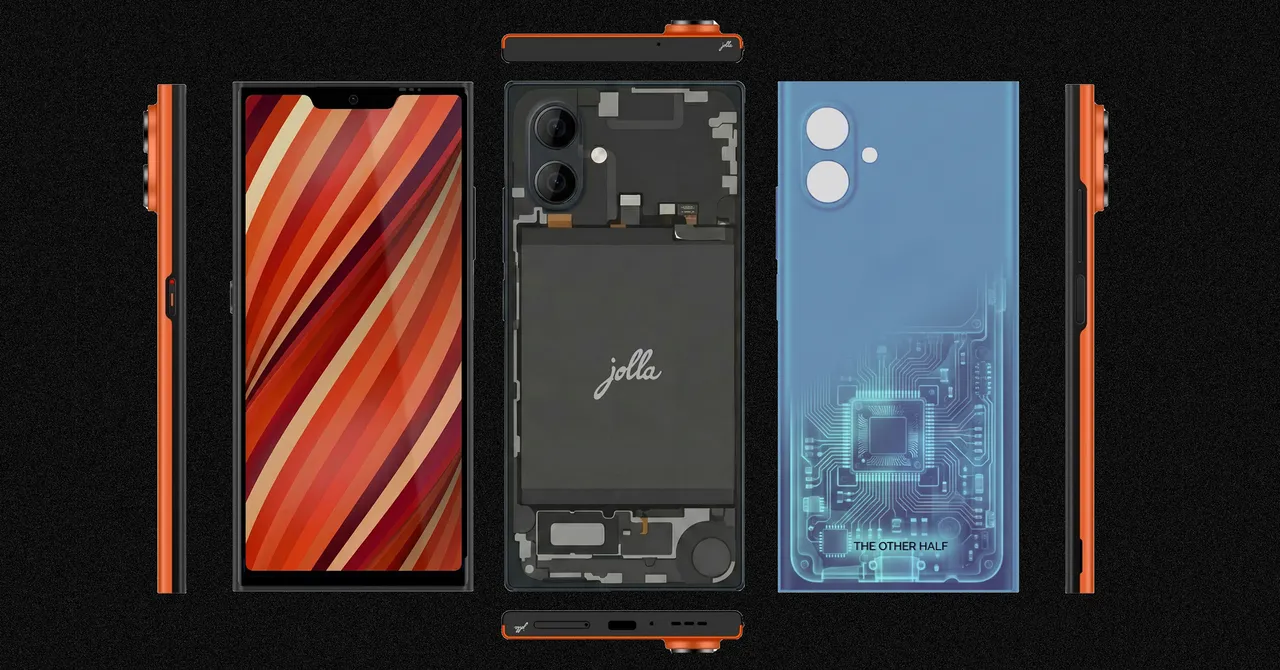
It is equipped with an intermediate-tier MediaTek Dimensity 7100 5G chip, paired with 8 GB of RAM and 256 GB of internal memory, alongside a microSD card slot and a dual-SIM tray. The device features a 6.36-inch 1080p AMOLED display, two primary photographic lenses, and a 32-megapixel front-facing camera. Its 5,500-mAh power unit is quite substantial given the phone’s dimensions, though its networking capabilities are somewhat antiquated, being limited to Wi-Fi 6 and Bluetooth 5.4.
Notably, the Jolla Phone reintroduces “The Other Half” utility-providing back panels from its original iteration. These interchangeable back covers feature pogo pins that connect to the phone, enabling users to develop bespoke add-ons such as an auxiliary screen on the device’s rear or even a keyboard peripheral. An Innovation Program exists where the community can jointly design and 3D print these functional covers. And indeed, a detachable back panel signifies that the Jolla Phone’s battery is easily exchanged by the owner.
{content}
Source:{feed_title}