
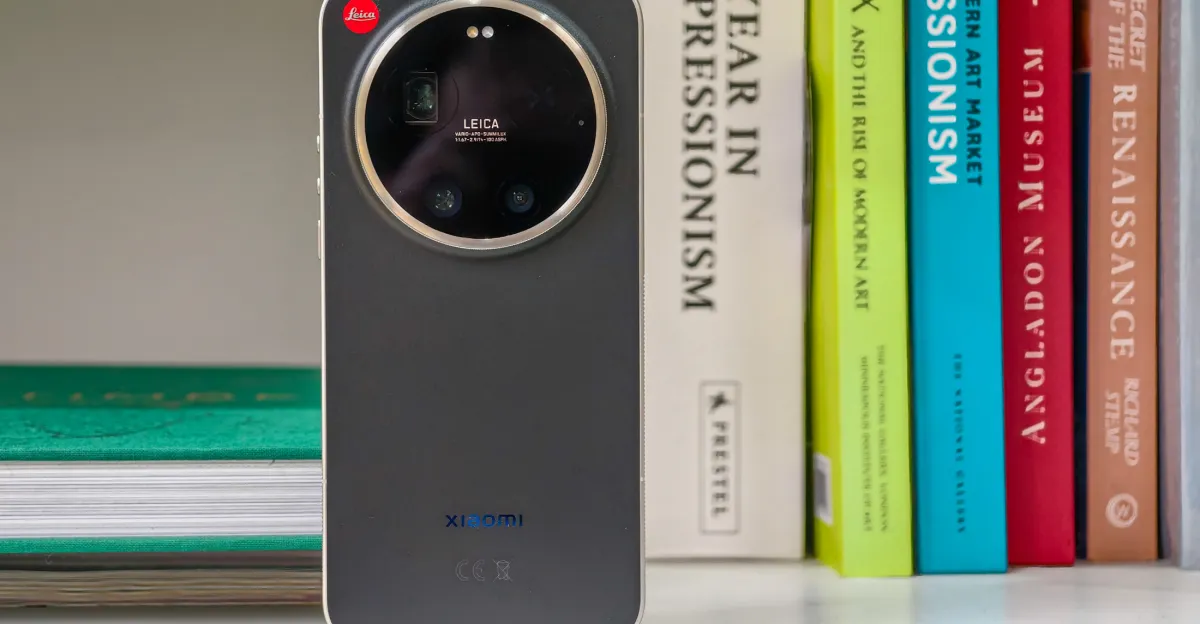
The enduring smartphone alliance between Xiaomi and Leica has recently become more intimate. Concurrent with the global debut of its 17 Ultra premium device, Xiaomi has been tasked with producing a distinct variant, marking the initial Leica Leitzphone unveiled beyond Japanese borders, following three Sharp-manufactured iterations solely for that market.
Essentially, the Leitzphone amounts to a 17 Ultra adorned with Leica insignia and featuring a revolving camera bezel. Aside from minor aesthetic adjustments, it’s largely identical to the Leica Edition of that phone previously accessible in China. Nevertheless, the marque’s presence carries significant weight: Leica had not permitted Xiaomi to feature its iconic red dot emblem on devices prior to this moment, despite their collaboration on Xiaomi’s premium camera systems since 2022. This progression to an entirely Leica-badged handset represents a strong endorsement from the imaging firm.
Following a fortnight of utilizing the Leitzphone iteration of the 17 Ultra, it becomes evident that such trust was merited. This stands as my preferred mobile device of 2026 to date, irrespective of the Leica emblem, though the majority of consumers might find greater advantage in economizing by choosing the regular 17 Ultra.

$2300
Merits
- Among the finest cameras integrated into a smartphone
- Two-day power autonomy (barely)
- Comprehensive premium functionalities
Drawbacks
- Large, cumbersome, and weighty
- Pricey
- The swiveling camera ring appears to be a mere novelty
The 17 Ultra and its initial Leica variant debuted in China on December 25th, 2025. The global iteration and the Leitzphone were unveiled at Xiaomi’s pre-Mobile World Congress media briefing in Barcelona on February 28th, concurrently with the standard Xiaomi 17. The 17 Ultra commences at £1,299 / €1,499 (approximately $1,750) with 512GB storage, escalating by £400 / €700 for the Leica version. That constitutes a substantial surcharge, yet several distinctions exist when compared to the standard 17 Ultra.
We commence with the Leica influence. Its presence is most apparent in the aesthetic: a subtly lustrous black surface on the rear, an engineered accent in the ridged aluminum-alloy periphery, and Leica’s distinctive red dot emblem positioned in a corner. This presents a modestly varied aesthetic compared to the 17 Ultra Leica Edition introduced in China towards the close of December, which featured a dual-shade coating and positioned the Leica emblem differently. It also comes equipped with branded peripherals, including an imitation leather cover with a Leica lens cap, a microfiber wiping fabric, and a vivid scarlet wristband.


Further alterations extend to the software. Although both iterations of the 17 Ultra operate on Xiaomi’s HyperOS 3, rooted in Android 16, the Leitzphone’s user environment has been tailored. There are exclusive Leica mini-applications, encompassing image collections and a golden-hour clock, and bespoke monochromatic application symbols for the most
Well-liked applications from Xiaomi and external developers appear stunning when the phone is first activated, yet their appeal wanes once they’re blended alongside the colorful programs users will certainly install from other sources.

The bulk of the personalization resides within the camera. An enlarged collection of Leica effects is available, and the user environment employs Leica fonts along with red as its highlight hue, departing from Xiaomi’s customary yellow shade. A fresh Leica Essential capture setting allows selection from a pair of camera emulations: a vibrant rendition of the M9 and a grayscale interpretation of the M3. Furthermore, the Leitzphone incorporates the capability to activate C2PA provenance details on each photograph captured.
Nothing here is quite as innovative as the Leitzphone’s distinctive physical attribute: a revolving lens bezel. The periphery of the camera module can be rotated, accompanied by pleasing tactile feedback that simulates the sensation of interlocking cogs engaging. While it serves as a superb tactile diversion, its primary function is to manage magnification within the photography application, or to toggle between light metering configurations or visual effects, should one choose.

This appears to be an excellent concept, indeed a feature I’ve desired on additional handsets since observing its inclusion on Nubia’s Focus 2 Ultra. Nonetheless, in actual use, its effectiveness is minimal. The camera module, while voluminous for a mobile device, would be compact on a dedicated photographic instrument, and it’s excessively recessed into the chassis to grip with ease. I’ve had to _compel_ myself to employ the lens bezel for magnification adjustment, consistently discovering the display-based controls to be swifter and more intuitive. Through sustained effort, it might embed itself into my motor skills; presently, I tend to inadvertently turn it, leading to frustration each instance.
The inclusion of the magnification bezel is logical, considering the 17 Ultra’s primary imaging capability: a long-range lens offering seamless optical magnification. While Xiaomi’s 15 Ultra incorporated a pair of telephoto modules, the 17 Ultra integrates them into a single unit. (The corporation bypassed the 16th iteration to align with Apple’s numbering.) A solitary 1/1.4-inch, 200-megapixel sensor is coupled with a Leica APO zoom lens that encompasses a 3.2-4.3x enlargement range — corresponding to 75-100mm — modifying its diaphragm from f/2.39 to f/2.96 during operation.
The apparent drawback is identical to that directed at Sony’s Xperia 1 IV, which featured uninterrupted 3.5-5.2x magnification: This span is too confined to yield significant variation. Seldom does a photograph’s composition alter profoundly as one traverses the spectrum, and beyond those boundaries, one reverts to the identical digital enlargement and sensor trimming that all other handsets provide.
1/20
Images are superb. The generous sensor provides genuine background blur, coupled with close-up capability at a closest range of 30 centimeters. It can manage difficult illumination scenarios, yielding favorable outcomes in low illumination — though it did once contend with the opposite extreme, overexposing bright areas on a particularly luminous day. Predominantly, I’ve captured images solely with the Leica Authentic setting — the alternative being Leica Vibrant — which I appreciate for its cinematic characteristics, retaining a greater degree of luminosity and gloom than most phones and circumventing the dull luster caused by overzealous HDR processing.
The remaining optics are equally remarkable, though I do tend to gravitate towards the long-range lens. The primary camera features a substantial 1-inch-type sensor, possessing the identical 50-megapixel pixel count as both the super-wide-angle and front-facing cameras. It stands among the initial handsets to incorporate a LOFIC (lateral overflow integration capacitor) sensor, which broadens the dynamic spectrum for brilliant areas, assisting me in capturing some of the most striking cityscape images achieved with a mobile device, and aiding in superior execution for nocturnal photographs featuring intense illumination.
1/14
class=”duet–article–article-body-component”>
Even with the Leica emblem, this device is more than *merely* a camera. The Leitzphone presents a full suite of premium specifications one would anticipate: Qualcomm’s advanced Snapdragon 8 Elite Gen 5 processor, a generous 16 gigabytes of memory (a remarkable amount given current market conditions!), 1 terabyte of internal capacity (with a 512GB alternative for the standard 17 Ultra variant), a 6.9-inch LTPO OLED screen featuring a variable refresh rate from 1 to 120Hz, and robust IP68 ingress protection.
Another prominent characteristic is the battery. Its 6,000mAh silicon-carbon cell, while not the largest available and being more compact than the device’s Chinese counterpart, remains quite commendable. Despite supplying energy to a high-performance handset equipped with a substantial screen, I typically achieved nearly two days of operation between recharges, though with minimal residual power remaining thereafter. A rapid replenishment is facilitated by 90W PPS wired charging and 50W wireless charging; however, users will experience restricted Qi speeds when utilizing non-proprietary wireless charging pads, and the magnetic Qi2 protocol is not supported.

The primary drawback of the Leitzphone stems from its status as largely a pricier variant of the 17 Ultra, which incorporates the majority of its superior attributes. I find the aesthetic of the Leitzphone more appealing and appreciate some of the exclusive Leica photographic modes along with the provided cover. However, these advantages do not justify an additional £200, nor does the revolving camera bezel. Unless that distinctive red emblem holds significant personal value for you, there’s insufficient justification to expend additional funds for this model, primarily because the 17 Ultra is an exceptional device independently.
Visuals captured by Dominic Preston / The Verge
Consent to Proceed: Xiaomi 17 Ultra
Each intelligent gadget presently mandates your assent to a collection of stipulations prior to its utilization — covenants seldom perused by users. It is unfeasible for our team to examine and dissect each individual one of these accords. However, we commenced tallying the precise number of instances requiring an “agree” confirmation for device operation during our assessment process, given that these are pacts commonly overlooked and unequivocally non-negotiable for the general populace.
For the operation of the 17 Ultra, your concurrence is required for:
- Google’s Service Provisions
- Google Play’s Service Provisions
- Google’s Data Protection Policy (integrated within Service Provisions)
- Application and Update Installation: “You consent that this gadget might automatically retrieve and install updates and applications from Google, your network provider, and the device’s producer, potentially utilizing mobile data.”
- Xiaomi’s Accord
- Xiaomi’s Data Protection Policy
Additionally, several non-mandatory accords are presented, encompassing:
- Furnish unidentifiable geographical information for Google’s offerings
- “Permit applications and functionalities to detect Wi-Fi networks and proximate gadgets at all times, even when Wi-Fi or Bluetooth is deactivated.”
- Transmit operational and diagnostic metrics to Google
- Google Gemini Applications Data Protection Disclosure if you elect to employ Gemini Assistant
- Transmit operational and diagnostic metrics to Xiaomi
- Xiaomi’s tailored advertisements
Various other functionalities, such as Google Wallet, might necessitate supplementary accords.
Concluding count: six obligatory accords and a minimum of six non-mandatory ones.