
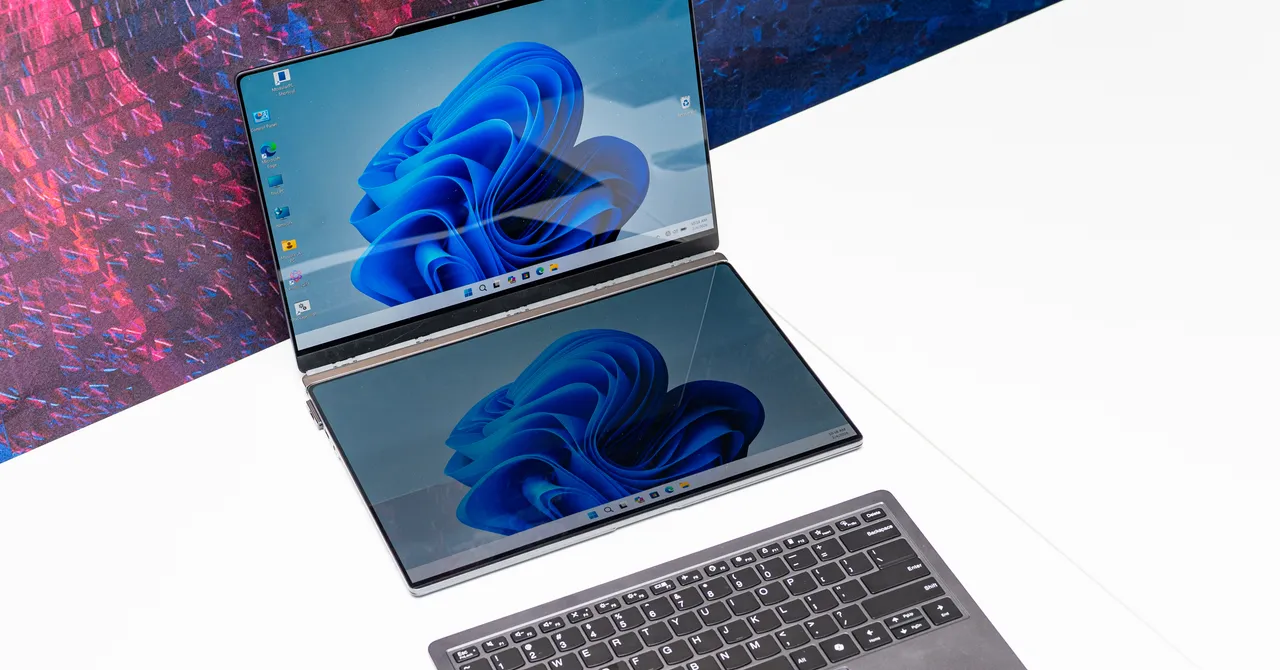
Are you fond ofutilizing an auxiliary display with your computing arrangement? Imagine if your portable computer could integrate an additional display? Such is the premise underpinning Lenovo’s newest conceptual prototype, the ThinkBook Modular AI PC, which was unveiled during the Mobile World Congress in Barcelona.
Lenovo routinely showcases unconventional and peculiar prototype notebooks. The company has presented personal computers featuring a transparent display, one boasting a rollable OLED screen, a pivoting screen, and another with a hinged display that flips. During CES earlier in the current year, the firm demonstrated a portable gaming rig equipped with a screen capable of expanding upon activation of a key. Occasionally, these concepts materialize as tangible offerings that become commercially available (typically with constrained availability).
At MWC 2026, Lenovo showcased a trio of conceptual designs. While it remains uncertain if any will transform into actual, marketable items, they do present some distinctive usefulness and offer a glimpse into potential shifts in user computing interactions going forward.
A Portable Computer Featuring an Integrated Auxiliary Display

Being an individual who utilizes a multiple-display configuration in my residence and possesses an affinity for mobile displays, the ThinkBook Modular AI PC holds the greatest allure for me. Upon initial observation, it resembles a conventional portable computer. However, observe its rear, and one will discern a secondary display gravitationally attached to the portable computer’s back, akin to a koala transporting its young on its dorsal side.
The display interfaces with the portable computer via pogo-pin connections, thus enabling its utilization in this configuration for presenting visuals to individuals situated opposite you, for instance, during a corporate briefing or a formal address. As another option, one can detach this secondary display, unfold a concealed support stand located beneath the portable computer, and affix it magnetically to the 14-inch main display, thereby achieving a conventional mobile monitor setup. (A USB-C cable connection to the portable computer will be requisite in this specific arrangement.)
Should desktop real estate be insufficient for that configuration, you retain the option of detaching the input device from its foundation and positioning the secondary display in that spot—it will automatically establish a connection with the portable computer through the pogo pins, allowing the use of the Bluetooth-enabled input device for data entry on a twin-display arrangement mirroring the design of the Asus ZenBook Duo. This entire arrangement presents an exceptionally mobile means of enhancing efficiency while traveling, and the portable computer itself avoids being excessively bulky or unwieldy.
{content}
Source:{feed_title}