
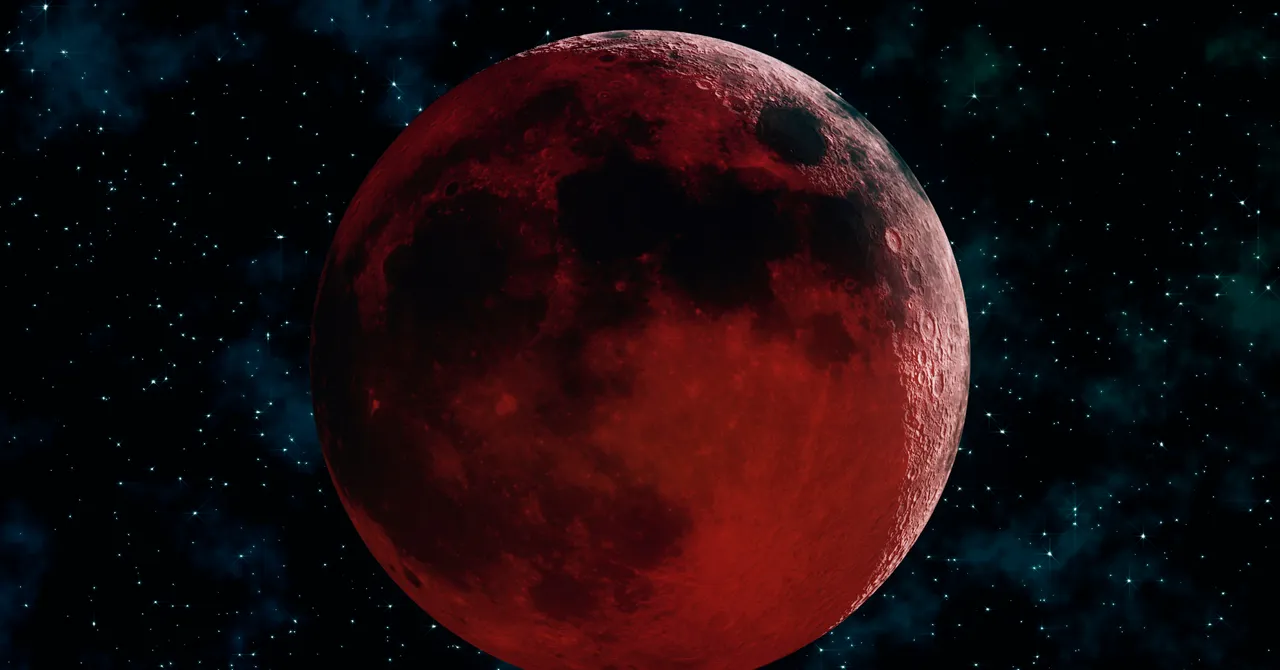
The initial significantcelestial occurrence observable in 2026 is a complete lunar eclipse, often termed a “blood moon.” This spectacle is greatly valued by sky-watchers as the entire lunar disk assumes a reddish hue for a short period.
This full lunar eclipse is scheduled for March 3. It will be distinctly observable across North and Central America, whereas in Central and South Asia, it will only be partially discernible. The event will remain unseen in Europe or Africa.
Even though the eclipse commences in the pre-dawn hours, the phase of totality will unfold almost at daybreak on March 3. Several hours prior to sunrise, the full moon will acquire its distinctive reddish hue for a mere 12 minutes.
Schedule for the Complete Lunar Obscuration, or “Blood Moon”
- Los Angeles: 3:04 am
- Denver: 4:04 am
- Chicago: 5:04 am
- St. Louis: 5:04 am
- New York: 6:04 am
- Washington, DC: 6:04 am
It is completely safe to observe a total lunar eclipse, contrary to a solar eclipse. No specialized gear is required; simply seek an elevated viewpoint and attire yourself in warm clothing. Be aware that during the phase of totality, the moon will nearly graze the horizon, on the verge of vanishing. Consequently, viewing it from an elevated location is essential, ensuring no structures or foliage obstruct your line of sight.
What Causes the Moon to Appear Red?
During a complete lunar eclipse, the moon does not entirely forfeit its luminosity, instead assuming a muted reddish shade. This phenomenon occurs due to Earth’s placement between the sun and the moon, projecting its umbra onto the lunar body.
In contrast to the moon, our planet is enveloped by an atmosphere, which acts as a solar filter. Owing to this, we perceive the cerulean sky, the amber sunset, or remote objects in muted hues. Solar rays traversing Earth’s atmospheric layer succeed in reaching the moon, albeit in a reduced amount. These pre-filtered beams strike the satellite, dyeing it crimson. “It’s akin to having all of Earth’s sunrises and sunsets cast upon the moon,” NASA elucidates.
Complete lunar obscurations are somewhat less common than full solar eclipses. On average, a blood moon manifests approximately every 2.5 years, whereas a full solar eclipse takes place roughly every 18 months, as per NASA’s celestial records.
Complete lunar eclipses appear more prevalent as they are discernible from any location experiencing night. Conversely, witnessing a full solar eclipse necessitates being precisely within the slender path of totality. For instance, a sky-watcher might observe a complete lunar eclipse every two to three years, yet could potentially await around 375 years to witness a full solar eclipse from their specific locale.
This article initially featured inWIRED en Españoland underwent translation from Spanish.
{content}
Source:{feed_title}