
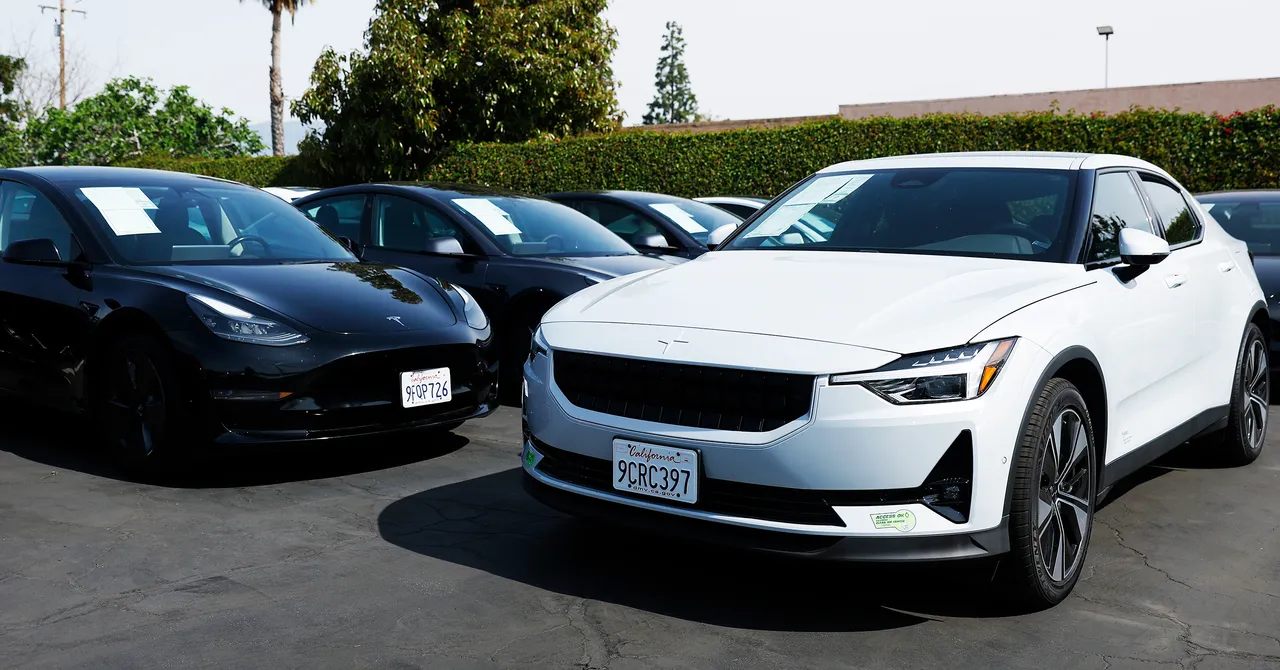
Interest in purchasing has surgedat iDrive1 Motors in Carrollton, Texas. For ten years, owner Dink Davis has focused exclusively on pre-owned electric vehicles. Petroleum costs are not quite as elevated in the Lone Star State compared to other regions of the US, even after the Iran war and the resultant crisis in the Strait of Hormuz caused a sharp rise in worldwide oil expenses in late February. Contrast the typical $3.68 per gallon in Texas with California’s $5.89. Nonetheless, AAA reports that prices nationally have climbed by over one-third since hostilities commenced. Davis and his three staff members—whose livelihood involves vending battery-powered cars, not gasoline ones—are exceptionally swamped.
“Over the past three weeks, it’s reached an absurd level,” Davis states. “We are struggling to manage the incoming inventory.” He mentions that on Tuesday, a patron exchanged a fuel-guzzling Jeep, which requires over $100 for a full tank, for a pre-owned EV.
Statistics from Cox Automotive reveal that US sales of pre-owned EVs climbed by 12 percent in the year’s initial quarter, in contrast to the identical period in 2025, with 93,500 vehicles vended in 2026 to date. While this remains a tiny fraction of the entire second-hand vehicle sector, “its upward path is striking,” as stated last month by Stephanie Valdez Streaty, the firm’s director of industry insights.
Edmunds, which monitors consumer investigations of electric-powered automobiles on its web platform, reports that buyer enthusiasm for this propulsion system has increased by several percentage points since the year commenced.
This surge in demand for second-hand EVs arrives at both a peculiar and opportune moment. On the unusual side: Automobile manufacturers vending electrics in the US are currently retreating from launching novel models, subsequent to the federal government reducing aid for both prospective EV purchasers and the firms producing these automobiles. Honda last month scrapped three electric models and a previously arranged partnership with Sony to construct an electric sedan prioritizing digital entertainment. Ford ceased production of the F-150 Lightning and scrapped plans for its subsequent electric truck model last year. Stellantis canceled its fully electric Dodge Ram last fall. Novel EV car sales are still expanding in the US, yet not matching anticipated levels from the start of this decade. To summarize, the electric vehicle atmosphere feels somewhat muted.
On the beneficial front: Second-hand EVs represent quite a bargain presently. Although novel battery-powered cars remain considerably costlier than their petrol-fueled counterparts—Cox observed an average $6,500 cost difference in January—the disparity is narrowing for pre-owned automobiles. The average for a used electric stands at $34,800, a substantial sum, but only $1,300 above the average gas-powered vehicle.
Over the ensuing months, the cost could become even more favorable: Approximately 200,000 pre-owned EVs are scheduled to complete their lease terms this year. This follows US consumers, formerly lured by substantial tax benefits for leased electrics, beginning to return them—a volume triple 2024’s levels. (Those stimuli were abolished by the Trump administration’s One Big Beautiful Bill.) Furthermore, the vehicles’ sizable, costly power packs, previously considered the fundamental weakness of the second-hand electric market, are performing significantly better than even sector specialists had anticipated.
Analysts at Cox contend it would require six months or more of higher petrol costs to genuinely shift buyer attention towards EVs. Should the hostilities persist, there’s an increased probability of enduring harm to petroleum infrastructure in the Middle East—and ongoing financial burden at fuel stations.
In Utah, Alex Lawrence, the Chief Executive Officer of second-hand EV firm, EV Auto, stated in mid-March that purchaser interest was extending inland from California as fuel costs continued to climb. “I’m increasing my investment in stock even more, because I’m gambling on an escalation in demand,” he remarked. Telephone calls and feedback on his business’s social media platforms were markedly higher, he noted, but patrons “are not yet arriving en masse.”
By the conclusion of the month, the pattern continued to advance gradually. “Everything is becoming more hectic,” Lawrence observed.
{content}
Source:{feed_title}