
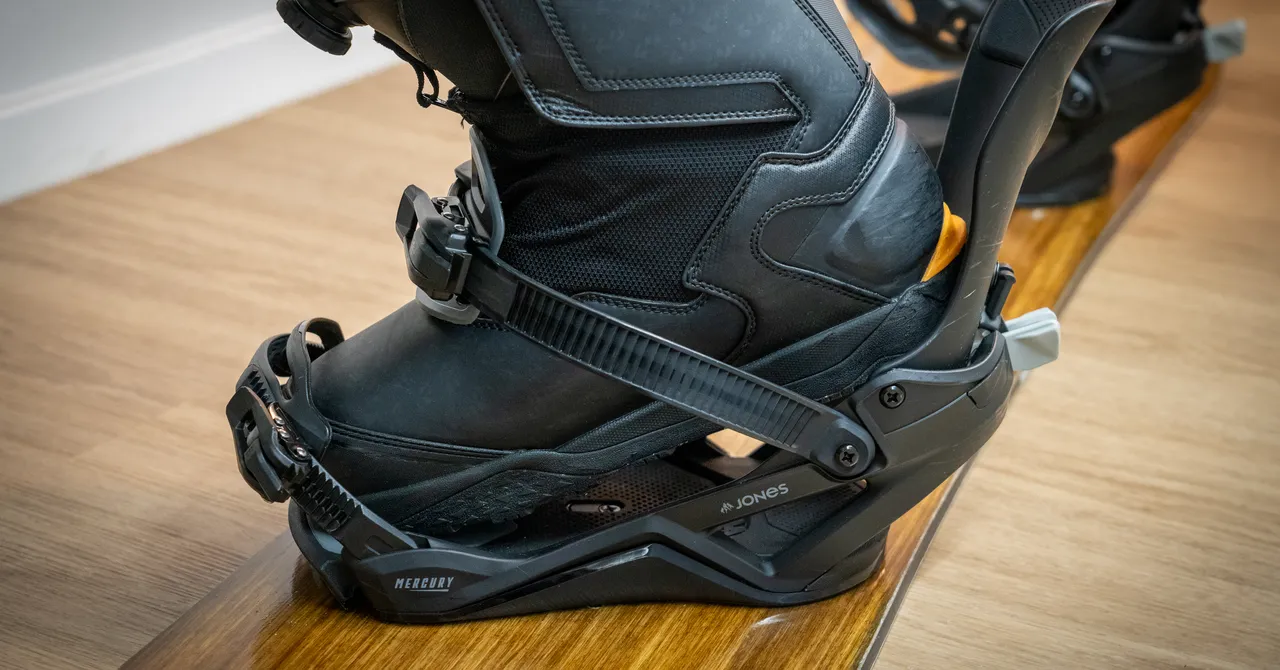
The most significant alteration lies within the binding’s rear support, known as the AutoBack within the FASE system. Although it retains the ability to collapse completely forward for transportation and low-clearance chairlifts, once extended, it inclines considerably further rearward than a typical rear support. Positioned on the underside of this rear support, internally, resides a robust plastic toggle.
Upon engaging with the binding, your footwear depresses this toggle. This action propels the rear support into its complete, erect stance, driving it firmly against the rear of your calf, as is customary. Subsequently, you merely secure the ankle fastener, and you’re ready to proceed. To disengage, you simply extend your hand to release the locking mechanism on the ankle fastener. It unfastens, allowing you to withdraw your foot effortlessly.
The Jones Mercury FASE fastening system, which I examined, exhibits significant commonalities with Jones’ conventional Mercury bindings. This is a quite rigid fastening system, conceived chiefly for freeride (i.e., backcountry) and deep snow conditions, rather than the terrain park; however, it performs admirably as a versatile, all-mountain option. An insert of foamed material is integrated both above and below the base plate, effectively attenuating oscillation and providing some shock absorption from forceful impacts.
Jones’ rear supports are not renowned for their adaptability, and this pattern persists in the current model. There are two options for forward inclination, but that is the sole adjustment. Should you be accustomed to Union bindings, which permit adjustment of the rear support’s orientation, you might find this limitation unsatisfying; however, for me, these rear supports perfectly conformed to my calves. They are rigid, offering excellent responsiveness, yet they are gently cushioned at the apex, and I found them exceptionally comfortable.
The most significant divergence from the conventional Mercury model is that the majority of Jones’ traditional fastening systems utilize a mechanism the firm refers to as SkateTech. A pivot point is integrated into the perimeters of the binding, which enables you to exert additional pressure on your edges for enhanced command. I have become an ardent advocate for SkateTech over the past few years, so I was dismayed that it wasn’t integrated here. Nevertheless, I adapted rapidly, and they still felt exceedingly responsive during operation. However!
Field Performance
Photograph: Brent Rose
I evaluated these fastenings during a wintery journey through British Columbia and encountered them in a diverse range of circumstances, spanning from precipitous, profound powder to treacherous icy pistes of doom. Additionally, I had the opportunity to experience them while cat-skiing and heli-skiing in remote terrain, an environment where rapid-entry systems have often disappointed me. I assessed their performance with the Jones Hovercraft 2.0 (a board I utilized for two seasons and critiqued for WIRED), as well as the quite aggressive 2025 Jones Flagship Pro, which serves as my current preferred choice for unreliable, intimidating, or varied topography.
{content}
Source:{feed_title}