
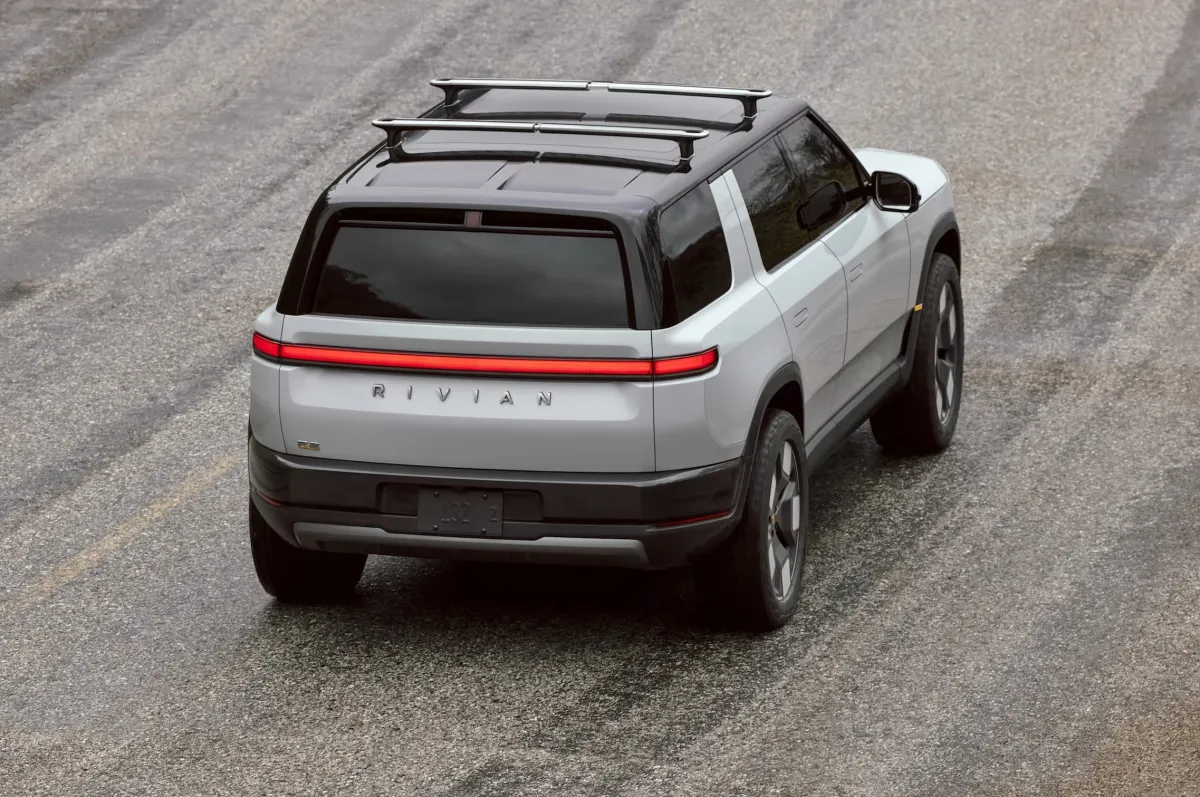
Based on corporate announcements and a TechCrunch examination of past sales figures, Rivian intends to achieve one of the swiftest market introductions for a novel all-electric vehicle in the U.S. with its impending R2 SUV.
Should Rivian achieve success, this would mark a robust commencement for an offering that its founder and CEO, RJ Scaringe, has characterized as “perhaps our most pivotal item we’ve unveiled up to this point.”
The company cannot afford otherwise. Rivian’s destiny — and its prospects for achieving financial viability — is predicated upon the R2’s favorable reception. Should it face difficulties in escalating the manufacturing and distribution of the R2, investors might withdraw their support. Minimally, this would elicit concerns regarding the firm’s approach of expending billions presently to ready itself for widespread market adoption.
Rivian informed its shareholders a month ago that it anticipates moving between 20,000 and 25,000 R2 units this year, with the initial sport utility vehicles slated for delivery to patrons by June, following the commencement of manufacturing. Even if Rivian reaches the minimum threshold of that objective, its pace of sales will surpass all other similar electric models priced at or below $60,000, save for the Tesla Model Y.
The Model Y, which debuted in March 2020, achieved sales exceeding 20,000 units in merely four months. Rivian targets accomplishing this in approximately half a year, a duration roughly equivalent to what the Honda Prologue required to hit that sales benchmark upon its 2024 introduction.
The subsequent swiftest electric vehicle to reach 20,000 unit sales in the U.S. was the Chevy Equinox EV, accomplishing this in approximately eight months following its 2024 market entry. Ford’s Mustang Mach-E required a comparable period after its 2021 debut, whereas South Korean electric vehicles such as the Hyundai Ioniq 5 and Kia EV6 needed roughly 10 and 11 months, separately.
Vehicles that experienced challenging introductions, such as Tesla’s Model 3 (famously associated with Elon Musk’s “production hell”) or the Chevy Blazer EV (which endured a significant halt in sales and a recall), required an equivalent or extended timeframe.
Techcrunch event
San Francisco, CA
|
October 13-15, 2026
Rivian is introducing the R2 into a considerably altered marketplace. Almost all of those prior models enjoyed the advantage of the $7,500 federal EV tax credit, which was terminated by Congress and President Trump in September of the previous year. Prominent car manufacturers are curtailing or scrapping intentions for some electric vehicles given more relaxed environmental standards. Trump’s disorganized import duties have additionally inflated vehicle costs — encompassing Rivian’s current range of products.
Scaringe has reframed these difficulties as favorable opportunities, asserting that the electric vehicle sector offers limited options, particularly within the more economically priced segment. Rivian has declared the R2 SUV will commence at $45,000, with Scaringe highlighting the importance of the lower price point for widespread market penetration.
A more modest initial cost might enhance the likelihood of the R2 achieving a swift and successful launch. However, neither Scaringe nor the corporation has specified when an actual $45,000 iteration of the R2 will become accessible. The firm is instead introducing a dual-motor, premium-level variant of the SUV, which will indisputably incur a greater expense.
Further information on cost and specifications will be unveiled during a March 12th gathering. However, in early February, the firm took down “Starting at $45,000” from the R2 segment of its online portal. Last month, Rivian informed TechCrunch that it stands “dedicated” to that foundational price point, notwithstanding the alteration. The enterprise did not reply to inquiries sent via email regarding its R2 deployment strategies.
Notwithstanding the present challenges facing electric vehicles in the U.S., a robust appetite seems to exist for forthcoming electric SUVs with a cost comparable to or moderately exceeding the R2, such as Volvo’s EX60, BMW’s iX3, and the Mercedes-Benz GLC. These models, however, are not expected to arrive in the U.S. until later this year, thereby granting the R2 a marketplace edge, as per Joseph Yoon, a consumer insights analyst at Edmunds.
“Scaringe is correct that this particular compact-to-mid-size category is genuinely absent” for electric vehicles, he remarked. Yoon mentioned that Rivian has diligently endeavored to streamline the R2’s production method in contrast to its existing models, a move anticipated to enable the firm to achieve rapid widespread production.
Nonetheless, certain financial market observers express doubt. A month prior, Michael Shlisky, an analyst at DA Davidson, reduced his valuation forecast for Rivian, attributing this to the company’s “ambitious” R2 launch projections.
Dan Levy, an analyst at Barclays, penned in a report released last year that he projects Rivian’s typical selling price for the R2 might oscillate around $60,000 or greater “for the upcoming few years” as they are assembled in Illinois, until the corporation commences operations at its new Georgia manufacturing plant.
{content}
Source:{feed_title}