
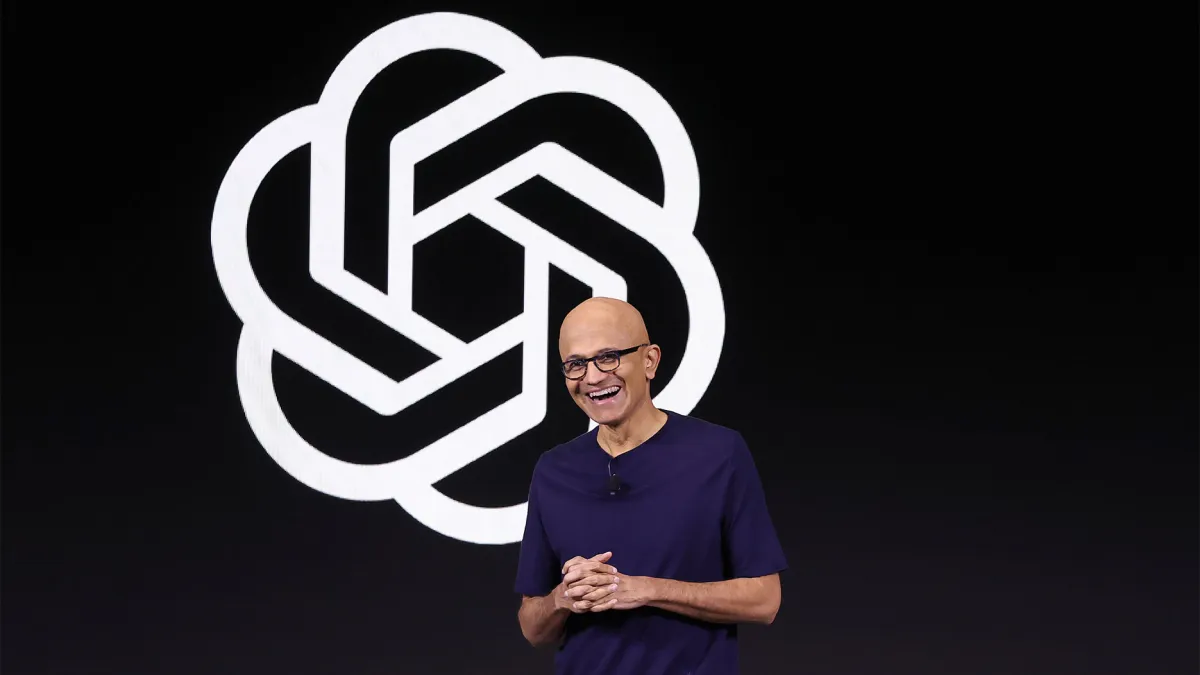
On Sunday, Microsoft CEO Satya Nadella doubled down on the shocking warning he issued earlier this month to businesses that use AI, taking it a step further this time. Companies that rely wholly on the proprietary AI labs for their AI needs ultimately won’t survive, he predicts.
Key Takeaways
- Don’t Outsource Your Thinking:Microsoft CEO Satya Nadella issues a stark warning to enterprises, asserting that complete reliance on proprietary AI labs will lead to their demise. Businesses must retain sovereign control over their data, prompts, and ultimately, their own AI models to survive.
- Demand for Infrastructure Control:To maintain independence, companies are urged to implement strategies such as retaining metadata from model usage, training custom “weights” for their AI, and utilizing AI gateways to decouple their proprietary information from core AI models.
- Beyond Cost Savings, an Existential Threat:Nadella’s caution extends beyond budget concerns, highlighting the profound risk of AI model providers evolving into direct competitors. This echoes long-standing fears within the startup community about the “platform playbook” and intellectual property erosion.
Satya Nadella’s Dire AI Prophecy: Why Outsourcing Your ‘Thinking’ Could Be Your Business’s Undoing
In a significant and more emphatic reiteration of a warning he first issued earlier this month, Microsoft CEO Satya Nadella has once again sent a seismic tremor through the corporate landscape. Speaking candidly on CNN’s “Fareed Zakaria GPS,” Nadella unequivocally declared that businesses fully dependent on proprietary AI labs for their artificial intelligence needs are marching towards an inevitable demise. This isn’t merely a cautionary tale; it’s a stark prediction about the future of enterprise in an AI-driven world.
Nadella’s message is a clarion call for strategic autonomy in an increasingly AI-centric economy. When pressed by Zakaria to define the line between beneficial collaboration and dangerous over-reliance, Nadella stressed that companies must be profoundly wary of every scrap of information they hand over – from their raw, proprietary data to the specific prompts used to interact with sophisticated AI models. This vigilance, he argues, is non-negotiable for long-term survival.
The Mandate for Sovereignty: Reclaiming Your AI Intelligence
The core of Nadella’s argument pivots on the critical importance of self-governance in the AI age. He articulated a vision for a robust operational framework where, “every time you use the model, all of the metadata around it is retained by you, so that you could use all of that to train perhaps your own weights or your own open model.” This isn’t just technical arcana; “weights” are the fundamental learned parameters of an AI model – essentially its accumulated intelligence. By meticulously retaining their usage data, companies empower themselves to develop, fine-tune, or even ultimately own their bespoke AI models, rather than perpetually leasing their cognitive function from external providers.
“Any firm that doesn’t have this control, I will claim will not remain a firm because you’ve essentially outsourced your thinking,” Nadella stated with conviction. This potent assertion underscores his belief that ceding strategic reliance on external AI intelligence, without a concomitant investment in internal capabilities and robust control mechanisms, represents a fundamental abdication of a company’s core strategic decision-making and intellectual property.
Architecting Independence: The Role of AI Gateways and Decoupled Harnesses
To circumvent this perilous path, Nadella offers clear, actionable advice: companies must either embark on the journey of developing their own AI models or, at minimum, deploy advanced AI infrastructure layers like AI gateways. These gateways act as crucial intermediaries, creating a protective buffer between sensitive business prompts and the foundational AI models. This architectural segregation ensures that businesses can harness the immense power of cutting-edge AI while safeguarding their intellectual property and strategic insights from becoming inextricably tied to a single vendor’s ecosystem.
A specific point of caution from Nadella focused on enterprises’ deep reliance on the built-in coding tools provided by AI labs, often referred to as “harnesses.” Popular examples include Anthropic’s Claude Code and OpenAI’s ChatGPT Codex. While undeniably convenient and powerful, these tools can foster a level of integration that Nadella views as a critical vulnerability.
“By keeping the harness separate from the model and the context and memory separate from the model, you absolutely can use multiple models for what they’re great at. At the same time, any one model can go away, and you can still continue to be in control of your own destiny,” Nadella emphasized. This decoupled approach promotes agility and resilience, allowing businesses to seamlessly integrate or swap out different AI models as technological advancements emerge, or as their specific operational needs evolve, without suffering from debilitating vendor lock-in.
The Existential Risk: When Your Provider Becomes Your Competitor
Nadella’s warning transcends mere budgetary concerns or the technical intricacies of AI deployment. It delves into a more profound, almost existential, strategic threat: the very real possibility that once a company has significantly “outsourced its thinking” to a model provider, there is little to prevent that AI lab from eventually morphing into a direct market competitor. This risk amplifies dramatically as enterprises increasingly integrate sophisticated AI agents, granting them deeper, often unprecedented, access to internal operations and proprietary corporate knowledge.
This chilling prospect has been a palpable fear within the vibrant startup community for years, frequently encapsulated by the question: “What’s to stop these powerful foundational model makers from observing, analyzing, copying, and ultimately competing directly with the very startups whose innovations they power?”
A prominent example surfaced in May when OpenAI CEO Sam Altman extended an offer to invest in every Y Combinator startup in its latest cohort through AI credits. This move prompted an immediate “buyer-beware” alert from seasoned seed investor Jason Calacanis, who cautioned founders: “If you take these tokens, there’s a non-zero chance that OpenAI will study exactly what your startup is doing, copy your idea and put your app into their free offering. This is the classic platform playbook — be careful, founders!” Nadella is now extending this critical strategic foresight from the agile startup ecosystem directly to the more established enterprise landscape, highlighting a universal risk.
Microsoft’s Strategic Ambiguity: Investor and Infrastructure Visionary
It is important to acknowledge Microsoft’s intriguing and seemingly paradoxical position within this narrative. The tech titan is a significant investor in two of the very AI labs Nadella implicitly warns against over-relying upon: Anthropic and OpenAI. Moreover, the coding agents — the very “harnesses” he advises caution against — are incredibly popular among enterprises and represent a substantial revenue stream for these model providers.
Yet, despite these vested interests, Nadella actively advocates against excessive dependence on them. This apparent contradiction can be understood by examining Microsoft’s broader strategic imperatives. While undoubtedly benefiting from the success of its AI investments, Microsoft also stands to gain immensely from its burgeoning cloud business, which is actively developing and selling the very kind of independent, alternative AI infrastructure Nadella champions. Thus, while there is an undeniable self-serving dimension to this “fear tactic,” the underlying strategic warning about vendor lock-in, intellectual property, and the imperative for control holds profound and genuine merit for any business leveraging AI.
The Inevitable Evolution: The Rise of Open-Weight Models and Enterprise Flexibility
Indeed, market dynamics are already validating the wisdom of Nadella’s strategic counsel. Enterprises are increasingly recognizing the strategic necessity of cultivating multiple model options, especially more cost-effective and customizable alternatives. This realization is fueling a significant industry shift towards open-weight models—AI models whose foundational code is publicly accessible. This allows companies to fine-tune, adapt, and run these models on their own hardware, achieving greater control and cost efficiency. This trend, in turn, is driving demand for sophisticated solutions for managing diverse AI models and for coding agents that are not inextricably tethered to a singular model provider, fostering a truly multi-modal AI ecosystem.
A Dual Perspective: Businesses vs. Consumers in the AI Era
An important nuance to Nadella’s warning is its specific audience. His concerns regarding oversharing and the potential loss of control with AI models are directed exclusively at businesses and large enterprises, not individual consumers. When Zakaria inquired about how everyday individuals might protect their data, Nadella largely downplayed the issue, framing consumer data sharing as a fundamental “value exchange” for using services, particularly free ones.
“To some degree there’s got to be some value exchange in the consumer space where you’re getting something for free, maybe for your data. That’s sort of how the advertising business model has worked,” Nadella explained. This distinction highlights the divergent stakes, power dynamics, and accepted norms between corporate entities and individual users within the rapidly evolving AI economy.
Bottom Line:Satya Nadella’s urgent and prescient message is a critical wake-up call for enterprises to proactively reclaim and solidify their strategic autonomy in the burgeoning age of artificial intelligence. While the immediate allure of powerful, ready-made AI models from leading labs is undeniable, the long-term survival, competitive edge, and intellectual integrity of businesses will ultimately hinge on their capacity to cultivate, control, and dynamically evolve their own AI capabilities and underlying infrastructure. This strategic imperative is crucial for safeguarding against debilitating vendor lock-in and, more importantly, mitigating the ultimate risk of becoming intellectually outsourced and thus competitively vulnerable. The future of enterprise undeniably belongs to those who actively choose to own their AI destiny.
When you purchase through links in our articles, we may earn a small commission. This doesn’t affect our editorial independence.
{content}
Source:{feed_title}