
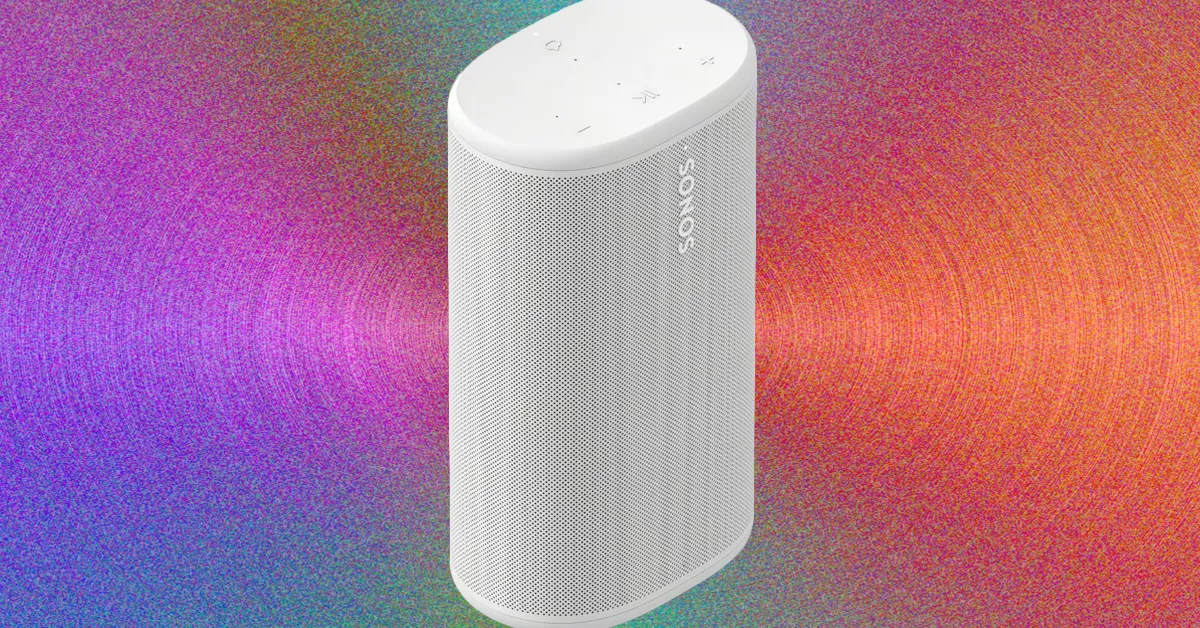
Compared to the hefty Move, it’s more compact and portable, yet its size is ample enough to deliver a richer audio experience than the tiny Roam. It has the capability to stay put on its recharging base, competing with the stationary Sonos Era 100, or conversely, it can accompany you everywhere. Essentially, it embodies Sonos’s adaptability, and with its current optimal functionality, it presents a compelling choice.
Enjoy the Audio
Unboxing the Play’s brown cardboard container reveals a blend of Nordic simplicity and environmental responsibility, consistent with newest launches like the Arc Ultra soundbar. Beneath, a white sound-dampening material uncovers a compact yet sturdy cylindrical audio device featuring an integrated rubber strap, with dimensions of 7.6 x 4.4 x 3 inches and tipping the scales at barely 3 pounds. A straightforward installation guide and a cordless power dock are also included, though an AC adapter is absent. A unit capable of providing a minimum of 9 volts and 2 amps (18 watts) is necessary, but a 15-volt, 3-amp (45-watt) variant is advised for the most efficient power replenishment. Sonos states the adapter’s absence aims to minimize electronic waste, yet they will readily provide one for purchase at $29.
Apart from that, the Sonos application is sufficient for commencing operation. Following the mandatory firmware update, my Play unit was broadcasting audio on my residential network within moments. Sonos natively supports more than 100 streaming services, and users can also broadcast via external platforms such as Spotify Connect, Tidal Connect, Apple AirPlay, among others. The speaker appears as a distinct “Zone” on the app’s primary interface; from there, you can drag to combine it with other Sonos devices on your network, or access settings to modify features like EQ, Zone designation (crucial for multiple Play devices), and Sonos Trueplay for automatically optimizing the audio to your surroundings.
Additionally, a power conservation switch is available, preconfigured to deactivate the device when inactive for an extended period. This functionality, as stated by Sonos, was responsible for my connectivity issues while I evaluated the device’s asserted 24-hour battery life. Sonos states they pinpointed the underlying issue, and since the firmware update, I’ve allowed the speaker to deactivate on numerous occasions, experiencing without any subsequent connectivity problems over a week of additional evaluation.
Photograph: Ryan Waniata
{content}
Source:{feed_title}