
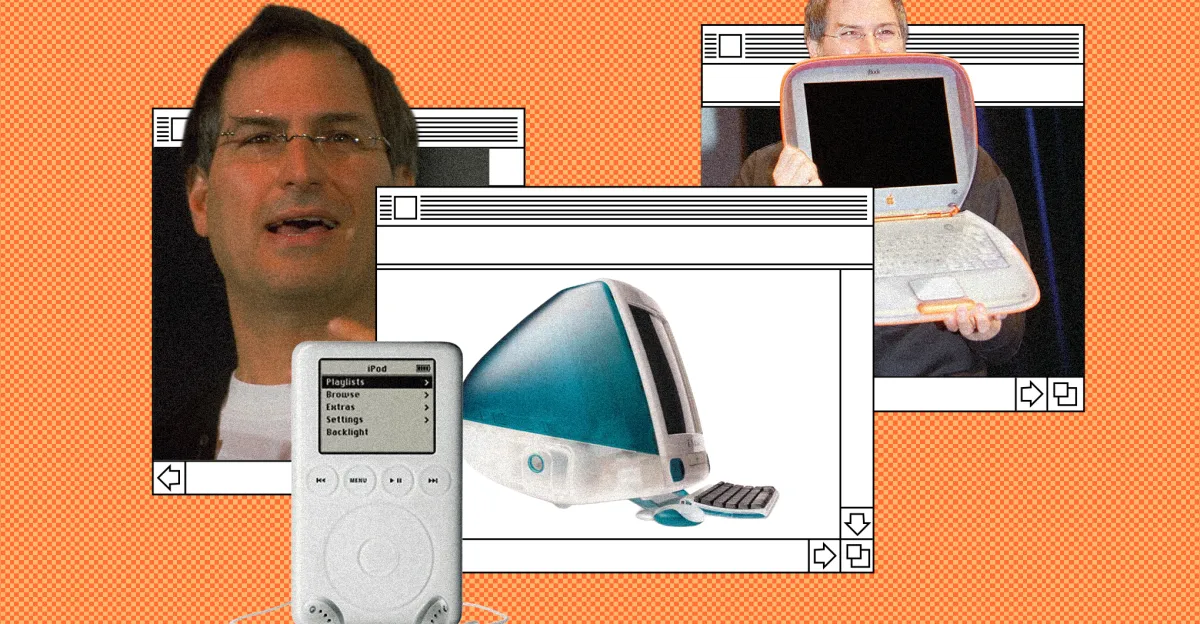
“I am delighted to inform you that Apple is once again on course.” This declaration came in May 1998, roughly ten months into Steve Jobs’ second tenure at the helm of the enterprise he had co-founded over two decades earlier. (Significantly, this was also a little over a decade after that very company had removed him.) Jobs ascended the platform at the annual Macworld convention, dressed in a white top and dark jacket, and communicated to the assembly that the Apple collective had been laboring more diligently than ever to finalize a new computing device, one conceptualized with internet connectivity in mind. It bore the name iMac. “We foresee the iMac becoming a truly substantial product,” he expressed to the spectators. His foresight was correct.
Upon Jobs’ return to Apple in 1997, he inherited an organization mired in a form of product chaos. Apple was manufacturing numerous Macs, seemingly without any coherent logic to the assortment; it was producing, yet largely failing to sell, printing devices; it was attempting to market servers to businesses; and it was developing the Newton, a portable gadget featuring a stylus and some ambitious concepts for recognizing handwriting. Apple created items known as Quadra, StyleWriter, AudioVision, Workgroup Server, and Pippin. While it had certainly engineered many excellent computers, and with the PowerBook notably, some highly inventive ones, the enterprise was encountering difficulties and was adrift.
Jobs had not been reserved about articulating this reality. “The offerings are terrible!” he had exclaimed not long after resuming an active capacity within the firm, according to a 2006Businessweekarticle. “They lack appeal anymore!” Even during his period away from the corporation, when he was purportedly engaged with Pixar and NeXT, he had dedicated years to granting interviews about Apple’s need for greater innovation, detailing how he would approach matters differently. “I possess a scheme that could salvage Apple,” he confided toFortunein 1995. “I cannot elaborate further, except to say it is the ideal merchandise and the perfect approach for Apple. However, no one there will heed me.”


Whether that particular strategy from ’95 was indeed what Jobs proceeded to implement remains unknown. However, Jobs commenced Apple’s revitalization almost instantly, overhauling the company’s internal ethos and inaugurating a decade of nearly uninterrupted product triumphs that ultimately culminated in perhaps the most profitable and influential gadget of all time. Early on, Jobs devised the now-renowned four-quadrant matrix, asserting that Apple merely required a portable and a desktop offering for both general consumers and professional users. He restructured Apple’s corporate framework and granted the design department unparalleled authority over the aesthetic and functionality of devices. (This was largely achieved with the assistance of a design executive named Jony Ive.) The revamped Apple resolved to reconsider the potential of computers, beginning with a device that was vivid, artistically shaped, transparent, and utterly distinct from the mundane beige boxes of components ubiquitous on shelves everywhere.
Apple vended 800,000 iMacs within the five months following its debut in stores in August of 1998, establishing it as the top-selling computer in the United States at that period. This occurred despite—or perhaps due to—the fact that it bore no resemblance to other personal computers of the era. It was an integrated unit in a market dominated by modular, upgradeable machines. It even discarded all the universally used ports in favor of a relatively novel standard called USB. Rejecting expandability had posed a challenge for the initial Macintosh, yet the iMac discovered a receptive populace eager for a computer that did not necessitate an advanced degree to comprehend.


Steve Jobs would subsequently claim that the corporation was merely 90 days from financial collapse upon his return. Nevertheless, its prospects seemingly reversed virtually immediately after the iMac’s introduction. This marked merely the prelude. Commencing with the iMac, Jobs and Apple embarked on one of business history’s most remarkable periods of immense success, consistently generating blockbuster items, instigating societal transformations, and introducing pivotal innovations regarding the future. From that pivotal May day in 1998 until the January Macworld of 2007, when Jobs unveiled the iPhone — an era aptly termed the iDecade — Apple maintained a prolific release cycle unparalleled in scope and success.
During the summer of 1999, following the iMac’s unveiling, Jobs introduced another extraordinary new computer: the iBook. This device adopted many elements from the vibrant iMac design, but presented them within a curved, foldable enclosure that offered enhanced mobility unlike any previous laptop. It came equipped with integrated wireless networking, a feature so unprecedented for its era that Apple’s marketing chief, Phil Schiller, transmitted data from his iBook to another machine while physically jumping from a raised platform. Jobs further passed a hula hoop around the iBook, seeking to dispel any notion of a concealed lengthy cable. The demonstration was effective, and the iBook also became one of the top-selling computers within its category.

During this era at the transition into the new millennium, Apple also persisted in improving its alternative PC series. In 1999, the Power Mac range underwent an iMac-inspired aesthetic redesign. Concurrently, the PowerBook received significant enhancements and stylistic adjustments, and Apple commenced marketing its Cinema Display independent screens for the first time. By 2000, the company introduced the PowerBook G4 Titanium, then its most advanced portable computer yet. It also released the Power Mac G4 Cube, which, despite being a triumph of industrial design, was functionally quite a disappointing machine. Not every venture can be a triumph.
Subsequently, in 2001, Apple evolved into a fundamentally transformed entity. In March, it issued Mac OS X, the system software derived from the code Jobs and his team had been developing at NeXT many years prior. OS X would serve as the bedrock for most of Apple’s electronics for the ensuing quarter-century. Then, that October, Jobs unveiled the inaugural iPod, a gadget capable of holding 1,000 songs in one’s pocket. “With iPod,” he proclaimed in an official statement then, “listening to music will never be the same again.” While it required several years for his assertion to be validated, the iPod swiftly became a premium item, evolving into a completely pervasive presence. The iPod was such a success that the hue of its headphone cable achieved legendary status; those silhouette advertisements featuring the white headphones are considered among Apple’s finest marketing campaigns.


Unwilling to rest on its laurels — or perhaps driven by the apprehension of its past near-collapse — Apple promptly embarked on reimagining its top-performing offerings. During 2002, the corporation dispatched the iMac G4, featuring its renowned sunflower aesthetic and planar display. Concurrently, another iPod was released, incorporating minor hardware modifications and a significant software adjustment: the iPod gained compatibility with Windows, thereby reaching countless prospective purchasers who swiftly converted into genuine customers. By 2003, the iPod underwent a redesign, transitioning from its initial arched controls to a straightforward scroll wheel situated beneath four distinct buttons. Merely twelve months subsequent, its direction shifted once more, this time towards a considerably superior concept: the click wheel, where the controls were seamlessly embedded within the navigation system.
By the year 2004, an additional iteration of the iMac emerged — the G5, a minimalist display mounted on a base, bearing a strong resemblance to contemporary iMac models — along with the fresh iPod Mini and iPod Photo. The subsequent year proved pivotal for compact gadgets: The Mac Mini launched, as did the iPod Shuffle and iPod Nano. The year 2006 introduced the inaugural MacBook Pro, accompanied by a shift to Intel processors that rendered Apple’s devices even more attractive. At this juncture, Apple’s sharpened, design-centric product methodology appeared virtually insurmountable, solidifying the reputations of both Jobs and Ive.


Apple undoubtedly encountered some setbacks throughout this period: It continued to distribute a range of Xserve servers for which demand was negligible, its endeavors with AirPort-series networking hardware never truly gained traction, and inexplicably, its numerous designers struggled to conceive a satisfactory mouse. Nevertheless, annually, as Jobs persistently motivated the group to explore novel approaches and attain seemingly unattainable objectives, Apple consistently innovated its paramount and prosperous offerings, a strategy that continued to yield results.
Furthermore, all these undertakings were culminating in something significant. Ive’s group commenced exploring the potential form of an Apple tablet, leveraging the nascent technology known as multitouch. They fashioned their initial models using components from iBooks and Mac OS X. Subsequently, Jobs assigned the iPod division the task of conceptualizing an Apple phone. An early concept involved simply an iPod equipped with cellular connectivity; another was fundamentally an iPod consisting entirely of a display. Ultimately, these distinct initiatives converged and materialized as the iPhone.
The introduction of the iPhone in 2007 represented yet another crucial turning point for Apple. Jobs’ declaration, “these are not three separate devices,” signaled the instant the enterprise transformed from a prosperous computer manufacturer into the globe’s largest corporation, accountable for arguably the most triumphant electronic device in history. It would, in due course, also release the iPad, and
the Apple Watch and AirPods, alongside a multitude of other triumphant creations. Its endeavors aren’t invariably successful — consider Siri, Ping, MobileMe, and the Vision Pro, for instance? — nonetheless, its triumphs significantly outnumber those of most competitors.
It is beyond doubt that Apple’s most substantial achievements transpired after the iPhone’s introduction. Yet, in terms of sheer speed and depth of inventive spirit, the ten-year period subsequent to Jobs’ rejoining the corporation was simply unparalleled. The enterprise that formerly struggled to even enhance the Apple II was presently conceiving one offering after another, compelling rivals to strive to keep pace, subsequently re-envisioning these fresh iconic items mere years, or even months, later, leading to even greater praise and increased revenue. Though we inhabit a world forged by the iPhone, the ‘iDecade’ was, without exaggeration, Apple’s pinnacle.
{content}
Source:{feed_title}