
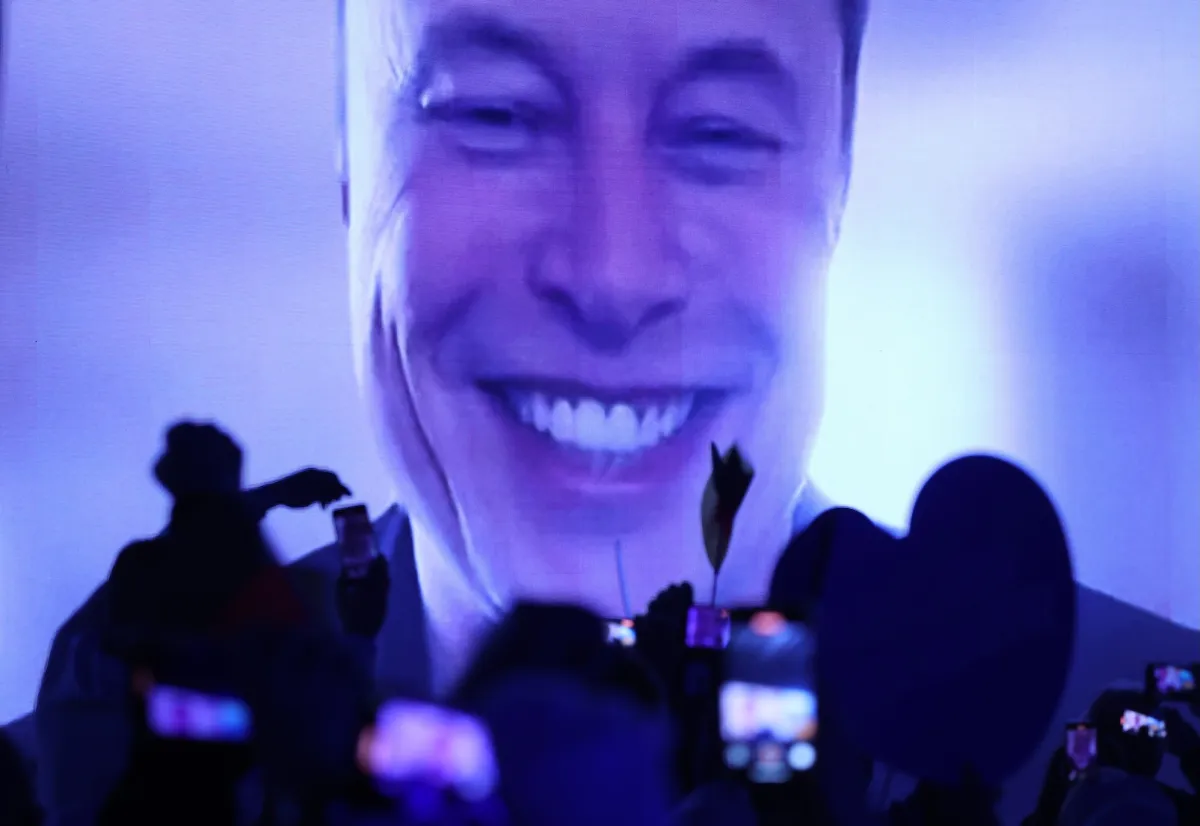
Elon Musk spent SpaceX’s first earnings call making some out-of-this-world claims about the company’s business and future prospects, while his fellow executives kept trying to bring his ideas closer to Earth — providing a hint of what’s to come now that his rocket-launching, compute-leasing, satellite-based telecom is public.
Key Takeaways from SpaceX’s Inaugural Public Earnings Call:
- Musk’s Grand Visions vs. Executive Grounding:CEO Elon Musk consistently presented vastly ambitious timelines and projections for Starlink, Starship, and overall revenue, which his COO and CFO frequently nuanced with more conservative, legally hedged language, echoing a pattern seen at Tesla.
- Aggressive Financial Targets Amplified:From Starlink’s internet dominance to a $100 billion annualized compute revenue run rate and an accelerated path to a trillion-dollar valuation, Musk’s pronouncements often inflated already ambitious executive targets, setting high investor expectations.
- Public Scrutiny Meets Legal Shield:As a public company, SpaceX theoretically faces increased regulatory oversight for its claims. However, a perceived pullback in corporate enforcement by agencies like the SEC and DOJ, coupled with the company’s Texas incorporation, offers considerable insulation against potential investor lawsuits.
Elon Musk’s SpaceX: Where Vision Meets Reality in a Public Debut
SpaceX’s inaugural earnings call as a public entity offered a fascinating, if predictable, spectacle. At its core, the Tuesday conference call laid bare the familiar dynamic that has come to define Elon Musk’s ventures: the visionary CEO making audacious, often fantastical, claims about the company’s future, while his executive team diligently works to ground those ideas in more digestible, and legally defensible, language for the investing public. This pattern, eerily reminiscent of Tesla, where Musk increasingly focuses on futuristic aspirations while his colleagues address the tangible business of selling cars, now sets the stage for how investors will perceive and value the rocket-launching, compute-leasing, and satellite-based telecom giant.
The transition to a public company brings with it a new level of scrutiny and accountability. While the private SpaceX could largely operate under the radar of public markets, every word spoken on an earnings call now carries regulatory weight and implications for investor confidence. The stark contrast between Musk’s unbridled optimism and his team’s careful qualifications wasn’t just a matter of style; it represented a strategic tightrope walk between inspiring faith in an ambitious future and mitigating the risks associated with unmet promises.
The Starlink Stratosphere: A Vision for Internet Dominance
One of the most expansive ideas Musk floated on the call concerned the future of SpaceX’s Starlink service. He boldly declared his expectation for Starlink to “deliver a majority of the world’s internet” within “less than 10 years.” This striking prediction came as SpaceX prepares to launch the “V3” versions of its Starlink satellites, which promise significantly higher bandwidth capabilities than their predecessors. Musk articulated his belief with characteristic certainty:
It’s kind of hard for people to wrap their minds around this, but like, it’s not out of the question that at some point, Starlink will deliver a majority of the world’s internet, at least in countries where we’re allowed to operate, which is the vast majority of countries. So this is, you know, important to bear in mind, and it’s not in like the infinity future. It’s, you know, less than 10 years.
Just minutes later, Chief Operating Officer Gwynne Shotwell offered a more measured, yet still ambitious, perspective. Her phrasing carefully recalibrated Musk’s vision into a statement that emphasizes significant market presence without claiming outright dominance:
The significant amount of capacity we’re able to add to the Starlink constellation from the V3 satellites will enable us to continue providing even better service — and it’s pretty great already — but to do so while serving more and more customers over the world.In fact, in the years ahead, we expect Starlink will represent a significant portion of global internet traffic, which Elon also talked about.
The distinction between “a majority” and “a significant portion” is crucial. While both are ambitious, Shotwell’s language is far more conservative, allowing for growth and impact without the definitive, almost monopolistic, implication of Musk’s statement. For investors, understanding this subtle yet profound difference is key to assessing risk and potential returns. A “majority” implies a fundamental shift in global internet infrastructure, while a “significant portion” suggests a powerful, but not necessarily dominant, player in a diverse ecosystem.
Billions in the Cloud: Compute Power and Financial Futures
Beyond satellite internet, SpaceX’s foray into renting out compute power to AI players has emerged as a new, lucrative business segment. Chief Financial Officer Bret Johnsen highlighted this area, offering one of the few new specific financial targets on the call. Johnsen’s remarks were meticulously crafted, designed to excite investors while carefully delineating the conditions and potential caveats of the projection. This hedging is critical for public companies to avoid legal exposure should projections not materialize as hoped.
Looking ahead, we continue to see robust demand in all three of our business segments, but in particular in our cloud services arrangements. We see increasingly favorable economics with each agreement we sign, and as Elon mentioned, we expect the supply-demand imbalance in the compute market to continue. The current economics have translated into a less than one-year payback on our new capital deployments for compute. For example, in the first few weeks of the third quarter, we’ve already contracted an additional $6.7 billion of cloud services revenue over a six month period that begins ramping starting in October of this year.We believe this puts us on a trajectory, including contribution from Cursor, to reach $100 billion of ARR, or annualized revenue run rate by the end of this year, based on our expected revenue in the month of December of this year.
Musk, however, swiftly bulldozed over Johnsen’s careful construction, not only stripping away the qualifiers but immediately inflating the target with an air of inevitability and potential upside:
To be clear, the $100 billion ARR in December is not a question mark. That’s… that’s what we would achieve if we basically did nothing. So like, you know, I think it may be higher than that. It probably will be higher than that.
This amplification transforms a carefully calculated “trajectory” based on “expected revenue in the month of December” into an assured baseline that Musk suggests will likely be surpassed. The implication for investors is that the $100 billion ARR is not just a target, but a floor, potentially driving up market expectations and valuation in the short term, but also increasing the pressure for the company to deliver.
Trajectory to a Trillion: Accelerating Revenue Ambitions
The pattern continued with an even broader financial prediction. Musk enthusiastically updated an already ambitious goal from SpaceX’s recent IPO documents concerning overall company revenue:
It’s probably also worth mentioning that our internal projections for reaching a trillion dollars in revenue, not ARR, but revenue, have moved up from 2031 to 2030. So prior to the IPO, the financial projections we had were reaching a trillion dollars in in revenue in 2031. We now expect that to be in 2030. And there’s a non-zero chance of that being in 2029.
A trillion dollars in annual revenue within less than a decade is an astronomical figure for any company, let alone one operating in the capital-intensive space sector. Accelerating this target by a year, with the added “non-zero chance” of hitting it even earlier, underscores Musk’s relentless push for speed and scale. This kind of declaration, while energizing to many, also demands a deep dive into the underlying assumptions about Starlink’s market penetration, Starship’s operational success, and the continued growth of new segments like compute leasing.
Starship’s Lofty Promises: Moon Missions and Daily Flights
The discussions around Starship, SpaceX’s ambitious next-generation rocket, also followed this familiar cadence. A shareholder question about progress on the “human landing system” (HLS) that SpaceX is developing for NASA’s Artemis moon missions prompted Musk to assert that the Starship prototype would be ready for human flight by the end of next year. He then went further, predicting Starship rockets would be flying once a day, or “possibly more,” by this time next year.
Gwynne Shotwell once again stepped in to provide a dose of reality. While still ambitious, her clarification emphasized the procedural and contractual nature of their work with NASA, offering a more generalized timeline:
wewantto put boots on the ground, boots on the moon, in 2028.
The difference between “ready to fly people by the end of next year” and “want to put boots on the moon in 2028” is significant. The former suggests imminent operational readiness for crewed missions, while the latter acknowledges the complex, multi-year program required for actual lunar landings, dependent on numerous technical and regulatory hurdles. The path to Starship’s full reusability and operational flight rate is fraught with engineering challenges, particularly the development of a robust heat shield for atmospheric re-entry.
Despite these complexities, and after only one recent test flight where the rocket stage, though intact, had yet to be recovered, Musk boldly claimed he’d “consider the heat shield problem solved at this point.” This statement, while potentially indicative of internal confidence, comes long before the rigorous testing and validation typically required to declare such a critical engineering challenge truly “solved.”
The Public Eye and Legal Landscape: Reckoning with Reality?
Elon Musk’s history is peppered with grand predictions that have not materialized within their stated timelines – recall his 2016 assertion of putting humans on Mars in six years. However, the stakes are considerably higher now. As a public company, SpaceX is ostensibly subject to the regulatory oversight of bodies like the Securities and Exchange Commission (SEC) and the Department of Justice (DOJ). These agencies have the power to investigate and fine companies and executives for making misleading statements or promises they know cannot be met, designed to improperly influence stock prices.
Yet, the current climate presents a complex picture. There is a widespread perception that both the SEC and DOJ have significantly “pulled back” on corporate enforcement, particularly against prominent public companies. This reduced regulatory vigilance could embolden executives to make more aggressive claims without immediate fear of repercussions. Furthermore, SpaceX has taken steps to “inoculate itself” against civil lawsuits from disgruntled investors by incorporating in Texas. Texas law, generally considered more corporate-friendly, offers a different legal landscape compared to traditional corporate havens like Delaware, potentially making it harder for shareholders to successfully pursue litigation for unfulfilled promises or alleged misrepresentations.
This dual reality – theoretical public company accountability clashing with practical regulatory leniency and strategic legal protections – creates a unique environment for SpaceX’s public debut. It suggests that while investor expectations will be shaped by Musk’s ambitious pronouncements, the avenues for recourse if those promises fall short may be more limited than typically assumed for publicly traded entities.
Bottom Line: The Musk-SpaceX Public Paradox
SpaceX’s inaugural public earnings call perfectly encapsulates the paradox of an Elon Musk-led enterprise: a dazzling vision of technological marvels and unprecedented growth, constantly presented through a lens of extreme optimism, contrasted with the more pragmatic, risk-mitigating language of his executive team. For investors, navigating this dynamic requires discerning between aspirational goals and concrete business projections. While Musk’s ability to inspire and disrupt is undeniable, the long-term success of public SpaceX will hinge not just on the grandness of its CEO’s pronouncements, but on the consistent, verifiable execution of its ambitious plans, all while operating within a complex and evolving regulatory and legal landscape. The call was a blueprint for the delicate balance between inspiring a futuristic narrative and delivering tangible results in the unforgiving glare of the public market.
When you purchase through links in our articles, we may earn a small commission. This doesn’t affect our editorial independence.
{content}
Source:{feed_title}