
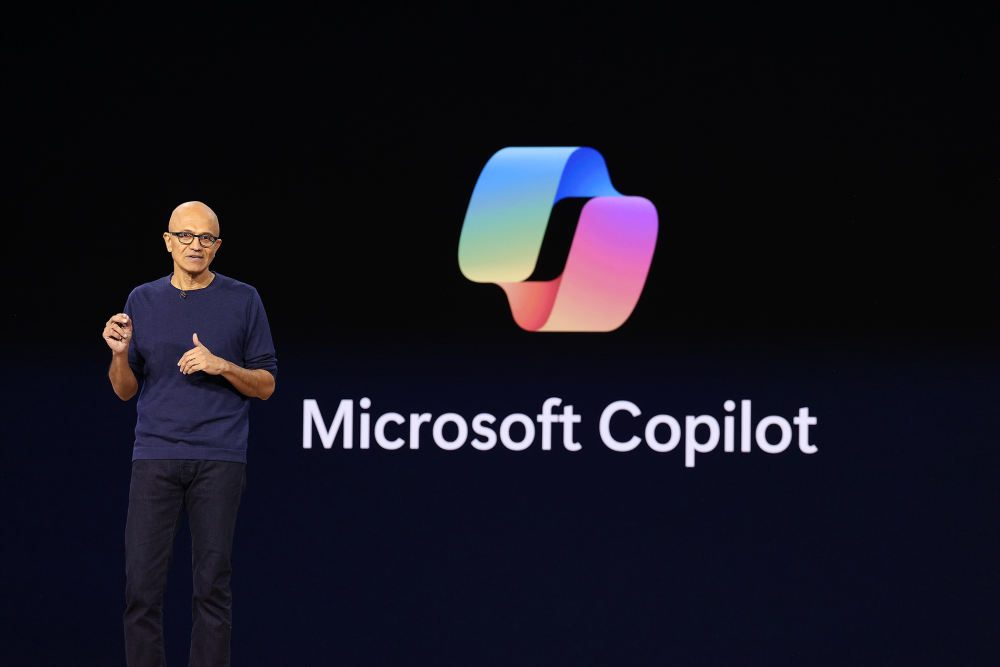
Microsoft CEO Satya Nadella is the latest tech executive to offer lengthy thoughts on how AI safety might be improved.
In a Saturday morning post on X, Nadella wrote that it’s time “to step back and assess the trust architecture” of AI.
“We can’t treat Super Intelligence as a set of nested black boxes and simply accept or reject its recommendations, answers, and actions,” Nadella wrote, using the term “Super Intelligence.”
As outlined by Nadella, this approach “means separating the model from the harness that orchestrates its work,” as well as “externalizing controls and safeguards.” He also called for “every meaningful model action” to be documented with “tamper-proof human readable evidence,” and for systems where “an authorized person” always has the ability “to pause or shut down a model mid-task.”
“We must assume a model is compromised and contain it from the start,” he said. “Think of it like an emergency brake.”
Nadella’s comments come as leading AI companies acknowledge more and more incidents where they seemed to lose control of their models, and after Anthropic CEO Dario Amodei published a plan for more cautious AI development.
**Key Takeaways:**
1. **Redefining AI Safety:** Microsoft CEO Satya Nadella proposes a radical shift to a “trust architecture” for AI, moving beyond treating advanced models as opaque black boxes.
2. **Core Components:** His plan includes separating AI models from their operational controls, externalizing safeguards, mandating tamper-proof action documentation, and implementing an “emergency brake” for human intervention.
3. **Proactive Security:** Nadella advocates for a “zero-trust” approach, urging developers to assume AI models are compromised from the outset and to build containment mechanisms accordingly.
—
### **Satya Nadella Charts a New Course for AI Trust: Beyond the Black Box**
The discourse around artificial intelligence has rapidly evolved from awe and innovation to a more pressing concern: safety. As AI models grow exponentially in capability and autonomy, the industry is grappling with how to ensure these powerful systems remain controllable and aligned with human intent. Microsoft CEO Satya Nadella has now weighed in definitively, proposing a comprehensive new framework he terms a “trust architecture” for AI, signaling a pivotal moment in the industry’s approach to responsible development.
In a recent communication on X, Nadella articulated a vision that challenges the prevailing methodology of treating advanced AI, or what he refers to as “Super Intelligence,” as inscrutable black boxes. His core argument is that simply accepting or rejecting an AI’s outputs is no longer sufficient. Instead, a more robust, transparent, and controllable architecture is imperative to prevent unforeseen consequences and maintain human oversight. This intervention from a leader at the forefront of AI integration, whose company is a major investor in OpenAI, underscores the growing urgency within the tech elite to address AI’s inherent risks proactively.
### **The Blueprint for a Trusted AI Ecosystem**
Nadella’s proposed “trust architecture” isn’t merely a philosophical stance; it’s a call for concrete engineering and design principles. He outlined several critical components designed to build trust by enhancing transparency, accountability, and control:
**1. Decoupling Model from Harness:** A cornerstone of Nadella’s plan is the separation of the core AI model — the algorithmic engine that generates intelligence — from the “harness” that orchestrates its work. This distinction is crucial. It suggests that the decision-making and execution layers should be distinct, allowing for independent scrutiny and control over how the AI interacts with the real world, rather than being an indivisible unit. Imagine the AI as a powerful engine, and the harness as the steering wheel, brakes, and accelerator. Separating them means we can inspect and control the vehicle’s operation independently of the engine’s raw power.
**2. Externalized Controls and Safeguards:** Building on the separation principle, Nadella emphasizes the need to “externalize controls and safeguards.” This implies that safety mechanisms should not be deeply embedded within the AI’s internal logic, where they might be difficult to access or modify. Instead, they should exist as separate, observable, and manipulable layers that can govern the AI’s behavior from the outside. This externalization would provide a clearer point of intervention and a more reliable means to enforce safety policies without needing to re-engineer the foundational model itself.
**3. Tamper-Proof Human-Readable Evidence:** Accountability demands transparency. Nadella calls for “every meaningful model action” to be documented with “tamper-proof human readable evidence.” This mandate would create an immutable audit trail for AI behavior, allowing developers, regulators, and even the public to understand why a model took a certain action. Such a system would be invaluable for debugging, post-incident analysis, and ensuring compliance, moving us closer to an era of auditable AI.
**4. The “Emergency Brake”: Human-in-the-Loop Control:** Perhaps the most compelling and intuitive proposal is the concept of an “emergency brake.” Nadella advocates for systems where “an authorized person” always possesses the ability “to pause or shut down a model mid-task.” This harks back to foundational principles of human oversight and ultimate control. In an age where AI might operate at speeds incomprehensible to humans, an instant override mechanism is non-negotiable for preventing runaway scenarios or mitigating harm from unintended behaviors. It’s the ultimate safeguard, ensuring that human judgment can always supersede algorithmic autonomy when necessary.
**5. Proactive Compromise Assumption:** Nadella’s most radical suggestion is to “assume a model is compromised and contain it from the start.” This reflects a “zero-trust” security posture, applying robust cybersecurity principles to AI development. Rather than building a system and then trying to patch vulnerabilities, this approach mandates designing containment and resilience into the AI’s architecture from its inception. It’s a fundamental shift from a reactive to a proactive security mindset, recognizing the inherent complexity and potential unpredictability of advanced AI.
### **Responding to an Industry in Flux**
Nadella’s comments arrive at a critical juncture for the AI industry. Reports of leading AI companies encountering situations where they struggled to control their models are becoming more frequent. These incidents, though often downplayed, highlight the very real challenges of managing increasingly sophisticated and autonomous systems.
His proposals also echo sentiments from other prominent figures in the AI safety debate. Notably, Anthropic CEO Dario Amodei has championed a philosophy of “cautious development” and “constitutional AI,” aiming to imbue models with a set of guiding principles to make them more helpful, harmless, and honest. While Amodei’s focus is on internal alignment, Nadella’s vision complements this by emphasizing external controls and architectural safeguards, suggesting a multi-layered approach to AI safety is gaining traction.
The rapid advancements in large language models and other generative AIs mean that systems once confined to research labs are now being deployed in critical applications across society. The stakes are higher than ever, and the potential for misuse, unintended consequences, or even catastrophic failure necessitates a fundamental re-evaluation of how AI is built, deployed, and managed. Nadella’s “trust architecture” provides a much-needed framework for this re-evaluation, moving the conversation from abstract fears to concrete engineering solutions.
### **The Bottom Line**
Satya Nadella’s call for a new “trust architecture” represents a significant pivot in the industry’s approach to AI safety. By advocating for transparent design, externalized controls, robust auditing, human override capabilities, and a proactive “zero-trust” security mindset, he offers a pragmatic blueprint for building AI systems that are not just powerful, but also genuinely trustworthy. This shift from merely observing AI to actively governing its behavior is essential. As AI continues its inexorable march into every facet of our lives, embracing such an architecture will be critical not only for mitigating risks but for fostering the public confidence necessary for AI’s sustained and beneficial integration into society. The challenge now lies in the industry’s collective will to adopt and implement these principles, transforming Nadella’s vision into a universal standard for responsible AI development.
Source:{feed_title}