
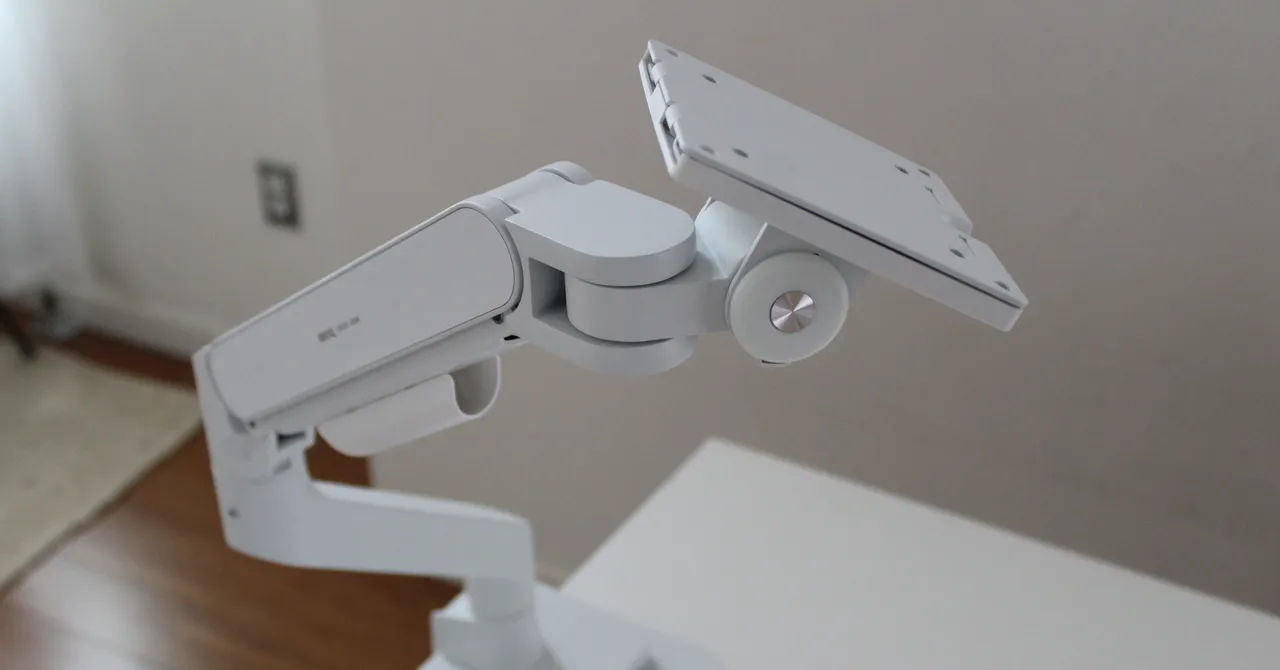
Alright, you’ve settled on the idea of acquiring a monitor arm, yet a multitude of choices are available, particularly if you’re browsing on Amazon. Herein lie some of the most crucial elements to contemplate.
Arm Mechanism: Currently, the most prevalent type of display mount is entirely multi-jointed. This configuration is likely what the majority envision upon hearing “monitor arm,” as it mirrors a robotic appendage. Nonetheless, simpler vertical pole designs exist, merely permitting height adjustment for the screen. I typically advise against these, given their highly restricted adjustability. An intermediate solution involves a pole structure paired with an articulated arm, a setup common to certain multiple-display configurations.
Manufacturer: Opt for a reputable manufacturer. Amazon features popular selections from less prominent brands like Huanuo or Ergotron, which present excellent economy. Display producers frequently craft monitor supports themselves and serve as a credible source, such as Asus, MSI, BenQ, or Acer. Finally, more premium contenders within the home workspace sector, like Branch and Herman-Miller, also produce display mounts boasting greater sophistication.
Construction and Aesthetics: Display supports frequently manifest as cumbersome apparatuses, particularly when excessively bulky and fabricated from inexpensive polymers. Seek out variants constructed from aluminum or steel to ensure sturdier supports with a more refined aesthetic.
Load Capacity: The primary function of a display mount is to suspend your screen, preventing perpetual descent or harm to your workspace. Ensure you ascertain the mass of your display unit and meticulously review the specified load capacity of the prospective monitor support. Should your screen be curved, allocate an additional margin of approximately 5 pounds, since the curvature imparts supplementary forward mass, exerting greater strain on the arm. Furthermore, deploying a lightweight display on a heavy-duty mount is ill-advised, as this may lead to unwanted buoyancy.
Attachment Methods: Clamps, Grommets, and Wall Mounts: Typically, when referring to “monitor arms,” one envisions a device that fastens to a desk edge. Certain display supports advance beyond this, offering a feature for permanent fixation of the arm to your workstation via drilling an aperture and securing it with a metallic plate or grommet. From a personal standpoint, the concept of perforating my desk is unappealing, yet it undeniably represents the most steadfast approach to stabilizing the support. Others are primarily engineered for wall-mounting, should that be your sole recourse.
{content}
Source:{feed_title}