
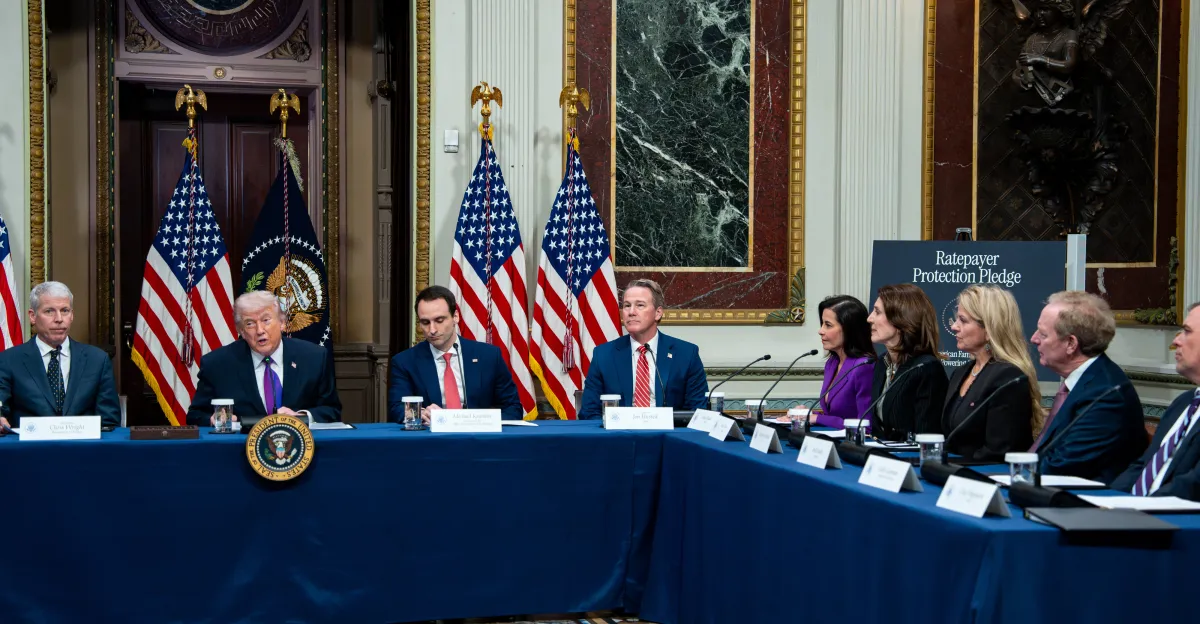
“Technology firms require some public relations assistance, as individuals tend to believe that if a data facility is established, their electricity expenses will rise,” Trump stated during the gathering. He added, “Some centers were previously opposed by local areas for this reason, but I anticipate the outcome will now be the reverse.”
“Individuals perceive that should a data center be built, their power costs will ascend.”
The official declaration specifies that the seven entities participating in the event have “agreed to the conditions of the Ratepayer Protection Pledge,” and that “the commitments contained therein advance the federal agenda of the United States.” Nonetheless, it also states that these corporations would still need to “autonomously broker” accords with utility providers and state administrations.
The president indicated that these companies bear the responsibility for expanding grid capacity “where feasible.” He further mentioned their obligation to cover the expenses associated with enhancing current energy systems to satisfy escalating electricity requirements. Trump noted that firms should negotiate distinct pricing arrangements with utilities. This action aims to guarantee they pay an equitable charge for the additional strain a data center places on the network. Corporations would be accountable for these expenditures even if the data facilities do not ultimately consume all of the supplementary power generated. This represents a crucial step that could allay concerns that local communities would be left bearing the burden for new power plants and transmission lines that become unutilized resources if excitement surrounding AI diminishes and data facility initiatives fail.
Trump articulated that the technology behemoths would “leverage their infrastructure to supply supplementary energy to local grids during periods of high demand.” Curtailing a data center’s energy consumption when power needs surge—for instance, during a harsh winter storm or an intense heatwave—is a strategy that could help avert blackouts in times of crisis. This year’s winter storms have sparked worries regarding how additional data centers might exacerbate strain on energy networks and elevate power costs during disasters. Last year, Texas enacted legislation granting its local grid manager the power to curtail data centers’ energy use in urgent situations. The pledge itself is less specific, stipulating that companies would “when circumstances allow, deploy their auxiliary power sources at periods of limited supply.”
At the gathering, Gwynne Shotwell, President and COO of SpaceX (which recently revealed its combination with xAI, intending to advance initiatives to launch data centers into space), stated that xAI plans to construct a 1.2-gigawatt generating facility as the main energy supply for its supercomputer. Shotwell added that the company would likewise establish a similar amount of power generation for “every subsequent data facility.” xAI also intends to enlarge its Megapack deployment to offer supplementary electricity to Memphis, Tennessee, and Southaven, Mississippi. The NAACP has already issued legal threats against xAI twice regarding emissions from the provisional gas generators it has set up in Tennessee and Mississippi to energize its data centers.
The commitment further encompasses a promise to recruit from within nearby localities where data centers are being built. Meta revealed recently that it initiated a trial scheme in Ohio to educate fiber optic specialists, including some individuals who were present at the day’s proceedings.
{content}
Source:{feed_title}