
Key Takeaways:
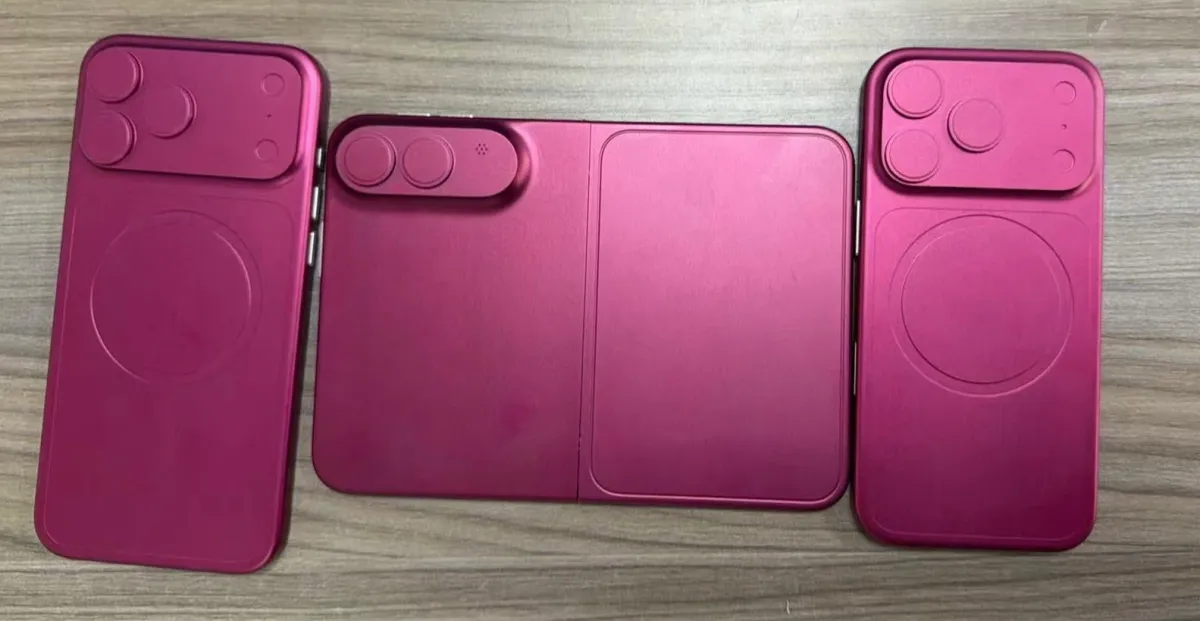
- Leaked dummy units, shared by reliable leaker Sonny Dickson, suggest the iPhone Fold will feature an unusually wide, squatter form factor with a distinctive pill-shaped camera island.
- Early engineering tests for Apple’s highly anticipated foldable have reportedly encountered significant production challenges, potentially delaying its market debut by several months.
- This unique design and potential production setback places Apple’s entry into the competitive foldable market on a challenging trajectory, even as other manufacturers explore similar ‘wide fold’ variants.
The tech world is abuzz with a potent mix of excitement and concern surrounding Apple’s inaugural foldable smartphone, widely anticipated as the iPhone Fold. A recent confluence of leaks and industry reports has painted a vivid, albeit challenging, picture of the device’s current state: an intriguing and unusually wide design has surfaced via credible dummy unit photos, while simultaneous reports warn of significant production hurdles that could push its launch well beyond initial expectations.
This dual revelation – a concrete glimpse at Apple’s innovative form factor juxtaposed with whispers of an arduous development cycle – underscores the monumental task of bringing a cutting-edge foldable to market. While Apple is renowned for its meticulous product launches, the foldable segment presents unique engineering complexities that appear to be testing even the Cupertino giant’s formidable capabilities, potentially delaying what many expect to be a transformative device.
Unveiling the iPhone Fold’s Distinctive Design: A Dummy Unit Leak
The clearest visual indication of the iPhone Fold’s potential shape comes courtesy of prominent leaker and journalist Sonny Dickson. Known for his accurate track record in obtaining dummy models – the non-functional prototypes used by accessory manufacturers for design and fit testing – Dickson recently shared a series of images on Bluesky. These photos purport to show a dummy unit of the foldable iPhone, presented alongside similar models of the forthcoming iPhone 18 Pro and 18 Pro Max, offering a direct comparison to Apple’s more traditional handset designs and highlighting the foldable’s unique proportions.
The most striking aspect of the leaked unit is its unique form factor. While Dickson did not provide exact measurements, the dummy appears noticeably squatter and wider than many book-style foldables currently on the market. It bears a resemblance to Google’s inaugural Pixel Fold, though initial impressions suggest Apple’s iteration might be even broader. This design choice implies a strategic decision by Apple to differentiate its foldable, potentially prioritizing a larger, more expansive external display or an internal screen aspect ratio optimized for specific productivity, gaming, or media consumption tasks. Such a wide stance could significantly enhance the multi-tasking experience when unfolded.
From the exterior, the dummy unit reveals a distinctive camera housing. Two rear cameras are horizontally aligned within a raised, pill-shaped island that stretches approximately two-thirds across the phone’s unusually wide rear panel. This layout, while not entirely unprecedented in the broader smartphone market, suggests a departure from the square camera modules seen on recent Pro models, possibly to accommodate the wider form factor or integrate specific camera technologies optimized for a folding device. The interior of the dummy unit, however, offers little insight into key design elements such as the selfie camera placement, Face ID sensors, or the crucial hinge mechanism that defines a foldable experience and often dictates its overall robustness.
Intriguingly, this “wide fold” form factor might represent an emerging trend across the industry. Industry rumors indicate that Samsung, a pioneer in the foldable space and Apple’s primary competitor, is also developing a “Wide Fold” variant for a potential launch later this year. If true, this suggests a convergence in design philosophy among major players, with manufacturers exploring broader, more tablet-like foldable experiences when unfolded, while still retaining the convenience and portability of a folded smartphone.
Production Headaches and Potential Delays: An Uphill Battle
While the design leak fuels excitement, a concurrent report fromNikkei Asiatempers expectations with news of significant production challenges. Apple had been widely expected to unveil the iPhone Fold alongside the iPhone 18 Pro and 18 Pro Max at its traditional September launch event, with the standard iPhone 18 potentially arriving in 2027. However,Nikkeireports that early production runs have been plagued by “engineering challenges” that are proving more difficult and time-consuming to resolve than initially anticipated, potentially delaying the first shipment by “months.” This could significantly shift Apple’s product roadmap and market entry strategy for its first foldable.
Sources cited byNikkeipaint a picture of a supply chain under immense pressure to meet Apple’s rigorous standards amidst these complexities. “Apple and the supply chain are working under a pressured timeline and the current solutions are not enough to completely solve the engineering challenges,” one source reportedly stated, adding, “More time is needed.” Such “engineering challenges” in foldable production typically revolve around the intricate hinge mechanism – ensuring durability, smoothness, and gap-free closure – the reliability and flatness of the flexible display panel, managing the screen crease over time, and ensuring robust internal components can withstand repeated folding cycles. These are complex hurdles that have challenged every manufacturer entering the nascent foldable market, and Apple, known for its uncompromising quality, is unlikely to rush a product that doesn’t meet its internal benchmarks.
This reported delay aligns with earlier predictions fromBloomberg’s well-connected Apple analyst, Mark Gurman. Gurman had previously suggested that while the foldable iPhone might be revealed concurrently with the Pro models, its actual shipping date would likely lag behind. The corroboration from multiple reputable sources adds significant weight to the concerns about the iPhone Fold’s readiness for a timely market debut. A multi-month delay could mean the device might not reach eager consumers until late 2026 or even early 2027, long after its initial unveiling and potentially impacting its competitive standing against established foldable rivals.
Apple’s Entry into a Maturing Market
Apple’s typical strategy involves entering established product categories relatively late, but with a highly refined and polished offering that often redefines the user experience. The foldable market, though still nascent compared to traditional smartphones, has seen several generations of devices from Samsung, Google, and various Chinese manufacturers like Huawei, Xiaomi, and Honor. A delayed entry for the iPhone Fold, especially one caused by production issues, could give competitors more time to innovate, refine their own offerings, and consolidate their market share, even as Apple aims to deliver a superior product.
The choice of a wider form factor could be a deliberate attempt by Apple to carve out a unique niche, appealing to users who desire a more expansive digital canvas for multitasking, professional applications, or immersive entertainment, while still retaining the portability of a folding device. This approach could differentiate it from narrower clamshell or book-style foldables. However, successfully executing such a design, especially with Apple’s stringent quality standards, is clearly proving to be a formidable engineering feat, underscoring the complexities inherent in bringing truly innovative hardware to mass production.
The Bottom Line
The journey of the iPhone Fold to market is shaping up to be a textbook example of the cutting-edge challenges inherent in foldable technology. While the leaked dummy unit offers an exciting glimpse into Apple’s distinctive vision for its first folding device – a uniquely wide and squat design that promises a rich user experience – the accompanying reports of significant production delays underscore the formidable hurdles in bringing such innovation to fruition. Apple’s unwavering reputation for perfection means it will likely take all the time needed to iron out these engineering complexities, even if it means a later-than-expected arrival. For eager consumers, the wait for the iPhone Fold might be extended, but the hope remains that it will ultimately deliver the polished, groundbreaking experience synonymous with an Apple product, setting a new benchmark in the evolving world of foldables and justifying the extended anticipation.
{content}
Source:{feed_title}