
Key Takeaways
- Smooth Sailing, Sustainable Future:Vessev’s VS-9 electric hydrofoil ferry offers a remarkably smooth, “sports car-like” ride, revolutionizing water transit with efficiency and comfort.
- Efficiency is Electric Gold:By lifting its hull above the water, hydrofoil technology drastically reduces drag, making electric propulsion viable and highly efficient for urban waterways, maximizing range and minimizing energy consumption.
- Strategic Innovation for Market Entry:Vessev’s approach, including in-house motor manufacturing and leveraging commoditized batteries, aims to control costs and accelerate the adoption of electric hydrofoils in the burgeoning transit sector.
“When will we start flying?” I asked Vessev co-founder and CEO Eric Laakmann, as we pulled away from the Brooklyn marina in the startup’s VS-9 electric ferry. “We already are.”
I’ll admit I was a bit disappointed. I thought the moment when it transitioned from sailing like a regular boat to almost-flying as a surface-skimming hydrofoil would be more … momentous. My mind conjured images of a sudden lift, a noticeable shift, perhaps even a subtle jolt. Instead, it was an almost imperceptible glide, a testament to the sophisticated engineering beneath the surface.
Having been on my share of boats – from large, lumbering ferries to nimble sailboats and countless others in between – I’d never experienced a hydrofoil. My curiosity was piqued, eager to discover what “flying along the water” truly felt like during the brief ride from the Brooklyn Marina out toward Governors Island on the East River in New York.
The Subtle Sensation of “Flight”
It didn’t feel like flying in the traditional sense, but it was remarkably akin to riding in a high-performance sports car. The ride was incredibly smooth, devoid of the typical choppiness and hull-slapping common to conventional vessels. Traditional boats of this size — about 30 feet — typically begin to bounce and slap the water with increasing speed, generating significant wake and discomfort. On the VS-9, as we accelerated, that’s precisely when the hydrofoils began to do their work, transforming the ride from merely sailing to a serene glide.
Unpacking Hydrofoil Technology: How Vessev Lifts Off
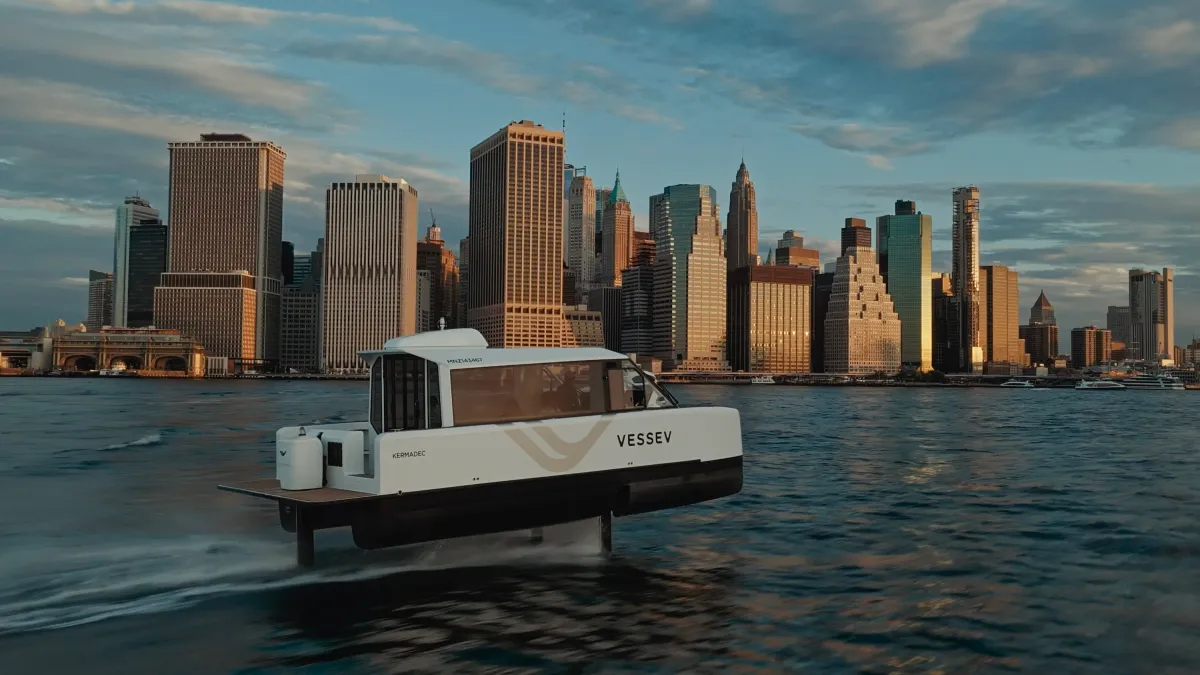
On the surface, the VS-9 presents itself as a sleek, modern catamaran, not unlike many other multi-hull designs. However, its true innovation lies beneath the waterline. Underneath the hull are two wing-like structures, the hydrofoils, designed to lift the boat as they slice through the water. These foils are akin to airplane wings, generating lift as water flows over and under them, effectively raising the main hull clear of the surface.
This dynamic lift is not merely a passive phenomenon. Computer-controlled underwater flaps actively manage the foils, ensuring the ride remains exceptionally smooth and stable, even as conditions change. In the VS-9, most of the lifting force – roughly 80% – is generated by the front foil, with the remaining 20% handled by the rear. This precise distribution and active control contribute significantly to the seamless transition and stable ride I experienced.
Shipbuilders and inventors have been experimenting with hydrofoils for well over a century, recognizing their inherent advantages. The design fundamentally reduces the wetted surface area, which is the amount of boat hull in contact with the water. This reduction dramatically decreases hydrodynamic drag, leading to a host of benefits, including higher speeds and, critically for electric propulsion, significantly lower energy consumption. The subtle transition I experienced on the VS-9, from sailing to almost-flying, truly underlined just how smooth and efficient a modern hydrofoil can be.

Vessev’s Strategic Build: Powering the Future of Water Transit
The rear foil also conveniently houses the electric motor, a critical component that Vessev manufactures in-house. When asked about this decision, Laakmann emphasized its importance for cost control and long-term viability. “Eventually, you’ll have to bring production in house,” he explained, suggesting that doing so earlier in the development cycle allows for greater control over design, quality, and ultimately, the unit economics. This strategic vertical integration is crucial for scaling up and making electric hydrofoils competitive. The only major component Vessev currently outsources are the batteries. “Those have been commoditized,” Laakmann noted, indicating a pragmatic approach to leveraging existing, cost-effective supply chains where appropriate.
By lifting the hull clear of the water, hydrofoils can operate with significantly greater efficiency than traditional displacement boats. This efficiency is paramount for electric vessels, where every kilowatt-hour of battery power directly translates to range and operational cost. Reduced drag means less energy is wasted fighting the water, allowing for longer routes, higher speeds, or smaller, lighter battery packs, which further reduces cost and complexity. The VS-9 is also designed for practicality, capable of charging using a typical EV charger, making infrastructure integration simpler for transit operators.

Navigating the Limitations: Where Hydrofoils Truly Shine
Despite hydrofoils’ significant advantages, they are not a universal panacea for all maritime challenges. The design inherently works best in waters calm enough for the boat to clear when sailing on its foils. For the VS-9, that optimal clearance is about two and a half feet, or 0.75 meters. If wave heights consistently exceed this threshold, the hull begins to hit the water, disrupting the smooth ride and significantly sapping efficiency as the drag increases. Therefore, while revolutionary, these vessels are not ideally suited for the turbulent conditions of the open ocean.
However, this limitation also clearly defines their ideal operational environment: sheltered waterways. Hydrofoils make immense sense for a vast array of other routes, including lakes, rivers, and bays – precisely the kind of environments where urban and inter-city water transit operates. Their ability to minimize wake is another critical environmental benefit, reducing erosion along sensitive shorelines and minimizing disturbance to marine life, a factor increasingly important for sustainable urban planning.
The Future of Urban Water Transit
Vessev, which successfully raised a $19 million Series A in August, is strategically targeting transit operations as its initial market. Laakmann and his team believe that the potent combination of efficient electric propulsion and hydrofoil technology can fundamentally transform how people move across urban waterways. Imagine faster, quieter, and cleaner commutes across bustling harbors and rivers, offering a viable alternative to congested road networks. The minimal wake, coupled with zero emissions, makes these vessels not just technologically advanced but also environmentally responsible, aligning perfectly with global sustainability goals for urban transportation.
Bottom Line
Vessev’s VS-9 represents more than just an innovative boat; it’s a compelling glimpse into the future of sustainable water transit. By harnessing the century-old principle of hydrofoils and pairing it with cutting-edge electric propulsion and a strategic manufacturing approach, Vessev is poised to make urban water travel faster, smoother, and vastly more environmentally friendly. While current limitations confine it to calmer waters, its potential to alleviate urban congestion, reduce carbon footprints, and offer an unparalleled passenger experience positions electric hydrofoils like the VS-9 as a critical component in building smart, green cities of tomorrow.
Source:{feed_title}
Key Takeaways
- Hydrofoil Revolution:Vessev’s VS-9 electric hydrofoil vessel drastically reduces drag, making electric marine transport efficient, quiet, and capable of significant range, overcoming traditional battery limitations.
- Urban Transit Game-Changer:The VS-9 offers a low-infrastructure solution for urban mobility, potentially augmenting existing mass transit systems in coastal cities like New York, connecting distant boroughs quickly and comfortably.
- Versatile Market Appeal:Beyond public transit, the VS-9 targets lucrative markets such as luxury tourism, hotel transport, and private ownership, showcasing the broad applicability of advanced electric marine technology.
Riding the Future: Vessev’s Electric Hydrofoil is Poised to Reshape Urban Waterways
Imagine gliding across the water, almost silently, at speed, with minimal wake and zero emissions. This isn’t a scene from a sci-fi movie; it’s the reality offered by Vessev’s groundbreaking VS-9 electric hydrofoil. Having recently experienced a demonstration ride, it’s clear this vessel is more than just a novelty – it represents a significant leap forward in marine transportation, one that could profoundly impact how we move through our most congested coastal cities and how we enjoy our leisure time on the water.
The challenge with traditional electric boats has always been range and speed. Batteries are heavy, and pushing a hull through water creates immense drag, rapidly draining power. Vessev, however, has engineered a solution that circumvents these fundamental limitations. Their VS-9 utilizes hydrofoils, wing-like structures beneath the hull that lift the entire vessel out of the water once it reaches a certain speed. This “flying” action dramatically reduces hydrodynamic drag by up to 95%, allowing the electric motors to operate with unparalleled efficiency.
The Science of Silence and Speed
The transformation is immediate and palpable. As the VS-9 accelerates, you feel a gentle lift, and the familiar sensation of a boat cutting through waves disappears. The ride becomes incredibly smooth, almost ethereal. The only sound is a faint hum from the electric motors, a stark contrast to the roar of conventional internal combustion engines. This isn’t just a comfort perk; it’s a critical component of Vessev’s strategy to bring down the cost of operating smaller vessels and make them comfortable enough to augment urban mass transit systems.
“We set out to tackle the core inefficiencies of marine travel head-on,” explains Laakmann, Vessev’s CEO and co-founder. “By leveraging hydrofoils, we’re not just making an electric boat; we’re redefining what’s possible for electric propulsion on water. The reduced drag means we can achieve speeds and ranges that were previously unimaginable for battery-powered vessels of this size, all while delivering a superior passenger experience.”

A New Blueprint for Urban Connectivity
The immediate implications for urban mobility are immense. Consider a sprawling metropolis like New York City, crisscrossed by waterways and burdened by a strained transit infrastructure. Instead of investing billions in new subway tunnels or bridge expansions, cities could deploy fleets of VS-9s. These vessels could zip people from Manhattan to Brooklyn or Queens, or even further afield, without needing to build much new infrastructure beyond existing dock improvements.
The operational cost savings are another compelling factor. Electric propulsion eliminates fuel costs and significantly reduces maintenance compared to complex marine diesel engines. For public transport operators, this translates to lower fares or more frequent service. For passengers, it means a faster, smoother, and more environmentally friendly commute, free from the vibrations and noise of traditional ferries.
Beyond Commutes: Luxury and Leisure
While urban mass transit is a prime target, Vessev isn’t limiting its vision. Hotels and tour operators are also an early target market. Imagine luxury resorts offering silent, swift transfers to guests, or eco-tourism companies providing unparalleled wildlife viewing experiences without disturbing marine life with engine noise. Public demonstrations like the one I attended have already attracted wealthy individuals looking for a cutting-edge, environmentally conscious addition to their fleet, Laakmann noted. The VS-9’s ability to carry a full passenger load up to 40 nautical miles (46 miles or 74 kilometers) makes it ideal for a variety of commercial and private applications, extending far beyond short hops.
The Road from Prototype to Pervasive
For now, the VS-9 I rode is one of a kind, a testament to Vessev’s pioneering spirit. But Laakmann said Vessev plans to build more, scaling up production to meet anticipated demand from various sectors. The long-term vision is even more ambitious: eventually, the company might shift to producing electric hydrofoil kits, allowing other boatbuilders to design their own vessels around the technology. This strategy could democratize advanced marine electrification, fostering a broader ecosystem of innovative, efficient watercraft.
Challenges remain, of course. Regulatory frameworks for novel marine technologies can be slow to adapt, and scaling production of sophisticated vessels requires significant capital and manufacturing expertise. However, the clear advantages in efficiency, comfort, and environmental impact position Vessev and its hydrofoil technology as a leading contender in the race to decarbonize global transportation. The increasing demand for sustainable solutions, coupled with technological advancements in battery density and motor efficiency, creates a fertile ground for such innovations to thrive.
The VS-9 isn’t just a boat; it’s a statement. It’s a tangible demonstration that electric marine travel can be both practical and exhilarating, offering a glimpse into a future where our waterways are cleaner, quieter, and more efficiently navigated.
The Bottom Line
Vessev’s VS-9 electric hydrofoil is more than an engineering marvel; it’s a pivotal innovation poised to redefine marine transportation. By dramatically improving efficiency, comfort, and environmental performance, it offers a compelling solution for urban mass transit, luxury tourism, and beyond. As cities seek sustainable and low-infrastructure solutions to congestion, and the marine industry strives for decarbonization, Vessev’s technology stands out as a powerful enabler for a cleaner, faster, and more enjoyable future on the water.
When you purchase through links in our articles, we may earn a small commission. This doesn’t affect our editorial independence.