
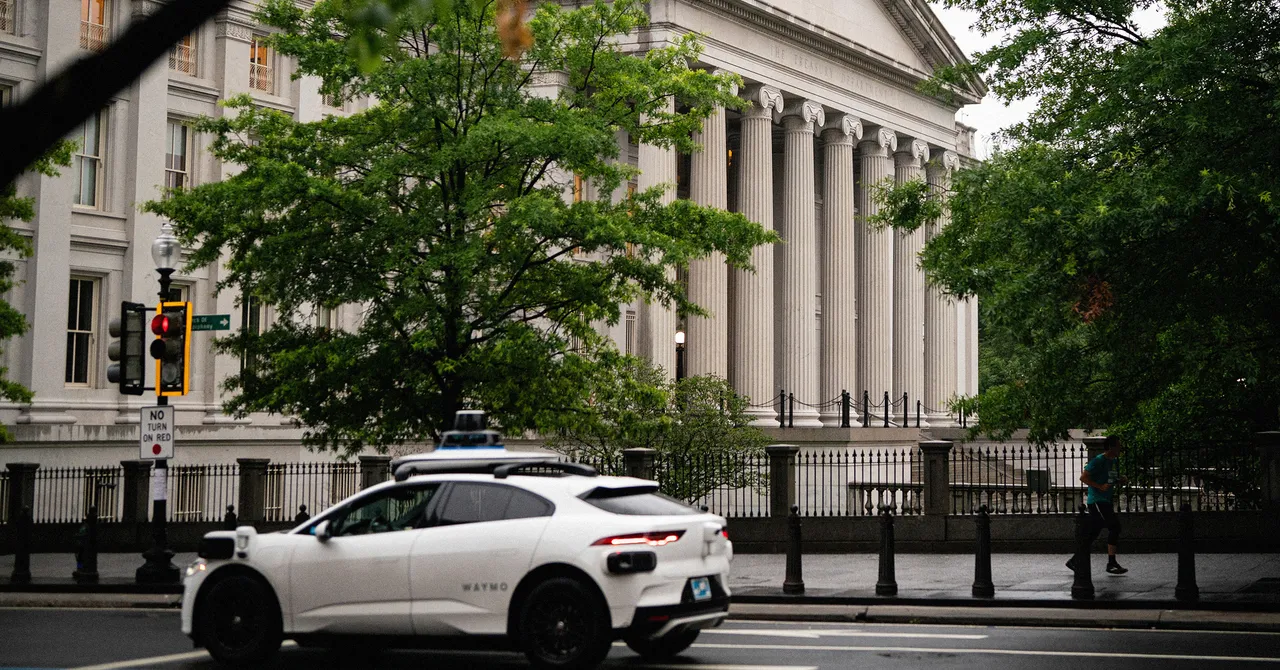
Waymo is seeking someaid, as revealed by an electronic mail the autonomous vehicle developer dispatched to inhabitants of Washington, DC, on Thursday.
For over twelve months, Waymo has been urging municipal authorities to enact novel rules permitting its autonomous taxis to function within the jurisdiction. Presently, self-driving vehicles are allowed to conduct trials in the metropolis with human supervisors, yet are unable to run without a driver. The Alphabet-owned entity—and its advocates—have appealed to regional legislators, among them Mayor Muriel Bower and the urban council’s representatives, to formulate fresh statutes enabling the technology to become fully autonomous on its communal thoroughfares. The firm has earlier stated it intends to commence providing autonomous journeys in DC this year.
But Waymo’s attempts to influence administrators have faltered, hence the corporation is presently soliciting inhabitants to exert some influence. “Our readiness to furnish Waymo journeys to the general populace of DC is imminent,” according to an electronic message forwarded to individuals enrolled in Waymo’s DC offering. “Nevertheless, notwithstanding substantial backing, the District’s governance has not yet granted the requisite authorizations for our initiation.”
The electronic mail guides addressees to reach out to DC authorities by means of a standardized missive which indicates, in essence: “Throughout the previous year, I have witnessed Waymo vehicles functioning across our neighborhoods, and I am enthusiastic regarding the prospective benefits this offering might deliver, encompassing improved reachability and a reduction in vehicular occurrences.” This correspondence implores DC citizens to revise the document to “phrase it in their own terms,” as tailored messages “possess greater influence.” Solely DC inhabitants or individuals possessing DC addresses are eligible to take part, Waymo indicates.
Via a formal declaration, Waymo’s representative, Ethan Teicher, affirms, “We anticipate being equipped to assist residents of Washington within the current year, and encourage the Mayor, the District’s Department of Transport, and the Municipal Council to take action.” The firm reports that one thousand five hundred individuals reached out to district administrators via its electronic mail within the initial ninety minutes following its dispatch.
Typically, creators of autonomous vehicles have exclusively introduced operations in locations where statutes explicitly define the manner in which the technology may commence street usage. Other American metropolises utilizing Waymo’s service, comprising those in California, Florida, and Texas, already possessed those statutes established prior to the firm’s entry into their markets. However, as Waymo’s aspirations have expanded, it has started focusing on major blue-leaning urban centers where autonomous vehicle technology lacks a “permit to operate.” At the start of this month, the corporation announced its intention to commence trials in Boston, where municipal legislators last year advocated for a decree that would prohibit autonomous cabs from functioning sans a human operator. Waymo has indicated that it requires Massachusetts legislators to “legitimize entirely self-governing vehicles” prior to its ability to initiate service in Boston.
Ultimately, creators of autonomous vehicles anticipate that the American Congress will enact legislation permitting the widespread evaluation and deployment of their technology throughout the US. This past Tuesday, a congressional committee progressed a proposed law which would instruct the federal administration to establish safety benchmarks for driverless vehicles, and preclude individual states from enacting their distinct statutes banning the sale or deployment of the technology, or from mandating corporations to furnish data concerning collisions.
Waymo’s recent DC advocacy initiative mirrors those undertaken by transport innovators, among them the colossal ride-sharing entity Uber and the bicycle- and scooter-sharing firm Bird, approximately ten years prior. Similar to autonomous technology developers, those corporations sought to introduce their novel offerings in areas where the regulations were not congruent with their commercial aspirations. Eventually, Uber and Lyft predominantly managed to have legislation approved in American legislative bodies permitting their services to function on communal thoroughfares—and hindering municipalities from establishing their unique statutes.
Presently, Waymo conducts operations in half a dozen American metropolitan regions—Atlanta, Austin, Los Angeles, Miami, Phoenix, and the San Francisco Bay Area—and intends to commence services in over ten additional locations this calendar year. An additional three firms, comprising Nuro and the Amazon-affiliated Zoox, possess authorizations to trial autonomous technology in Washington, DC.
{content}
Source:{feed_title}