
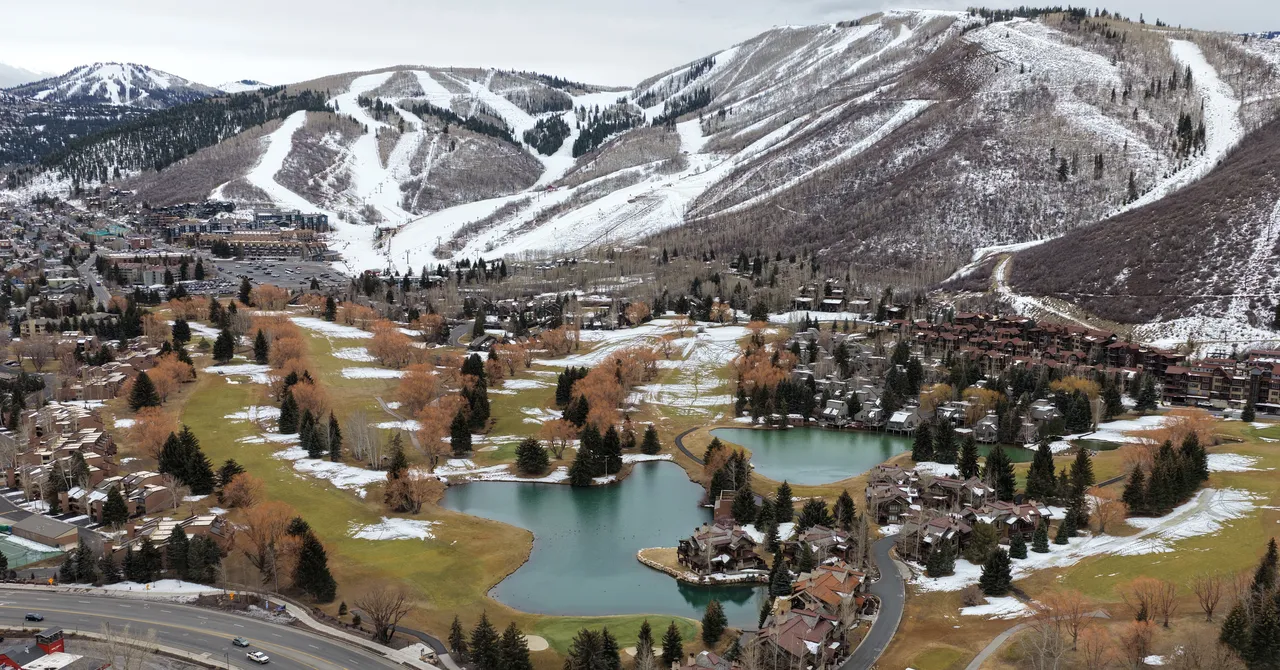
Many states throughout theoccidental United States are currently grappling with historically low snow accumulation, amidst the heart of the winter period. This predicament of scant snow, potentially leading to a more arid, conflagration-vulnerable summer, arises as states are fruitlessly striving to meet a crucial deadline. Their goal is to finalize agreements for water distribution from the Colorado River Basin, a vital water source for 40 million individuals spanning seven western states.
“Absent a truly miraculous reversal” over the balance of the cold season, Daniel Swain, a climate researcher with the University of California Agriculture and Natural Resources, suggests that this diminished snow cover “could exacerbate both the environmental and governmental predicaments within the Colorado Basin, and furthermore, instigate profoundly detrimental wildfire circumstances in certain Western localities.”
Information furnished by the U.S. Department of Agriculture indicates that by February 12th, snow accumulation in various regions across nine Western states registered below half its customary volume—marking some of the most meager levels observed in many decades. Typically, a specific watershed or a limited locale in the West might experience reduced snow cover during this annual period. However, what raises concern, according to Swain, is the extensive reach of this snow deficit, forming a broad band extending from southern Washington through significant portions of Arizona and New Mexico, even reaching eastward into Colorado.
“The figures are exceptionally dire,” remarks Swain. “Were this November, their significance might be diminished. Nonetheless, it is not November; rather, we are approaching mid-February. Typically, the usual readings are quite elevated. Consequently, registering half those customary amounts signifies, in real terms, a substantial shortfall.”
While a significant portion of the East Coast has been gripped by freezing conditions during the initial weeks of the year, numerous Western states are encountering some of their mildest winters documented. For instance, sections of Colorado registered temperatures nearing 80 degrees Fahrenheit earlier this week. Despite precipitation levels holding constant in numerous states—with some areas of Washington even enduring catastrophic inundations in December—the prevailing temperatures in many regions are simply insufficient for snow to form or to persist as snowpack.
An investigation published last year by Dartmouth academics revealed that climatic shifts have contributed to diminished snow accumulation throughout the Northern Hemisphere across the last four decades. Such a scarcity of snow carries several troubling consequences for the Western region throughout the remainder of the year. Woodlands possessing sparse snow cover desiccate more rapidly and exhibit reduced resistance to blazes upon the arrival of the warm season. (Furthermore, areas of forest devastated by wildfires might, consequently, be less apt at retaining snow cover; contemporary studies have indicated that snow thaws more quickly in recently scorched locales compared to unburned areas.)
A significant portion of the Western water provision, encompassing the vital Colorado River Basin, is determined during the winter period. Snow cover amassing throughout the frigid months liquefies in springtime; when snowpack levels are robust, this water flows into waterways and reservoirs. However, prevailing circumstances endanger this established pattern.
“In certain locales, we are not contending with a conventional drought; instead, we face a snow drought. Here, precipitation has been close to or exceeding typical levels, yet unprecedented warmth has truly instigated a comprehensive obliteration of the current snow cover,” explains Swain. The elevated temperatures elsewhere, he adds, have “resulted in the fallen precipitation—which at times has been quite plentiful—manifesting as rain, even at altitudes of 7,000 and 9,000 feet.”
Swain notes that the season is still sufficiently early for substantial weather events to potentially restore snow depths in certain regions. “The challenge lies in the substantial shortfall we’ve amassed thus far—even if we experience near or slightly above-average snowfall over the coming weeks, that might merely align with the typical accumulation for the remainder of February, failing to genuinely nullify the existing deficit,” he clarifies.
{content}
Source:{feed_title}