
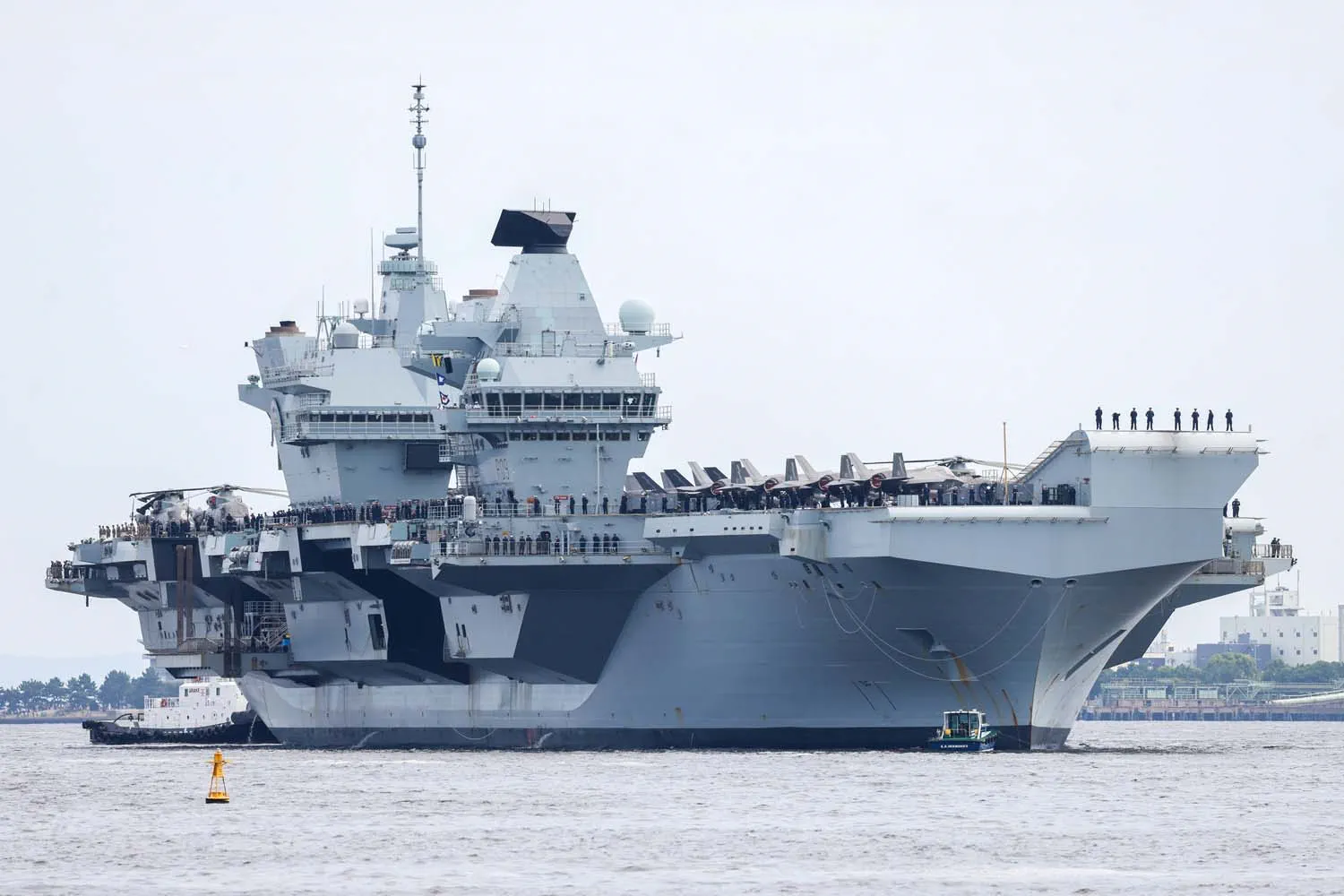
HMS Prince of Wales Begins Nordic and High North Deployment for NATO Exercises
The aircraft carrier HMS Prince of Wales has commenced a significant deployment to Nordic waters and the High North, departing from the Glen Mallan jetty in Loch Long, Scotland. The vessel spent the preceding bank holiday weekend engaged in the loading of essential ammunition and supplies, as confirmed by the Royal Navy.
This deployment sees the HMS Prince of Wales, one of the Royal Navy’s two Queen Elizabeth-class aircraft carriers, leading a Carrier Strike Group. It is joined by the Type 45 destroyer HMS Duncan, which provides advanced air defence capabilities, and the Royal Fleet Auxiliary (RFA) tanker RFA Tidespring, crucial for sustained operations at sea. The group’s primary objective is to participate in a series of exercises with both NATO allies and forces from the Joint Expeditionary Force (JEF), a UK-led rapid reaction force comprising ten Northern European nations.
The initial phase of the deployment will focus on the complex maritime environment of the fjords near Bergen, Norway. Here, the Carrier Strike Group will engage in Exercise Tamber Shield. This exercise is specifically designed to refine tactical agility and enhance capabilities in defending high-value naval assets against what are termed “small, fast-manoeuvrable threats” in confined waters. Participants in these intensive swarm attack drills include Wildcat helicopters from the 815 Naval Air Squadron, P2000 patrol boats, and Norwegian missile craft, all working collaboratively to simulate and counter asymmetric threats that could potentially target larger vessels.
Following the exercises in the Norwegian fjords, the focus of the deployment will shift northward to the expansive and challenging environment of the High North and open waters. The Carrier Strike Group will participate in Dynamic Mongoose, an exercise recognized as NATO’s premier anti-submarine warfare (ASW) drill in Northern Europe. This segment of the deployment is critical for enhancing the interoperability and effectiveness of allied forces in detecting, tracking, and neutralizing submarine threats in a strategically vital region.
Captain Ben Power, the Commanding Officer of HMS Prince of Wales, articulated the carrier’s readiness to serve as the nation’s flagship, emphasizing its role in demonstrating the United Kingdom’s unwavering commitment to both NATO and the Joint Expeditionary Force. He also extended gratitude to the families of the crew for their “unwavering support as we deploy for a period away from home waters,” acknowledging the personal commitment involved in such operations.
Commander James Mitchell, Commanding Officer of HMS Duncan, highlighted the critical contribution of his vessel, stating that the Type 45 destroyer brings “world-class air defence capability to the Carrier Strike Group.” He further emphasized that this capability provides “essential protection to HMS Prince of Wales and other high-value units” within the formation. Commander Mitchell also noted that the opportunity to train alongside allied navies in the North Atlantic and High North significantly strengthens the collective ability to “operate as an integrated and resilient force.”
Commodore Rich Hewitt, who commands the UK Carrier Strike Group, underscored the broader strategic message of the deployment. He stated that it delivers “a clear signal of the UK’s steadfast commitment to working with regional partners and securing Europe’s northern flank.” In light of the current global security landscape, Commodore Hewitt stressed that in an “increasingly volatile environment,” close integration with partner nations is “vital to safeguarding our mutual interests.” These statements collectively emphasize the defensive and deterrent posture of the deployment, reinforcing international alliances in a period of heightened geopolitical tensions.
Why This Matters
The deployment of HMS Prince of Wales and its accompanying Carrier Strike Group to Nordic waters and the High North holds significant geopolitical and strategic importance for several reasons, extending beyond a routine exercise.
Firstly, it underscores the United Kingdom’s unwavering commitment to NATO and the Joint Expeditionary Force (JEF). In a post-Brexit landscape, the UK continues to position itself as a key security guarantor in Europe, actively contributing to collective defence structures. This deployment demonstrates the practical application of this commitment, showcasing the UK’s capability to project power and operate alongside allies in critical regions. The carrier strike group represents a substantial investment in naval power, and its deployment signals both readiness and resolve to international partners and potential adversaries alike.
Secondly, the focus on Nordic waters and the High North is strategically vital. This region, encompassing the Arctic and its surrounding seas, has seen increasing geopolitical competition, particularly from Russia. Melting ice caps are opening new shipping routes and access to vast natural resources, making the area a critical frontier for security and economic interests. By conducting exercises such as Dynamic Mongoose, which specializes in anti-submarine warfare (ASW), NATO is explicitly addressing the challenge posed by increased Russian submarine activity in the North Atlantic, which could threaten vital transatlantic communication cables and shipping lanes. The ability to effectively counter such threats is paramount for maintaining regional stability and protecting critical infrastructure.
Thirdly, the nature of the exercises themselves reflects modern threat landscapes. Exercise Tamber Shield, with its focus on defending high-value assets against “small, fast-manoeuvrable threats,” directly addresses contemporary asymmetric warfare concerns. This includes potential threats from drone swarms, fast attack craft, and other unconventional tactics that have proven effective in recent conflicts. Practicing these drills in complex environments like the Norwegian fjords enhances the tactical agility and defensive capabilities of the Carrier Strike Group, ensuring it is prepared for a wide spectrum of challenges. This proactive approach to training is essential for adapting to evolving military technologies and doctrines.
Finally, the deployment serves as a powerful signal of deterrence and alliance cohesion. By integrating with Norwegian forces and other NATO and JEF partners, the UK reinforces interoperability and demonstrates the strength of a united front. This collective display of capability and readiness deters potential aggression by signaling that any hostile action would be met with a coordinated and robust response from multiple nations. In an “increasingly volatile environment,” as stated by Commodore Rich Hewitt, such integrated deployments are not merely training exercises but critical demonstrations of shared security interests and the determination to safeguard them. The deployment thus contributes significantly to maintaining stability and security on Europe’s northern flank and across the wider North Atlantic region.