
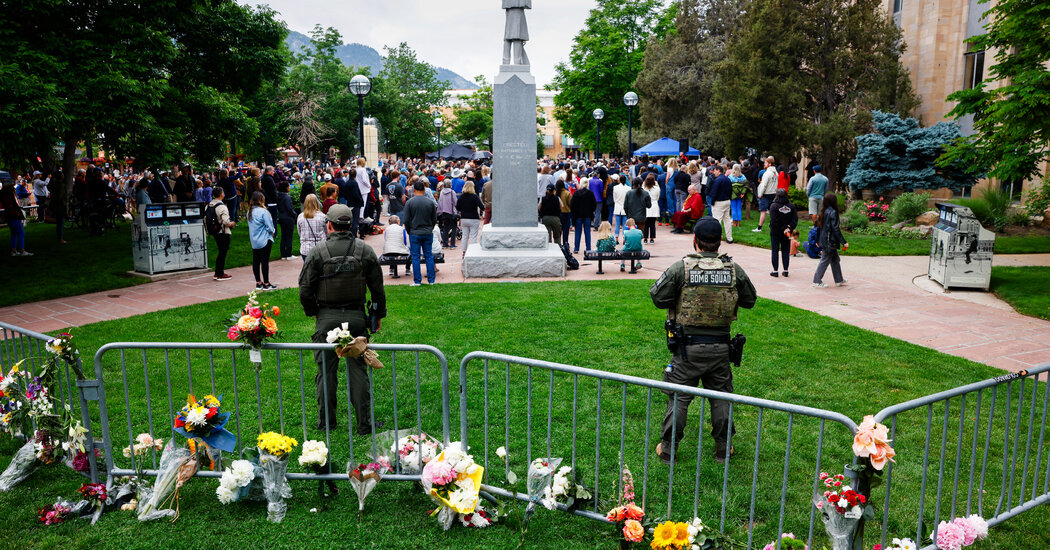
In a solemn court proceeding held in Boulder, Colorado, Mohamed Sabry Soliman, an Egyptian national, was sentenced to life in prison on Thursday after pleading guilty to a deadly firebombing attack that targeted a group of Jewish marchers nearly a year ago. The attack, which occurred in October 2023, resulted in the death of 82-year-old Karen Diamond and wounded more than a dozen other individuals.
Mr. Soliman pleaded guilty to a comprehensive list of 101 charges, including one count of murder for Ms. Diamond’s death, alongside multiple counts of attempted murder, assault, and other related crimes. The sentencing marks a significant development in a case that has deeply affected Boulder’s Jewish community and contributed to broader concerns about rising antisemitic violence.
During the hearing, numerous survivors delivered victim impact statements, many speaking publicly for the first time about the traumatic event. They recounted the moments Molotov cocktails exploded, describing efforts to extinguish flames that scorched their clothing and burned those around them. Survivors detailed the lasting psychological toll, with many reporting being haunted by the smell of gasoline and burned hair, even months after the incident. Orrie Gartner, a participant in the march, shared in court, “When I’m alone and close my eyes I can vividly see Karen’s body in flames.”
The impact on daily life was also a recurring theme. Some survivors expressed a new vigilance, constantly scanning for potential threats or exits in public spaces. The sense of security in the generally peaceful college town of Boulder was described as irrevocably broken. While one man indicated he now concealed his Star of David necklace, another woman affirmed her decision to wear hers openly, in a gesture of defiance against hatred. The sons of Karen Diamond, Ethan and Andrew, conveyed in a letter read aloud, “We learned the full meaning of the expression ‘Living Hell’.”
The attack severely injured Ms. Diamond’s husband, Lou Diamond, who endured a month of recovery in a hospital burn unit, reportedly in considerable pain, just rooms away from his wife. Karen Diamond succumbed to her injuries three weeks after the attack. Her sons described a vibrant life cut short, highlighting the couple’s shared passions for hiking, gardening, attending symphony performances, and their recent participation in a 10K race where Ms. Diamond placed fourth in her age group. Their plans for a trip to France, among other future endeavors, were noted as now impossible.
Mohamed Sabry Soliman, who immigrated to the United States in 2022, addressed the court publicly for the first time following the victim statements. Speaking in Arabic, he expressed regret for his actions and stated that he deserved the death penalty. However, he simultaneously denied that his crimes were driven by anti-Jewish hatred, instead launching into a statement against Zionism, which he characterized as “the enemy.” He affirmed, “Yes, I am against Israel, and I can’t deny that,” asserting it as his right, and also condemned the deaths of children during the conflict in Gaza.
Chief District Judge Nancy W. Salomone directly challenged Mr. Soliman’s assertion, stating that his “choices were acts of terror, and they victimized an entire community.” She emphasized, “You chose to victimize these people because they were members of the Jewish community.”
Mr. Soliman also sought to exonerate his wife and five children, claiming they were unaware of his plans and would have intervened had they known. Following the attack, his family was taken into federal custody and held for several months in an immigration detention center in Texas. They were released less than two weeks prior to the sentencing hearing, and their lawyers are currently engaged in efforts to prevent their deportation.
The hearing commenced with Judge Salomone meticulously reviewing each of the 101 charges, naming each victim, and verifying Mr. Soliman’s plea. He responded concisely in Arabic, repeatedly confirming his guilt and acknowledging his forfeiture of the right to a trial and appeal for charges including attempted murder, assault, and other offenses.
Given that Colorado abolished the death penalty, the state-level sentence of life in prison without the possibility of parole represents the most severe penalty available under state law. However, Mr. Soliman still faces an ongoing federal prosecution, which could potentially seek the death penalty under federal statutes.
Prosecutors detailed that Mr. Soliman had meticulously planned the attack for approximately a year. His target was the “Run for Their Lives” group, which regularly convened on Sundays in downtown Boulder to demonstrate for the release of hostages captured by Hamas during its October 7, 2023, assault on Israel. Many participants in these marches were members of Boulder’s Jewish congregations. On the day of the attack, the group included vulnerable individuals, such as an 88-year-old Holocaust survivor, at least one child, and a person using a wheelchair, all described by District Attorney Michael Dougherty as “completely defenseless.”
Law enforcement authorities stated that Mr. Soliman disguised himself as a gardener to approach the group before throwing homemade Molotov cocktails at the marchers and shouting “Free Palestine.” An FBI affidavit related to the case further indicated that Mr. Soliman had expressed a desire to “kill all Zionist people.”
District Attorney Dougherty underscored the profound impact of the attack, stating it had sown “terror, fear and death” within the community, and that it “horrified Boulder’s tightknit Jewish community and intensified fears of the rising antisemitic violence in the United States.”
Why This Matters
The firebombing attack in Boulder, Colorado, and the subsequent sentencing of Mohamed Sabry Soliman, carries significant implications that extend beyond the local community. This event serves as a stark illustration of how international conflicts, specifically the Israel-Hamas war, can manifest in domestic acts of violence, fueling extremism and hate-motivated crimes globally.
Firstly, the incident highlights the escalating concerns regarding antisemitism, which has seen a documented rise in many countries, including the United States, particularly since the October 2023 events in Israel. The targeting of a Jewish group demonstrating for humanitarian causes underscores the vulnerability felt by Jewish communities and the imperative for law enforcement and societal institutions to actively combat prejudice and hate.
Secondly, the case delves into the complex interplay between anti-Zionism and antisemitism. While Mr. Soliman claimed his actions were driven by anti-Zionist sentiment rather than anti-Jewish hatred, the judge’s clear declaration that he targeted victims “because they were members of the Jewish community,” along with FBI evidence of his intent to “kill all Zionist people,” underscores the often-blurred lines and the potential for anti-Zionist rhetoric to translate into violence against Jewish individuals. This distinction is a critical point of discussion in contemporary geopolitical and social discourse.
Thirdly, the legal outcome, with a life sentence in state court and potential federal charges including the death penalty, sets an important precedent for accountability for hate crimes and acts of terror. It signals a firm commitment by the justice system to prosecute individuals who perpetrate violence motivated by extremist ideologies, reinforcing the principle that such actions will face severe consequences.
Finally, the suffering endured by the victims and their families, as articulated in their impact statements, serves as a poignant reminder of the human cost of hatred and extremism. Their experiences underscore the profound and lasting psychological, emotional, and physical trauma inflicted by such acts, and the critical importance of fostering community resilience, support for victims, and ongoing efforts to promote understanding and tolerance in an increasingly polarized world.