
Sharron Albertson, a long-standing Republican activist, has been engaged in text message exchanges with her long-time acquaintance, Ken Paxton, and has expressed dissatisfaction with his responses. One of the subjects discussed involved the welfare of his estranged wife.
“One of the recent ones was, ‘People are thinking that Angela’s getting a bad deal in the divorce.’ He wrote back, ‘She’s getting a better deal than I am,’” Ms. Albertson recounted.
Mr. Paxton, who serves as the Attorney General of Texas, faces accusations of adultery from his wife of 38 years, Angela Paxton. She initiated divorce proceedings last year, citing “biblical grounds.” Additionally, he has been indicted on charges of felony securities fraud. He was also impeached by the Texas House of Representatives, with support from members of his own party, on allegations including bribery, dereliction of duty, obstruction of justice, and abuse of public trust, among other alleged misdeeds. These impeachment articles are currently awaiting trial in the Texas Senate.
Despite these significant legal and personal challenges, Mr. Paxton has remained a formidable figure in the U.S. Senate race in Texas. He is currently contesting a runoff election against Senator John Cornyn, a four-term incumbent, later this month. This contest occurs despite Mr. Paxton being vastly outspent by tens of millions of dollars during the Republican primary. Observers suggest that Mr. Paxton’s most significant hurdle often lies in the controversies surrounding his own conduct.
“If he loses,” remarked Ms. Albertson, who has known Mr. Paxton for decades, “it will be his own doing.”
However, Ms. Albertson herself faces a political dilemma. “I can’t really go against Ken,” she stated. “I cannot do John Cornyn.”
The predicament articulated by Ms. Albertson highlights the complex dynamics of this high-stakes election, which could have implications for the partisan distribution of power in Washington D.C.
Mr. Paxton, 63, has maintained an undefeated electoral record throughout his quarter-century in public service. Despite the array of accusations and legal issues, and in some respects because of how his supporters interpret them, he has consistently prevailed in crowded primaries and critical runoff elections. Current polling indicates a potential victory in the upcoming runoff. The winner of this Republican contest will advance to face James Talarico, a Democrat who has demonstrated rising support and significant fundraising capabilities, in the November general election.
Mr. Paxton’s continued electoral success, despite the controversies, is frequently attributed to his strong connection with a dedicated segment of the Republican base. This core group of conservative voters is notably consistent in participating in the state’s typically low-turnout primary elections. His political narrative, characterized by supporters as a journey of overcoming adversity, often frames his legal and political challenges as acts of “political persecution.” This perspective suggests he is targeted by a faction of established Texas Republicans perceived as clinging to outdated values, a group that Mr. Paxton’s backers believe includes Senator Cornyn.
Senator Cornyn has publicly described Mr. Paxton as “flawed, self-centered and shameless.” Similarly, Mr. Talarico once characterized Mr. Paxton as “the rot at the core of our broken political system.” Both campaigns express a belief that a definitive political reckoning for Mr. Paxton is imminent.
Regardless of the election outcome, Mr. Paxton remains a significant and illustrative figure in contemporary American politics. While he is often described as less outwardly theatrical and ideologically flexible than former President Donald Trump, and does not possess the same “central casting” persona—he has been noted for his mid-life physique, a slightly uneven smile, and near-blindness in one eye—Mr. Paxton is nevertheless seen as highly representative of the current political era, arguably as much as the former president himself.
“He was Trump before Trump was Trump,” stated Michelle Smith, a former aide to Mr. Paxton.
“Had Trump not been normalized by the party, Paxton would never have had a chance,” commented Stuart Stevens, an anti-Trump former adviser who worked with Mitt Romney, John McCain, and George W. Bush. “But now that he has been normalized, he’s the future.”
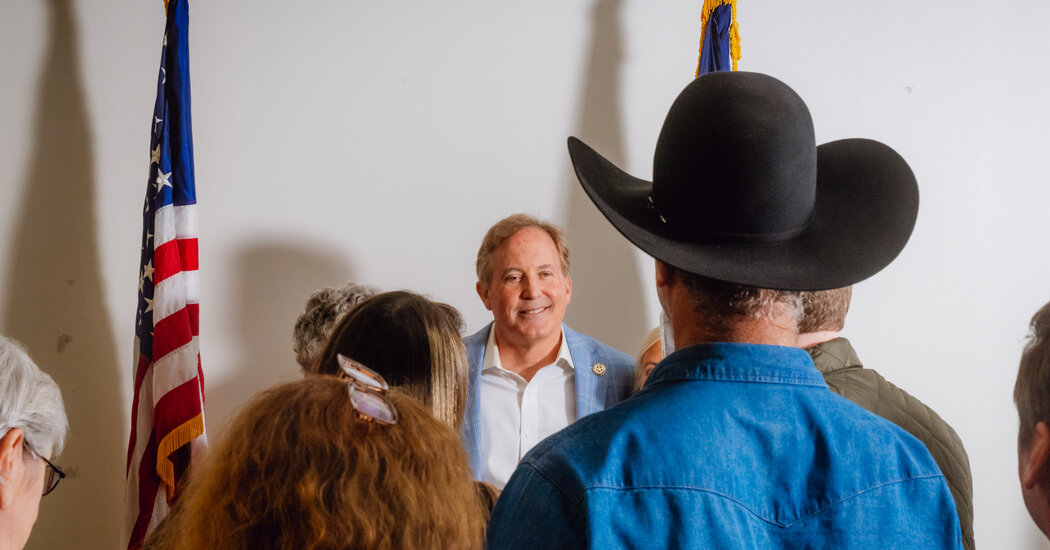
Last month, following a standing ovation at a potluck supper organized by the Republican Party of Victoria, a city in South Texas, Mr. Paxton—who is generally regarded as more adept at small talk than formal speeches—spent time engaging with attendees in a meet-and-greet line, shaking numerous hands. Before departing, he paused in a hallway for a 10-minute interview with The New York Times.
During the interview, he was asked to explain why his base continues to support him, given his indictment, impeachment, and accusations of adultery.
“Why does the base stick with President Trump,” he responded, “when you can say all those same things?”
The Endurance of a Political Career
Mr. Paxton’s political career developed during a period of significant political realignment and emerging populism in the United States.
In the 1990s, he began as a will-and-trust attorney in the rapidly growing suburbs of Collin County, located north of Dallas. He and his wife, a homeschooling parent and guitarist, were active within intersecting business, social, and political networks that included influential megachurch evangelicals and grassroots anti-abortion activists. This environment was characterized by an emerging Christian nationalist and proto-Tea Party sentiment, accompanied by a growing disillusionment with established political institutions.
Initially, Mr. Paxton was not widely perceived as a strong candidate, even for lower-level political offices. His background included student government involvement in high school in Lawton, Oklahoma, serving as student body president at Baylor University in Waco, Texas, and earning a law degree from the University of Virginia. However, a Baylor peer noted he was more a “blender” – someone who fit in – rather than a highly prominent figure on campus.
When he decided to seek election as a state representative in 2002, even some of his supporters expressed doubts about his prospects. Nevertheless, he displayed a personable, if unassuming, demeanor and a notable ability to remember names. He was also receptive to suggestions, described by Ms. Albertson, a leader of the influential Golden Corridor club of local Republican women, as someone who “listened and did the stuff that we suggested.”
His assets included his four young children and his wife, Angela, who was an enthusiastic partner in his political endeavors. He secured the highest number of votes in a five-person primary and subsequently defeated an older, establishment-backed attorney in a runoff. This victory positioned him as part of a new cohort of elected officials that enabled Republicans to gain full control of Texas state government for the first time since the Reconstruction era.
“He was just so unimpressive,” commented Chris Oldner, a former Collin County judge who has been critical of Mr. Paxton. “But after that race, I’d tell everybody I talked to, ‘Do not underestimate him.’”
During his decade as a state legislator, a period marked by growing disenchantment among his most ardent supporters with the presidency of George W. Bush, strong opposition to the election of Barack Obama, and an environment conducive to the eventual rise of Donald J. Trump, Mr. Paxton consistently received high ratings from conservative watchdog organizations.
His legislative efforts included advocating against undocumented students receiving in-state college tuition.
Why This Matters
The ongoing political career of Ken Paxton, particularly his enduring support amidst significant legal challenges and personal controversies, offers crucial insights into the evolving landscape of American politics and the modern Republican Party. This situation extends beyond a single state election, holding broader implications for national political trends and the health of democratic institutions.
Firstly, the Texas U.S. Senate race is highly significant for the balance of power in Washington D.C. As the second-most populous state and a major economic force, Texas plays a disproportionate role in national politics. The outcome of this election could impact the narrow partisan control of the U.S. Senate, influencing critical legislative priorities, judicial appointments, and the overall trajectory of federal policy. A victory for Paxton would solidify a particular conservative, anti-establishment wing within the Senate, potentially shifting the internal dynamics of the Republican caucus.
Secondly, Paxton’s continued electoral viability, despite indictments for felony securities fraud, an impeachment by the state House on multiple charges including bribery and abuse of public trust, and accusations of adultery, challenges traditional notions of political accountability and ethical standards. His ability to frame these issues as “political persecution” by an “establishment” resonates deeply with a segment of the Republican base, mirroring a broader populist sentiment seen with figures like Donald Trump. This phenomenon suggests a shift in what some voters prioritize—often valuing perceived loyalty to a political movement or a narrative of victimhood over conventional concerns about character or conduct.
Thirdly, Paxton’s career illuminates the power of highly motivated base voters in low-turnout primary elections. His consistent success underscores that in certain electoral contexts, a passionate core constituency can override the preferences of party establishment figures, significant campaign spending disparities, and negative media coverage. This dynamic is a key factor in understanding how candidates who might otherwise be considered unconventional or controversial can not only survive but thrive in contemporary American politics.
Finally, the comparison of Paxton to “Trump before Trump” highlights a fundamental transformation within the Republican Party. It suggests that the populist, anti-establishment, and often confrontational political style that characterized the Trump era was not an anomaly but rather an acceleration of trends already present in conservative grassroots movements. Paxton’s story indicates that this style, coupled with a narrative of fighting against perceived institutional enemies, has become a durable and effective pathway to political power for a growing number of politicians, irrespective of traditional political norms. Understanding Paxton’s resilience in Texas offers a lens through which to comprehend the broader forces shaping American democracy and the evolving nature of its political parties.
In his initial years as a state representative, Ken Paxton advocated for public school curricula designed to foster a “sense of pride in our country” rather than cultivating “a source of shame.” A pivotal moment in his early career involved launching a campaign to become Speaker of the Texas House, a direct challenge to the incumbent, Joe Straus. Mr. Paxton publicly characterized Mr. Straus as excessively willing to compromise with Democratic lawmakers. Although Mr. Paxton ultimately withdrew his candidacy just prior to the vote, his challenge was widely perceived as a strategic move that established his reputation as an insurgent within the party, successfully positioning him against the political establishment.
Brendan Steinhauser, a Republican strategist based in Austin, noted that this challenge “branded him as a guy willing to take on the establishment.”
This positioning paved the way for Mr. Paxton’s successful run for the State Senate in 2012, followed by his bid for Attorney General two years later. However, during his campaign to become the state’s chief law enforcement official, questions arose regarding his compliance with state regulations.
In the spring of 2014, Mr. Paxton was fined $1,000 for violations of state securities laws. The violations stemmed from his solicitation of investors in an associate’s company without being properly registered with the state and without transparently disclosing that he would receive a commission from these investments.
The outcome of this election established a recurring pattern in Mr. Paxton’s political trajectory: allegations of legal transgressions did not impede his campaigns. He successfully advanced through a primary election to a runoff against a more traditional Republican opponent and withstood opposing advertisements that portrayed him as an untrustworthy lawbreaker. Ultimately, he secured victory.
Subsequently, during his first summer as Attorney General, Mr. Paxton faced indictment on three felony fraud charges directly linked to the aforementioned securities case. He was arrested, fingerprinted, and formally booked.
For his critics, including protesters who gathered at the Collin County courthouse, this indictment appeared to confirm their view of him as a legislator primarily focused on financial gain rather than public service. They characterized him as an attorney drawn to the wealth associated with Austin lobbyists and West Texas oil donors. Conversely, his supporters interpreted the indictment as politically motivated retribution.
Years before former President Donald Trump’s widely publicized booking photograph, Mr. Paxton’s own mug shot was released, in which he was depicted smirking.
Legal Challenges and Political Ascent
As Attorney General, Mr. Paxton utilized his office to advance his political ambitions while simultaneously navigating numerous legal and ethical challenges.
He frequently initiated lawsuits against the administration of President Barack Obama, a strategy he often highlighted in speeches, claiming “27 times” in two years. His wife, Angela Paxton, also referenced this tactic on the campaign trail, famously singing, “I’m a pistol-packin’ mama, and my husband sues Obama.”
Mr. Paxton consistently filed lawsuits concerning contentious social and political issues, including abortion rights, gun control, and environmental regulations. These actions generated widespread media attention and resonated with conservative voters.
In 2018, a challenging election year for Republicans nationally, Mr. Paxton was re-elected. He defeated an opponent who had previously served as a Supreme Court clerk for Sandra Day O’Connor, despite campaign advertisements that included an “indictment explainer” and a reminder of an incident where Mr. Paxton was captured on security camera pocketing a $1,000 Montblanc pen at a courthouse checkpoint (which he later returned).
In the same election cycle, Angela Paxton successfully ran for and won the State Senate seat previously held by her husband.
The most significant challenge to Mr. Paxton’s political career emerged in the fall of 2020, when eight of his senior deputies formally accused him of bribery and abuse of office, subsequently bringing their concerns to federal law enforcement. They informed a Texas House investigative committee that Mr. Paxton had allegedly provided improper assistance to a real estate developer who was both a campaign donor and the employer of a woman with whom Mr. Paxton was reportedly having an extramarital affair. These staffers subsequently resigned or were terminated; those who were fired initiated a lawsuit against Mr. Paxton, alleging whistleblower retaliation.
Throughout this period, Mr. Paxton also faced other investigations, including a grand jury inquiry into alleged self-dealing in a Collin County land development (he was cleared) and a bribery investigation related to a campaign contribution from a donor whose company his office had previously investigated for fraud (the investigation was dropped). The original securities fraud case, meanwhile, experienced multiple delays, venue changes, and protracted legal proceedings.
In 2024, Mr. Paxton reached an agreement to dismiss the felony fraud charges. The terms of the deal included performing community service and paying restitution, without an admission of guilt.
Concurrently, Mr. Paxton’s personal wealth reportedly increased substantially. Upon his initial election to public office, he declared assets totaling less than $200,000. Two decades later, despite an annual state salary of approximately $150,000, he reported a net worth nearing $8 million, including residential properties in Oklahoma, Florida, Utah, and Hawaii. Mr. Paxton has maintained a degree of secrecy regarding the origins of his wealth, establishing a blind trust but reportedly failing for several years to disclose its assets to regulators as required by state ethics regulations.
Following the November 2020 presidential election, Mr. Paxton initiated lawsuits against the states of Georgia, Michigan, Pennsylvania, and Wisconsin, challenging the election results. On January 6, 2021, he delivered a speech at the rally preceding the riot at the U.S. Capitol.
Upon President Joseph R. Biden Jr. assuming office, Mr. Paxton significantly escalated his legal challenges against the federal government, filing over 100 lawsuits in total.
His actions consistently resonated with the Republican party’s base. In 2022, Mr. Paxton once again emerged as the top vote-getter in a primary election, progressing to a runoff, this time against George P. Bush, a member of the prominent Bush political family. In an advertisement, Mr. Bush stated, “This race isn’t about my last name. It’s about Ken Paxton’s crimes.” Mr. Paxton ultimately defeated Bush by a margin of more than 2 to 1.
Sam Cooper, a consultant to Mr. Paxton, observed that “Like Trump, he’s got a pretty good gut for the base and where the base is,” adding, “where they’re going.”
Impeachment Proceedings
The most significant challenge to Mr. Paxton’s tenure, which also solidified his connection with his political base, involved an impeachment attempt. In February 2023, he reached a settlement of $3.3 million with the former employees turned whistleblowers. Mr. Paxton subsequently sought state legislative funding to cover this settlement. In response, the Republican-controlled Texas House of Representatives initiated an inquiry. Three months later, a House investigative committee formally recommended 20 articles of impeachment against him.
Republicans in the House then convened a four-hour hearing to determine whether to proceed with the impeachment process. Some
Why This Matters
The political career and ongoing legal challenges surrounding Ken Paxton, Texas’s Attorney General, carry significant implications for both state and national politics, as well as the broader principles of governance and public accountability. His trajectory offers a compelling case study into the resilience of a politician despite persistent allegations of misconduct, and how such figures can resonate with a specific electoral base.
For Texas, Mr. Paxton’s tenure has profoundly shaped the state’s legal landscape. His aggressive strategy of suing federal administrations, particularly those led by Democrats, has established Texas as a leading voice in conservative legal challenges to federal policy. This approach has influenced policy debates on issues ranging from immigration and environmental regulations to healthcare, often setting precedents or contributing to national legal discourse. The internal divisions within the Texas Republican Party, highlighted by his challenge to former Speaker Joe Straus and the impeachment attempt by a Republican-controlled House, demonstrate ongoing ideological battles over the party’s direction and the role of anti-establishment populism.
On a national level, Mr. Paxton’s career reflects a broader trend in American politics where figures who openly challenge traditional norms and face legal scrutiny can maintain and even strengthen their political support. His alignment with former President Donald Trump, including his efforts to challenge the 2020 election results and participation in the Jan. 6, 2021 rally, underscores the fusion of state-level conservative legal activism with national populist movements. This dynamic raises questions about the future of the Republican party, the efficacy of traditional political accountability mechanisms, and the impact on the rule of law when high-ranking officials face numerous accusations.
Furthermore, the repeated instances of legal investigations, indictments, and ethical questions surrounding Mr. Paxton — from securities fraud to abuse of office allegations and financial opacity — test the public’s trust in government institutions. His consistent electoral victories despite these issues suggest a segment of the electorate prioritizes other aspects of his political identity or views the accusations as politically motivated. The eventual plea deal in his felony fraud case, without an admission of guilt, highlights the complexities and often protracted nature of the legal system, particularly when involving powerful public figures. The impeachment process, initiated by his own party, represents a rare attempt at internal accountability within the legislative branch, yet its outcome and implications for future governance remain a critical point of interest.
Ultimately, Ken Paxton’s career is significant not just for the policies he has pursued or the legal battles he has fought, but for what it reveals about modern political polarization, voter behavior, and the enduring challenges of ethical conduct and accountability in high office.
As Texas Attorney General Ken Paxton prepares for a Republican runoff election for a U.S. Senate seat, his political career stands as a testament to an unusual resilience amidst persistent legal and ethical controversies. Despite facing a felony indictment for securities fraud, a whistleblower lawsuit alleging abuse of office, and an impeachment by the state House of Representatives, Mr. Paxton has consistently maintained significant grassroots support and electoral success.
His enduring popularity, particularly among conservative voters, underscores a complex dynamic in contemporary American politics where loyalty to a political figure can often outweigh concerns about alleged misconduct. Mr. Paxton’s trajectory offers a compelling case study of how a politician can not only survive but potentially thrive in the face of challenges that might derail others.
A History of Legal Scrutiny
Ken Paxton’s legal troubles began early in his tenure as Attorney General. In 2015, he was indicted on three felony charges related to securities fraud, accused of soliciting investments in a technology company without being properly registered with the state, and failing to disclose to investors that he was being paid by the company. These charges have been pending for nearly a decade, with legal battles over procedural issues preventing a trial from moving forward.
Further allegations emerged in 2020 when seven of his senior aides reported him to the Federal Bureau of Investigation (FBI) for alleged bribery, abuse of office, and other crimes. These whistleblowers claimed Mr. Paxton used his office to benefit a wealthy donor and real estate investor, Nate Paul. The allegations included that Mr. Paxton directed his agency to intervene in a lawsuit on Mr. Paul’s behalf and issued an unusual legal opinion to assist Mr. Paul’s business interests. The whistleblowers subsequently filed a lawsuit, which the state of Texas later agreed to settle for $3.3 million.
The accusations escalated dramatically in May 2023 when the Texas House of Representatives voted overwhelmingly to impeach Mr. Paxton. The impeachment articles detailed 20 charges, including abuse of public trust, bribery, obstruction of justice, and misapplication of public resources, largely stemming from the allegations made by the former aides and his relationship with Mr. Paul. The House General Investigating Committee, composed of both Republican and Democratic members, conducted an investigation that led to the impeachment vote.
Impeachment and Acquittal
The decision to impeach Mr. Paxton came after a tense period in the Texas capital. Amidst the impeachment proceedings in the House, Mr. Paxton reportedly contacted state representatives directly, urging them to vote against the measure. Despite these efforts, the vote was 121 in favor and 23 against, with 60 Republicans joining Democrats to send the impeachment to the Senate for trial.
The impeachment garnered national attention, with former President Donald Trump, who himself had been impeached twice, publicly labeling the decision “very unfair.” State Representative James Talarico, a Democrat, commented at the time that the situation could have been avoided if Mr. Paxton had resigned, suggesting a lack of accountability.
The subsequent 10-day trial in the Texas Senate became a high-stakes political spectacle. Prosecutors presented evidence supporting the accusations of abuse of office and other alleged misconduct. Mr. Paxton’s legal team, however, adopted a strategy that framed the impeachment as a politically motivated attack by establishment Republican forces. His attorneys characterized the proceedings as a “political witch hunt,” with his top attorney, Tony Buzbee, declaring, “The Bush era ends today,” a reference to a perceived faction within the Texas Republican Party.
During the trial, state senators reported feeling pressure from Mr. Paxton’s supporters, who expressed strong loyalty to him and drew parallels to Mr. Trump’s impeachments, dismissing the allegations as politically driven. Angela Paxton, Mr. Paxton’s wife and a state senator, was barred from voting due to a conflict of interest but attended the proceedings, including testimony regarding her husband’s alleged infidelity, which was also a component of the charges.
Ultimately, Mr. Paxton was acquitted of all charges by the Senate. This outcome was seen by many as a significant victory for Mr. Paxton and his conservative base, reinforcing his image as a fighter against perceived political elites.
Political Rebound and Ongoing Campaign
Following his acquittal, Mr. Paxton swiftly engaged in political retaliation, campaigning actively for primary challengers against the House members who had voted for his impeachment. This strategy proved successful, with several of his endorsed candidates, including one of his impeachment attorneys, Mitch Little, winning their races. Mr. Little acknowledged that the impeachment process directly contributed to his own political ascent.
The state Republican Party chair, Abraham George, noted that the impeachment process galvanized Mr. Paxton’s base, stating that “the grass roots were furious” and that it “made him more popular and more powerful than ever.” This dynamic highlights the fervent loyalty among a segment of the electorate that views attacks on figures like Mr. Paxton as attacks on their own values and beliefs.
Mr. Paxton’s current campaign for the U.S. Senate presents another test of his political strength. Despite facing a significant financial disadvantage against his opponent, John Cornyn, a long-serving senator, Mr. Paxton’s performance in the primary indicated strong voter support, nearly matching Mr. Cornyn’s vote count. This suggests that large campaign spending may not be as effective against a candidate with deep grassroots backing and a narrative of being targeted by the establishment.
His personal life, including an ongoing and public divorce, has also been subject to scrutiny. However, for many of his supporters, such as state legislator Shelley Luther, personal conduct is not a determining factor in their vote. This sentiment is echoed by observations from political strategists, who suggest Mr. Paxton possesses a unique ability to connect with voters, despite or perhaps even because of his perceived “normal-looking” demeanor, as described by lobbyist Bill Miller.
Even some Democratic strategists acknowledge Mr. Paxton’s remarkable political durability, predicting that if he wins his current race, he could serve multiple terms in the U.S. Senate, potentially outlasting other prominent figures in conservative politics. This assessment points to a broader trend where a candidate’s perceived authenticity or willingness to challenge norms resonates strongly with a specific voter base.
Voter interactions further illustrate this dynamic. When questioned about Mr. Paxton’s scandals, supporters like Peggy Borchert, an 85-year-old voter, expressed unwavering support, often framing their views through a lens of faith and forgiveness rather than focusing on specific allegations of misconduct. This reflects a deeper connection that transcends conventional political evaluation.
Why This Matters
The ongoing political career of Ken Paxton, marked by repeated legal challenges and a unique ability to garner fervent grassroots support, carries significant implications for political accountability, voter behavior, and the future of governance in the United States.
Firstly, Mr. Paxton’s resilience challenges traditional notions of political accountability. Despite facing serious felony charges and an impeachment attempt for alleged abuse of office and bribery, his ability to retain and expand his political power suggests that for a segment of the electorate, legal and ethical transgressions by a favored politician are not necessarily disqualifying. This phenomenon raises critical questions about the effectiveness of institutional checks and balances, such as grand juries and legislative impeachments, in holding high-ranking officials to account when public opinion is deeply polarized.
Secondly, his narrative exemplifies the power of grassroots movements and the appeal of anti-establishment rhetoric. Mr. Paxton’s defense during his impeachment trial, which portrayed him as a victim of “deep-state G.O.P. forces,” resonated deeply with his base. This approach allowed him to reframe accusations as political persecution, transforming potential weaknesses into strengths among voters who distrust traditional political establishments and media narratives. This trend suggests that a strong, ideologically aligned base can insulate a politician from scrutiny that might otherwise prove fatal to a political career, fundamentally altering campaign strategies and voter engagement.
Thirdly, Mr. Paxton’s sustained popularity could set a precedent for future political figures, indicating that perceived authenticity and a willingness to fight against perceived enemies—whether political rivals or the “establishment”—can be more influential than a clean ethical record. This shift in voter priorities could embolden other politicians to adopt similar strategies, potentially further eroding norms of conduct in public office and impacting the quality of governance.
Finally, his ongoing presence in Texas and national politics reflects deeper societal divisions and the increasing role of identity and tribalism in political affiliation. Voters’ willingness to overlook or forgive alleged misdeeds in favor of ideological alignment or a shared sense of grievance highlights a challenge to fostering a political culture based on shared facts and universal standards of integrity. The outcome of Mr. Paxton’s current Senate campaign will provide further insight into these evolving dynamics, potentially shaping the discourse and expectations for political leadership for years to come.