
Larry Kudlow and former Energy Secretary Dan Brouillette discuss why gasoline prices fall slower than they rise, a phenomenon known as ‘rockets and feathers.’
Key Takeaways:
- “Rockets and Feathers” in Action:The disparity between rapidly rising and slowly falling gasoline prices, often termed the “rockets and feathers” phenomenon, is a complex interplay of crude oil costs, refining margins, distribution expenses, and localized market competition, rather than simply retailer gouging.
- Geopolitical Risk Premium & Volatility:Recent fluctuations in crude oil prices, particularly West Texas Intermediate (WTI), are heavily influenced by geopolitical tensions, such as the Israel-Iran conflict. While de-escalation can reduce a “risk premium,” underlying supply-demand fundamentals and market sentiment continue to drive volatility.
- Political Intervention vs. Market Efficiency:Presidential calls for immediate price reductions and Department of Justice investigations into alleged “gouging” highlight political pressure on a critical consumer cost. However, such interventions risk disrupting the natural forces of supply, demand, and competition that typically dictate market prices, potentially creating uncertainty for energy investors and producers.
Market Context: President’s Call for Price Cuts Ignites Debate on Energy Market Dynamics
President Donald Trump’s recent exhortation to gasoline retailers nationwide to “IMMEDIATELY!” lower prices, coupled with a stern warning of “big problems” for non-compliance, thrusts the complex dynamics of the energy market squarely into the political spotlight. His demands, issued via Truth Social, arrive amidst a period of notable volatility in global oil markets, challenging retailers to pass on perceived lower crude oil costs to consumers with unprecedented speed. The President’s comments also renew a long-standing critique of California’s gasoline tax policies, framing them as an abuse of the state’s residents.
“Gasoline Retailers must get their Prices down, IMMEDIATELY!” Trump declared. “They’re too high considering that Oil is now at $68 a Barrel, and heading south. The Retailers must quickly react to this statement, and do what they know is right — DROP YOUR PRICE FOR OUR GREAT AMERICAN PEOPLE! There will be no gauging, which is totally illegal. If Retailers don’t do this, big problems lie ahead!” He continued, suggesting a target of “$2.50 a Gallon” and urging California to “stop charging such heavy Taxes on their Gasoline,” claiming, “Soon the Tax will be higher than the Product itself, and the United States will not stand for it, nor will the People of California, who are being abused by these ridiculous Taxes, and by their own Government.”
Unpacking “Rockets and Feathers”: The Economics of Retail Fuel
The President’s directive resonates with a common consumer perception – the phenomenon known as “rockets and feathers,” where gasoline prices appear to soar like “rockets” when crude oil costs rise but drift down like “feathers” when crude prices fall. While often perceived as evidence of market manipulation or “gouging,” economists and energy analysts point to a more nuanced reality.
The retail price of gasoline is not solely determined by the spot price of crude oil. It is a composite of several factors: the cost of crude oil (typically 50-60%), refining costs and margins (15-20%), distribution and marketing expenses (10-15%), and various federal, state, and local taxes (15-20%). When crude oil prices spike, refiners and retailers quickly adjust their prices to cover the higher cost of their next inventory purchase, anticipating future costs. Conversely, when crude prices fall, retailers might be selling inventory purchased at a higher cost. They also face competitive pressures and strategic decisions on when to lower prices, often aiming to maintain margins or clear existing stock before fully reflecting the decline. The lag can also be attributed to consumer behavior; drivers are quick to notice price increases but less sensitive to gradual decreases. The video segment featuring Larry Kudlow and Dan Brouillette likely delves into these very complexities, highlighting that the market mechanism, while imperfect, is rarely a simple one-to-one reflection of daily crude fluctuations.
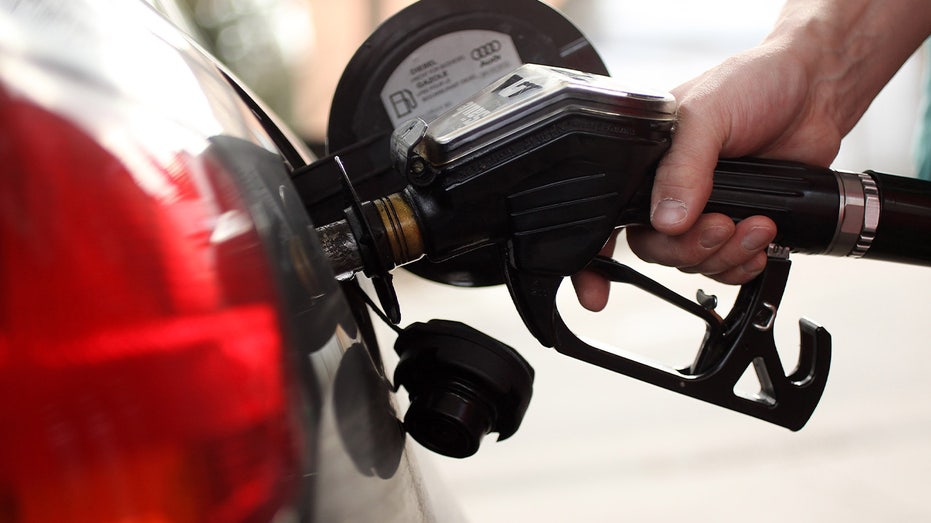
U.S. gas prices have eased from last month’s spike but remain well above year-ago levels, keeping pressure on drivers.(Sean Gallup/Getty Images / Getty Images)
Geopolitical Tensions and Crude Oil Volatility
Trump’s demand follows nearly a week after he instructed the U.S. Department of Justice to investigate alleged fuel price gouging by energy companies, specifically criticizing “big Oil Companies” for not dropping pump prices commensurate with falling crude costs. This latest intervention comes as Americans have witnessed significant fuel price volatility, particularly following the recent conflict between Israel and Iran.
Global crude oil markets are inherently sensitive to geopolitical events, especially in the Middle East, a vital region for oil production and transit. Escalations in conflict, such as those between Israel and Iran, often introduce a “risk premium” to oil prices. Traders and investors price in the potential for supply disruptions, even if actual output remains unaffected. This speculative buying drives prices higher. When tensions subside, as they reportedly have in recent days, this risk premium can quickly evaporate, leading to a sharp decline in crude futures. West Texas Intermediate (WTI) crude oil futures, which were trading around $70.24 per barrel Monday evening, had indeed climbed during the Israel-Iran conflict before retreating. The President’s observation that “Oil is now at $68 a Barrel, and heading south” reflects this post-de-escalation price movement. However, the lag in retail price adjustments, as discussed, contributes to the perception of unfairness.
The Impact of Taxes: California’s Unique Position
Trump’s renewed criticism of California’s gasoline tax policies highlights another significant component of retail fuel prices. California consistently has among the highest gasoline prices in the nation, not just due to its geographic isolation and stricter environmental regulations (requiring specialized fuel blends) but also due to its substantial state and local taxes. These taxes fund infrastructure projects and environmental initiatives. While these taxes contribute to higher pump prices, they are a deliberate policy choice by the state government, reflecting a different set of priorities than those driving market fluctuations in crude oil. The implication that “the Tax will be higher than the Product itself” underscores the magnitude of these levies in the overall cost structure.
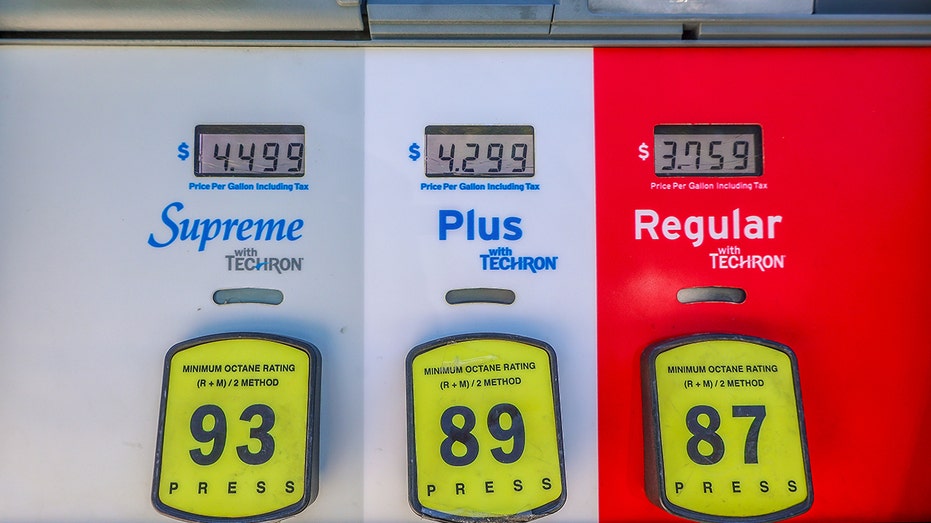
Fuel prices on a pump at a Chevron gas station in Bay Harbor Island, Florida, on Monday, June 22, 2026. (Zak Bennett/Bloomberg via Getty Images / Getty Images)
National Averages and Consumer Strain
The AAA national average for regular gas was $3.860 per gallon as of June 29, a welcome decrease from $4.391 a month earlier. However, this figure remains significantly higher than the year-ago average of $3.187. This persistent elevation, despite recent declines, continues to put financial pressure on American consumers already grappling with broader inflationary trends. The President’s Memorandum of Understanding related to Iran, signed on June 17, likely signals diplomatic efforts that contributed to the easing of tensions and subsequent drop in oil prices.
While presidential calls for price cuts may resonate with the public, the intricate balance of supply, demand, geopolitical factors, refining capacity, and local taxation dictates the actual price consumers pay at the pump. The energy market, a global and interconnected web, often responds more to these fundamental forces than to direct political pressure.
President Donald Trump demanded that gasoline retailers lower their prices.(Win McNamee/Getty Images / Getty Images)
Market Impact:
The confluence of presidential calls for price controls, a Department of Justice investigation into alleged gouging, and ongoing geopolitical volatility creates a complex outlook for the energy sector and broader economy. For energy companies, such political interventions introduce regulatory uncertainty, potentially deterring investment in refining capacity or exploration at a time when stable supply is crucial. This could lead to long-term market inefficiencies if companies perceive an elevated risk of government interference in pricing. Investors in energy stocks may react cautiously, weighing the potential for reduced margins against the underlying strength of demand. For consumers, while lower gas prices are always welcome, the methods to achieve them matter. Artificially suppressed prices could lead to supply shortages or a lack of investment, paradoxically causing greater price spikes down the line. Furthermore, sustained high gas prices, even with recent dips, continue to act as a drag on consumer discretionary spending, impacting sectors from retail to hospitality. This contributes to inflation concerns and could influence Federal Reserve policy decisions regarding interest rates, as energy costs are a significant component of the Consumer Price Index. The market’s natural mechanisms for price discovery, though sometimes slow, are generally considered the most efficient way to allocate resources and respond to supply and demand signals without creating unintended consequences.
FOX Business’ Alex Nitzberg contributed to this report.