
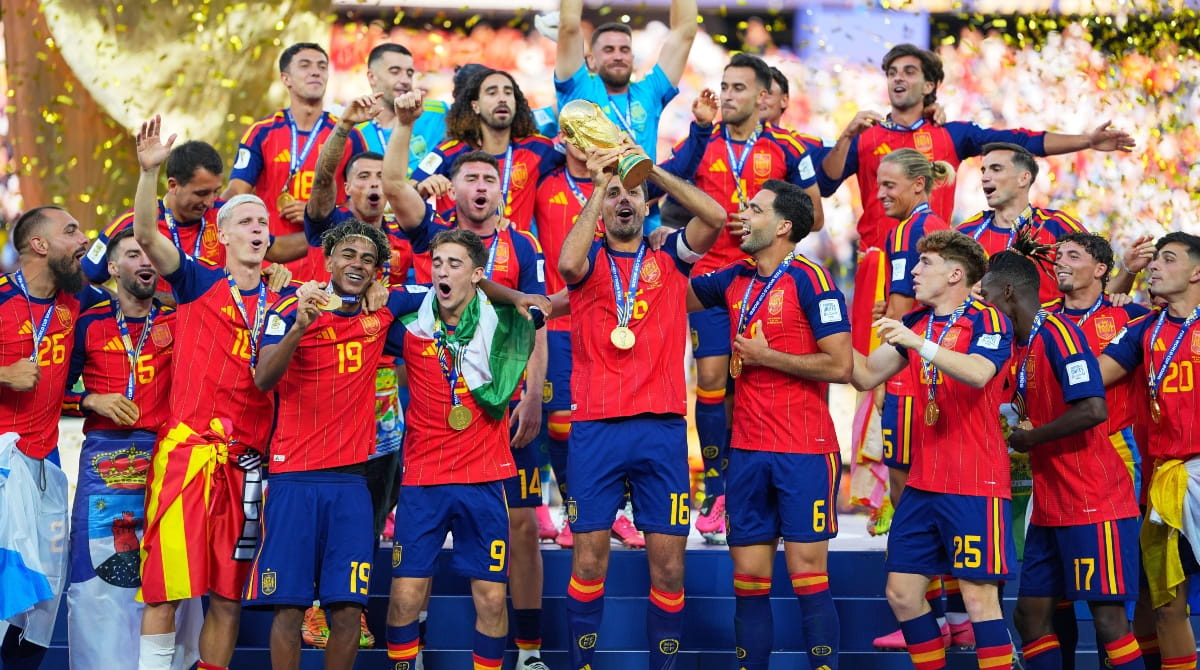
The roar that erupted from MetLife Stadium wasn’t just for a goal; it was the sound of history being forged, a symphony of triumph echoing across the New Jersey night. Spain, under the visionary guidance of Luis de la Fuente, didn’t just win a World Cup; they *conquered* it, completing an unprecedented double by adding football’s most coveted trophy to their European Championship crown. The 1-0 extra-time victory over Argentina was not merely a final; it was a grueling, mesmerizing testament to resilience, tactical brilliance, and the sheer, unyielding will of a new generation.
Ferran Torres, the clinical embodiment of Spain’s relentless pressure, became the architect of destiny, slotting home a close-range finish in the 106th minute. The build-up was classic Spain: incisive, relentless, and ultimately, irresistible. It was the electrifying Nico Williams, a blur of pace and trickery on the flank, who delivered the killer pass, pulling a perfectly weighted cross back into the box, leaving Torres with the simplest yet most significant tap-in of his career. The celebration was a cathartic explosion, years of dedication culminating in one glorious, golden moment.
Yet, to focus solely on the goal is to overlook the epic struggle that preceded it. This wasn’t a walk in the park; it was a siege against the most formidable of goalkeepers, a defiant wall of human brilliance named Emiliano Martinez. The Argentine shot-stopper performed a masterclass in defiance, making an astonishing 11 saves – a new World Cup final record. Time and again, he flung himself across his goal, outstretched limbs and lightning reflexes denying Spain what seemed like inevitable breakthroughs. From acrobatic dives to point-blank blocks, Martinez single-handedly dragged the defending champions through 90 minutes of Spanish domination, turning the final into a personal duel between one man and an entire attacking force. His heroics transformed a potential rout into a nail-biting, goalless stalemate, keeping Lionel Scaloni’s side alive long after logic suggested they should have capitulated.
But even the most formidable walls eventually crumble. Argentina’s resistance, built on Martinez’s heroics and a desperate, scrambling defense, finally gave way deep into stoppage time. Enzo Fernandez, a tireless engine in Argentina’s midfield, saw red for a second yellow card after a clumsy, desperate foul on Pau Cubarsi. It was the pivotal moment, the crack in the dam. Reduced to ten men for extra time, the writing was on the wall. Spain’s eventual victory felt less like a possibility and more like an inevitability, a ticking clock counting down to their coronation. Torres merely provided the precise moment, 37 seconds into the second period of extra time, turning inevitability into glorious reality.
This triumph solidifies Luis de la Fuente’s status as a tactical savant and a master motivator. Taking the reins in 2022, he inherited a talented squad but one in need of a renewed identity. He delivered precisely that, as he eloquently put it, “an idea, a philosophy.” This philosophy, rooted in intelligent possession, fluid movement, and a fearless embrace of youth, has now taken the nation to the absolute summit of world football. Spain’s back-to-back European and World Cup titles are not a fluke; they are the meticulously crafted outcome of a coherent, audacious vision.
Speaking after the final whistle, the Spain manager, usually composed, was visibly overwhelmed by the magnitude of the achievement. “So much pride. Pride for this generation of footballers that have been growing with this idea, staying loyal to the idea, and doing their best,” he managed to articulate, his voice thick with emotion. “They are an example of a team, a group, a family, and a collective of great players that have been exceptional. I’m just so proud to have accompanied them on this journey, to have been there with them on this trajectory is an honour.”

De la Fuente continued, “I can’t really tell you how I feel. All I can say was it was worth it. Of course, at the moment I am very emotional, particularly having watched from behind the scenes. I have spoken so much to the players, who said to me, ‘Boss, we’ve won it all’, and it’s marvellous. This generation of players is an example for Spanish sport, for the Spanish youth. Together we are much stronger, and that is why we don’t forget anyone.” His words painted a picture of a tight-knit unit, a collective spirit that transcends individual brilliance – a hallmark of true champions.
‘We like to suffer’ – The Mentality of Champions
Even with overwhelming dominance and a numerical advantage, De la Fuente acknowledged the arduous nature of the night. “Of course we would have liked to win the game much sooner. The Martinez save prevented us from doing so. We tried and tried to get on the scoresheet but weren’t able to, but this is a World Cup final, even against ten men at the end we had to suffer. But, we like to suffer, and I’ll say it again, we were prepared for everything.” This statement, delivered with a wry smile, encapsulates the new Spanish mentality. Gone are the days of a perceived fragility under pressure; this team embraces adversity, understands the demands of the grandest stage, and finds strength in the struggle. Their preparation wasn’t just physical and tactical; it was mental, designed to withstand the very suffering a World Cup final inevitably brings.
Game Highlights
- Martinez’s Early Brilliance:Emiliano Martinez produced a string of incredible saves within the first 25 minutes, denying Spain’s relentless attacks, including spectacular stops from Pedri and Álvaro Morata.
- Spain’s Near Misses:Throughout the second half, Spain continued to press, hitting the woodwork once and forcing Martinez into several more acrobatic interventions that left spectators gasping.
- Enzo Fernandez’s Red Card (90+3′):A desperate tackle on Pau Cubarsi, already carrying a yellow, resulted in Fernandez’s dismissal, leaving Argentina with ten men for extra time and drastically shifting the momentum.
- Torres’s Decisive Strike (106′):Just moments into the second half of extra time, Nico Williams’ precise pull-back found Ferran Torres unmarked, who slotted home calmly to break the deadlock and secure the World Cup for Spain.
- Argentina’s Valiant Stand:Despite being a man down, Argentina showed incredible spirit, defending resolutely and even creating a late half-chance that was well-defended by Spain.
The Dawn of a New Dynasty? A Prediction.
Spain’s triumph is not merely a single victory; it feels like the emphatic declaration of a new era. With a squad brimming with young, world-class talent – Pedri, Gavi, Nico Williams, Lamine Yamal, and Pau Cubarsi all under 23 – and a manager who has masterfully blended youth with experience, the potential for a sustained period of dominance is palpable. De la Fuente’s Spain possesses the tactical sophistication of their predecessors but with an added layer of grit and dynamism that makes them incredibly difficult to break down. They have conquered Europe and the World, and with such a youthful core, they now stand poised not just as champions, but as the architects of a potential new golden dynasty in international football. Expect Spain to be the team to beat for the foreseeable future, their current success merely the opening chapter of what could be a truly historic run. The world has been warned: La Roja are here to stay.