
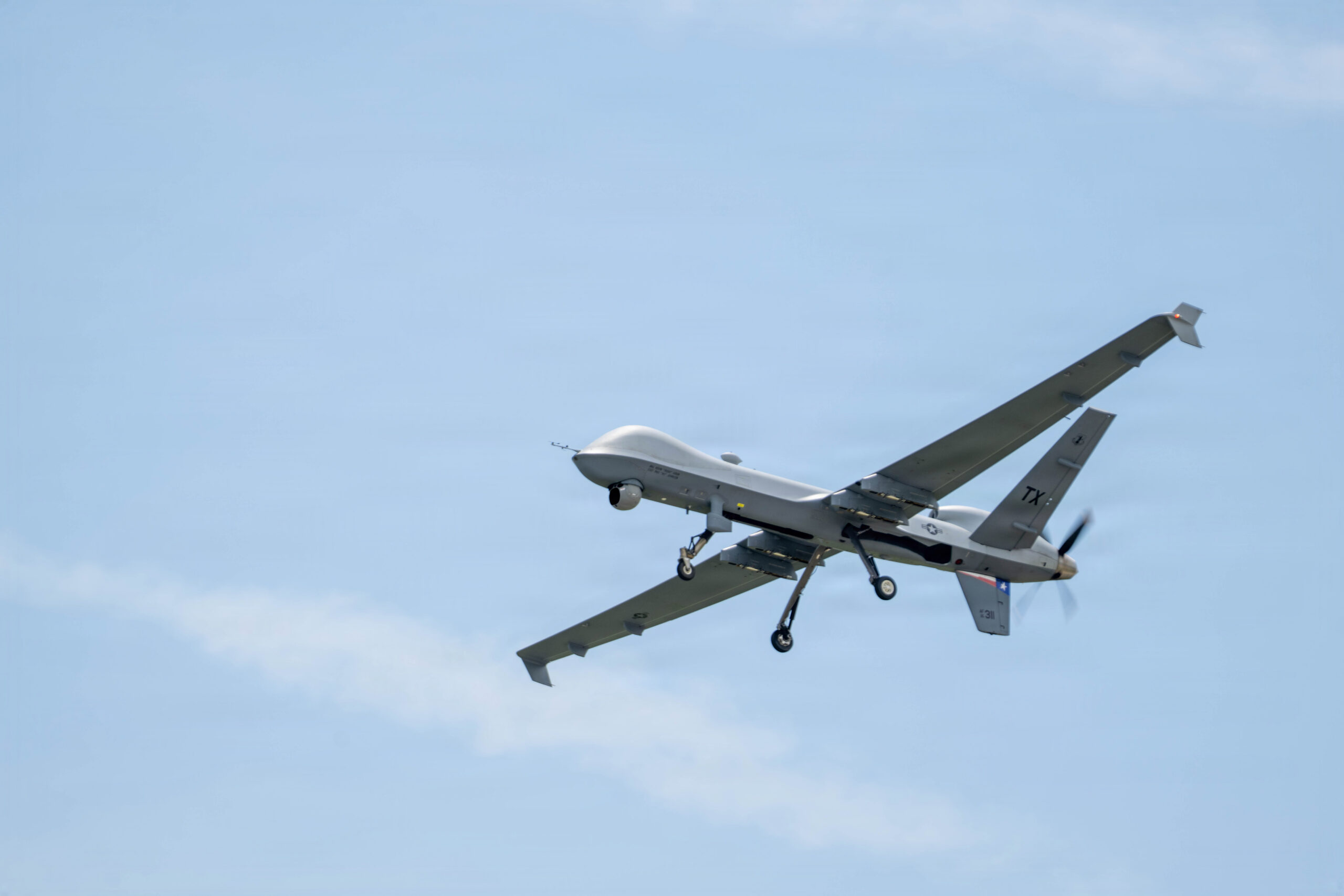
The United States Air Force is significantly accelerating its plans to acquire a replacement for its MQ-9A Reaper drone fleet, top officials announced on September 3. This expedited timeline is a direct response to substantial losses of Reapers sustained during recent operations involving Iran and Iranian-backed groups. The Air Force is now targeting a rapid fielding of these new drones, aiming for a price point of just $10 million per aircraft.
The initiative, known as Massed Modular Aircraft (MMA), was initially unveiled in July by the Air Force and the Defense Innovation Unit (DIU). The goal then was to develop a low-cost, uncrewed aircraft capable of performing all current MQ-9 missions, with the added capability of operating in large groups to overwhelm enemy air defenses and force the expenditure of expensive munitions. At that time, officials projected a prototype within 21 months of a contract award, with an initial operating capability (IOC) of 20 mission-ready aircraft by fiscal year 2031.
However, this timeline has now been compressed dramatically. During a media roundtable at the Pentagon, Major General Joseph Kunkel, DIU military deputy, indicated that the MMA program would strive to meet DIU’s more aggressive standard timeframe: prototyping a system within one year of contract, followed by fielding at scale within three years—potentially as early as 2029 for initial operational deployment.
Lieutenant General Christopher Niemi, the Air Force’s new chief modernization officer, confirmed that these accelerated goals were established “fairly recently,” following a directive from Air Force Secretary Troy Meink to “move faster.”
Niemi acknowledged that the primary catalyst for this increased urgency was the significant number of MQ-9 losses over the past year or so. In the context of the ongoing conflict and tensions with Iran and its proxies, the Air Force has lost at least 45 MQ-9s, representing approximately a quarter of its entire fleet. While the service was already considering a successor for the MQ-9 as a medium-altitude intelligence, surveillance, and reconnaissance (ISR) platform, Niemi stated that these combat losses provided a crucial impetus to expedite the process. “Although we have plenty of MQ-9As today, we are going through them at a rate that is concerning to us,” Niemi noted.
A Cost-Effective, Attritable Replacement
The MQ-9 Reaper has long served as a crucial component of the Air Force’s operational capabilities. It is highly valued by combatant commanders for its extended endurance, persistent loitering ability, and its dual capacity for strike and intelligence, surveillance, and reconnaissance missions. General Kenneth S. Wilsbach, Air Force Chief of Staff, even referred to the Reaper as the “most valuable player” during Operation Epic Fury in a May congressional hearing, underscoring its importance.
Given the Reaper’s utility, officials are keen to replace the lost aircraft efficiently. Niemi disclosed that the Air Force has dedicated considerable effort in recent months to identify replacement options, concluding that “there’s not a lot of good options to immediately replace those aircraft” through traditional procurement methods.
The Air Force explored the MQ-9B, a more advanced, larger, and consequently more expensive variant produced by General Atomics. However, officials ultimately determined that the MQ-9B was not the appropriate solution. The critical requirement was for an “attritable” platform—meaning an aircraft inexpensive enough to be acquired in large quantities and easily replaced if lost in combat, without incurring prohibitive financial costs or extended production delays. “If you don’t like losing an MQ-9A that cost on the order of $50 million, with the sensors, you’re probably not going to like losing an MQ-9B at a higher price point,” Niemi explained.
This strategic decision led the Air Force to fully commit to the MMA concept. The plan calls for fielding at least 180 of these new drones, with Niemi suggesting that the actual number is likely to be even higher.
To achieve rapid development and maintain low costs, Niemi indicated that the Air Force intends to “accept prudent risk” within the MMA program. Kunkel further emphasized the need for “significantly increased levels of competition” among defense contractors to drive down unit costs. When defining the necessary attributes for MMA drones, Niemi stressed the importance of flexibility, avoiding overly specific requirements that would push technological boundaries. Such advanced specifications, he argued, typically result in higher costs due to complex engineering, cutting-edge science, and emergent technologies. Instead, the Air Force is pursuing an “80 percent is good enough” approach, focusing on mature, proven technologies.
This philosophy means MMA drones will forgo the latest advancements in flight control systems, engines, or manufacturing processes. Consequently, they are expected to share some fundamental design characteristics with the MQ-9, such as long-aspect wings and turboprop engines.
A key difference, however, will be the incorporation of higher levels of autonomy and automation compared to the current MQ-9A. Niemi described this as enabling “more mouse clicks and keyboard strokes instead of a stick and throttle,” which will reduce the number of Airmen required to operate MMA drones and allow a single operator to manage multiple drones simultaneously.
Despite this enhanced automation, Niemi clarified that MMA drones will not possess the same degree of advanced autonomy as the Air Force’s flagship autonomous drone program, Collaborative Combat Aircraft (CCA). “It’s not going out and autonomously finding targets and employing weapons,” Niemi stated regarding MMA. “It’s more like a truck that’s carrying packages, whether it’s a sensor package or whether it’s a weapon, to a point where it can be employed.”
Distinguishing CCAs and MMAs
While both CCAs and MMAs will be uncrewed and incorporate autonomous software, Niemi was quick to highlight fundamental differences between the two programs. “They’re going to look very different,” he explained. The MMA is anticipated to “look like an MQ-9,” whereas the CCA is “going to look more like a fighter, like you’ve seen in the current two CCAs that we’re flying.”
The Air Force envisions MMA drones with a substantial range of approximately 4,000 miles—more than double the projected range of autonomous Collaborative Combat Aircraft drones—and the ability to carry heavy payloads. They will, however, be slower than CCAs.
These distinctions also extend to cost. While the Air Force aims for a $10 million unit cost for an MMA drone, it is targeting $20 million per CCA once they reach full production. It is important to note that these costs refer specifically to the base aircraft, excluding sensors, weapons, or other mission-specific equipment that may be integrated.
From an acquisition standpoint, the Air Force plans to apply consistent methodologies across both the CCA and MMA programs to manage costs and streamline production. This includes accelerating contract awards and maintaining multiple vendors to foster competition and provide a range of drone options. Similar to CCAs, MMA drones will also utilize an open architecture, as explained by Niemi. This approach ensures that the drones feature standardized interfaces, enabling easy upgrades with newer sensor packages or weapons capabilities, potentially even from different manufacturers. This flexibility would allow MMAs to be customized for specific mission requirements. “If you want to build a package that’s going to go on this new aircraft, as long as it conforms to this [standardized interface], we can do it very speedily and very readily,” Niemi said. He contrasted this with platforms like the F-35, where incorporating new technologies is significantly more challenging due to its complex, closed architecture.
Another critical requirement for manufacturers is the ability to produce MMA drones in large quantities, with the flexibility to scale production up or down rapidly. This adaptability is crucial in scenarios where the Air Force might experience significant losses in a high-intensity conflict. Niemi emphasized that simplicity in design is the best way to ensure this production flexibility. “If you wanted to suddenly ramp up production of something like an F-35, it’s not a limiting factor so much as money, as the ability to build out your production capacity and actually crank more of those things out,” Niemi explained. “And the more complex the aircraft, the harder that problem is. … In major combat operations, depending on who you’re fighting, we could be losing dozens [of MMA drones] a day, and so you have to figure out how do you adjust the industrial capacity in order to make [necessary production levels] happen.”
General Atomics, the current manufacturer of the MQ-9, has announced plans to propose a newly designed drone called Wildfire for the MMA program. “Our new Wildfire aircraft addresses all of the concerns posed by the MMA solicitation,” General Atomics spokesman C. Mark Brinkley stated. “We can deliver years earlier and maintain the same high quality. You can have everything that makes Reaper special, plus more, at a price that doesn’t break the bank.”
Why This Matters
The United States Air Force’s accelerated pursuit of the Massed Modular Aircraft (MMA) represents a significant strategic pivot with wide-ranging implications for military doctrine, defense spending, and global power dynamics. This move underscores a fundamental shift in how the U.S. military perceives and plans for future conflicts, particularly against sophisticated adversaries.
Firstly, the rapid development of an “attritable” drone fleet signals a departure from the long-standing emphasis on exquisite, multi-role, and expensive platforms designed to survive highly contested environments. The willingness to accept losses of relatively inexpensive drones, rather than risking high-value crewed aircraft or costly advanced uncrewed systems, reflects a pragmatic adaptation to the realities of modern warfare. This “massed” approach aims to overwhelm enemy air defenses through sheer numbers, forcing adversaries to expend expensive munitions on low-cost targets, thereby depleting their resources and exposing vulnerabilities. This strategy could redefine cost-exchange ratios in future conflicts, making it more challenging for peer competitors to counter U.S. air power effectively.
Secondly, the direct link between MQ-9 Reaper losses against Iran-backed forces and the accelerated MMA timeline highlights the immediate and evolving threats faced by U.S. forces in current operational theaters. These losses, while concerning, provide critical lessons that are now informing a rapid procurement process. It demonstrates the U.S. military’s capacity to quickly adapt its acquisition strategies in response to real-world combat experience, rather than relying solely on theoretical projections. This responsiveness is vital for maintaining a technological edge and ensuring the safety and effectiveness of personnel and assets.
Thirdly, the emphasis on open architecture and increased competition in the defense industry could foster greater innovation and efficiency. By standardizing interfaces and allowing multiple vendors to contribute, the Air Force aims to reduce development cycles, cut costs, and ensure future adaptability. This approach could streamline upgrades and modifications, making it easier to integrate new technologies and maintain relevance in a rapidly changing threat landscape. It also challenges the traditional single-vendor, monolithic defense program model, potentially opening the market to a broader range of innovators.
Finally, the distinction between MMA and Collaborative Combat Aircraft (CCA) indicates a nuanced strategy for autonomous systems. While CCAs are envisioned as advanced, fighter-like drones operating in concert with crewed aircraft, MMAs will serve as more utilitarian, ISR-focused platforms with a different level of autonomy and cost profile. This layered approach suggests a future where different classes of autonomous drones fulfill distinct roles, from high-end combat support to persistent surveillance and strike, optimizing resources and capabilities across the spectrum of military operations. The success of the MMA program will not only shape the future of air power but also influence the broader adoption of autonomous and attritable systems by other military branches and allied nations, potentially ushering in a new era of drone warfare.