
Barstool Sports founder Dave Portnoy weighs in on Zohran Mamdani’s grocery store plan, Nantucket’s viral ‘No Influencers’ sign, stay-at-home boyfriends and why money isn’t an excuse for dating.
Key Takeaways:
- Market Distortion & Competition:New York City’s proposed taxpayer-funded grocery stores spark a heated debate over government intervention in highly competitive retail markets, raising concerns about potential market distortion and unfair competition for private sector players like bodegas and established grocery chains.
- Sustainability vs. Subsidies:Critics, notably Dave Portnoy, argue that any initial success of these municipal stores, fueled by significant public funding, could be a “mirage,” masking true operational inefficiencies and lacking the long-term financial sustainability inherent to profit-driven private enterprises.
- Economic Precedent & Taxpayer Burden:The initiative sets a significant precedent for public sector involvement in commercial ventures, highlighting the ongoing tension between addressing consumer affordability (particularly amidst food inflation) and the potential for increased taxpayer burden and reduced private sector innovation.
New York City Mayor Zohran Mamdani’s ambitious taxpayer-funded grocery store proposal has reignited a critical debate within financial and economic circles: can government-run businesses sustainably compete in commercial markets without perpetual reliance on public subsidies? This question cuts to the core of market efficiency, government intervention, and the long-term viability of public ventures in sectors traditionally dominated by private enterprise.
Amidst ongoing food inflation and a persistently high cost of living in New York City, the proposal aims to alleviate financial pressure on consumers. However, its implications extend far beyond simply lowering grocery bills, touching upon the delicate balance of a free-market economy and the potential for significant market distortion.
Barstool Sports founder Dave Portnoy, a keen observer of consumer behavior and market dynamics, offered a critical perspective on “Varney & Co.,” questioning the fundamental economic premises of Mamdani’s plan. The initial confusion surrounding access – whether a membership card would be required – underscores the inherent challenges in defining the operational model of a publicly funded commercial entity. Portnoy’s immediate reaction, “This is crazy to let… anybody go,” speaks to the broader concern about equitable access and the potential for these stores to draw customers away from existing private businesses, regardless of need.
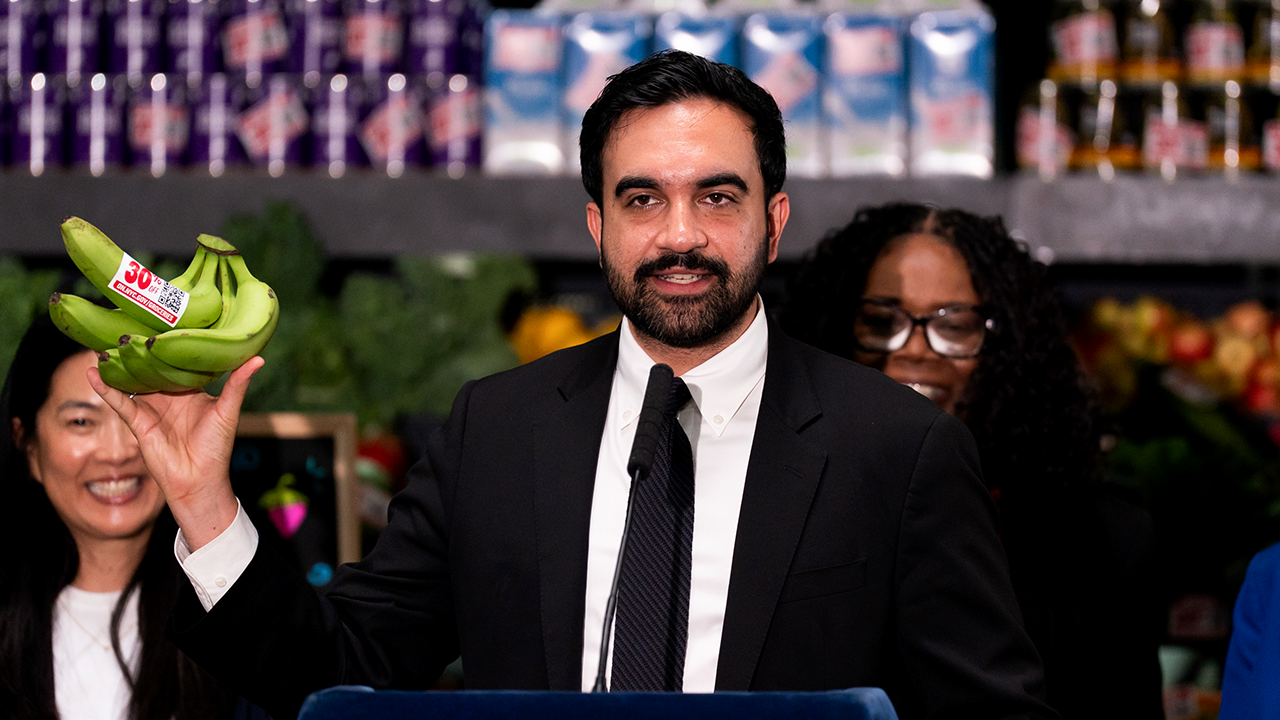
NYC Mayor Zohran Mamdani, mayor of New York, holds up bananas labeled with a 30% off sticker during an announcement on municipal grocery stores.(Adam Gray/Bloomberg / Getty Images)
The highly competitive grocery retail sector operates on razor-thin margins, demanding sophisticated supply chain management, aggressive pricing strategies, and constant innovation to attract and retain customers. Private grocery chains, from national giants to local bodegas, thrive on efficiency, economies of scale, and a relentless focus on profitability. They invest heavily in logistics, technology, and customer experience, driven by the imperative to deliver shareholder value and remain competitive. Introducing a publicly subsidized competitor immediately alters this delicate ecosystem.
Portnoy, while critical, predicted a paradoxical early “success” for these government-run stores, directly attributing it to the influx of public funding. “If you’re gonna put… some astronomical amount of money into this, I think it’s gonna sorta be a mirage,” he stated. This “mirage” is a critical economic concept: the artificial success created by subsidies masks the true cost of operations and shields the enterprise from the disciplinary forces of the market. Without the need to generate profit or face the risk of failure, a publicly funded store may appear to offer lower prices or better services in the short term, but at the ultimate expense of taxpayers and potentially, the health of the broader private sector.
Such interventions can lead to what economists call the “crowding out” effect, where government programs displace private investment and activity. Bodega owners, as highlighted by Multicultural Business Coalition Chairman Frank Garcia, have already voiced significant concerns. These small businesses, often family-owned and deeply embedded in their communities, operate with even tighter margins and face immense pressure from larger chains. A municipal grocery store, unburdened by the same profit motives or tax obligations, presents an existential threat to their livelihoods and local economic fabric.
Manhattan Institute senior fellow John Ketcham discusses New York City Mayor Zohran Mamdani’s proposed city-run grocery plan and why bodega owners say it could threaten their businesses on ‘Maria Bartiromo’s Wall Street.’
Portnoy further elaborated on this point: “I think taxpayers will make this work and he’s gonna look how great communism, socialism is,” he said, emphasizing that the program’s initial months would not be a true reflection of its viability. The true test, he argued, would come “in two years, talk to me three years when you’re running an actual business and have to maintain it.” This distinction between short-term political expediency and long-term economic sustainability is paramount. Private businesses must continuously innovate, manage inventory, negotiate with suppliers, control labor costs, and adapt to changing consumer preferences to survive. Without these market pressures, public enterprises often struggle with inefficiency and a lack of responsiveness, ultimately requiring ongoing public financial support.
‘The Big Money Show’ discusses NYC Mayor Zohran Mamdani’s controversial plans, including a $9 billion childcare program and ousting business leaders from a mayor’s fund.
From a broader market perspective, such initiatives can create uncertainty for investors and businesses contemplating operations in New York City. Mayor Mamdani’s controversial plans, which also include a $9 billion childcare program and tensions with business leaders like Ken Griffin, signal a potential shift towards greater municipal intervention in economic affairs. This raises questions about regulatory risk, the sanctity of private markets, and the overall business climate in a city that historically prides itself on being a global financial and commercial hub.
Portnoy’s characterization of the proposal as “kind of a publicity stunt” suggests a skepticism about its underlying economic rationale, implying that its primary objective might be political visibility rather than a genuinely sustainable solution to food affordability. While addressing food deserts and low-income communities is a valid societal goal, the debate centers on the most effective and economically sound mechanisms to achieve it. Many economists would argue for targeted subsidies or vouchers for consumers, or incentives for private businesses to operate in underserved areas, rather than direct government competition.
Multicultural Business Coalition Chairman Frank Garcia says the mayor did not want to meet with his group over concerns about the city-run grocery store project on ‘The Bottom Line.’
The fundamental question remains: can a government entity, by its very nature designed to serve public good rather than profit, effectively manage the complexities and competitive pressures of a commercial grocery operation? The absence of profit motive, coupled with potential bureaucratic inefficiencies and political influences, often leads to higher operating costs and a lack of agility compared to private sector counterparts. The risk is that instead of fostering a more robust and affordable food system, the city could inadvertently create a drain on public resources and undermine the very businesses that contribute to its tax base and provide essential services.
GET FOX BUSINESS ON THE GO BY CLICKING HERE
Market Impact:
The proposed municipal grocery stores in New York City could have multifaceted market impacts. For the retail grocery sector, it introduces an element of significant uncertainty and potential market distortion, pressuring existing private grocers and bodegas with subsidized competition, potentially leading to store closures and reduced private investment in the city’s food retail landscape. Taxpayers face an ongoing financial burden as initial “success” will likely depend on continuous subsidies, diverting funds from other public services. Furthermore, this initiative could set a precedent for increased government intervention in other commercial sectors, raising concerns among investors and businesses about regulatory risk and the overall business environment in NYC. The long-term efficiency and innovative capacity of the city’s retail market could be compromised, potentially hindering economic growth and job creation in the private sector.