
Unlock the Editor’s Digest for free
Roula Khalaf, Editor of the FT, selects her favourite stories in this weekly newsletter.
Key Takeaways
- German regional elections signal deepening political fragmentation and instability, potentially eroding investor confidence in the eurozone’s largest economy and its capacity for stable governance.
- The significant surge of the far-right AfD and the hard-left Die Linke, particularly the latter’s policy call for property expropriation in Berlin, introduces direct policy risks to the real estate sector and raises concerns about fiscal discipline and property rights.
- Setbacks for the CDU, threatening a leadership crisis for Friedrich Merz, could lead to prolonged policy uncertainty, potentially weighing on the Euro, German Bunds, and the DAX, with broader implications for EU economic cohesion and geopolitical stability.
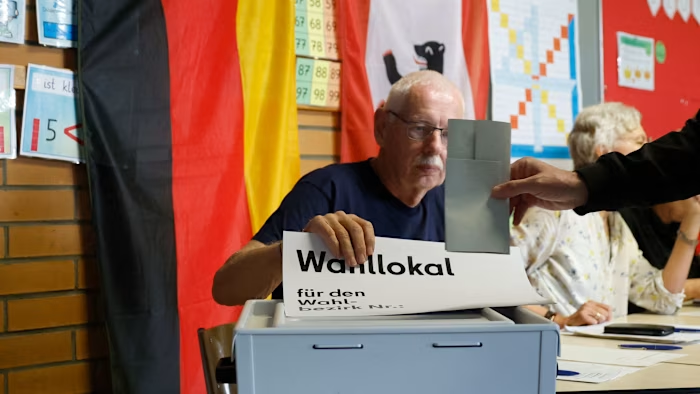
The political landscape of Germany, the eurozone’s economic engine, is undergoing a seismic shift, with recent regional election results signalling profound instability that could reverberate through financial markets across Europe. The Christian Democratic Union (CDU) under Friedrich Merz is facing a severe repudiation at the polls in two key states, a development that is far more than just a domestic political hiccup; it’s a bellwether for investor confidence and the future direction of Germany’s economic and geopolitical standing.
In the north-eastern state of Mecklenburg-Vorpommern, the CDU’s performance was nothing short of a catastrophe. Exit polls project the party to secure a paltry 5 to 5.5 per cent of the vote, barely scraping above the 5 per cent parliamentary threshold. This abysmal showing contrasts sharply with the 13 per cent achieved in the 2021 elections and, if confirmed, would mark the CDU’s lowest result in any state election in Germany’s post-war history. Friedrich Merz’s candid admission, “This is a disaster,” underscores the gravity of the situation for a party traditionally seen as a pillar of German stability and economic orthodoxy.
This dramatic decline for the centrist CDU is mirrored by a significant surge in support for more extreme political factions. The governing Social Democrats (SPD), while still projected to come second with 35.5-36.5 per cent, also saw a dip from their 2021 performance. However, the truly striking outcome is the doubling of support for the far-right Alternative for Germany (AfD), expected to reach 37-38 per cent, up from 17 per cent. The AfD’s growing footprint, especially in former communist states, is a significant concern for markets. Often associated with anti-EU sentiment, protectionist economic policies, and a less predictable fiscal approach, their rising influence introduces an element of uncertainty into Germany’s commitment to European integration and its broader economic policy framework.
The situation in the city-state of Berlin presents an equally complex and potentially more direct challenge to market confidence. Here, the CDU is projected to be relegated to second place with just 20 per cent, a notable decline from 28.2 per cent in the 2023 election. The most unsettling development for investors, however, is the projected surge of the hard-left Die Linke party, set to claim first place with an estimated 24.5-26 per cent. This represents a more than doubling of their 12 per cent tally from 2023.
Die Linke’s platform includes an explicit vow to expropriate property from corporate landlords in the capital. This policy stance sends shivers down the spines of real estate investors and developers, raising serious questions about property rights, capital allocation, and the overall investment climate in one of Europe’s most dynamic capital cities. Such a policy, if implemented, could trigger capital flight from Berlin’s property market, depress asset values, and significantly deter future investment, potentially impacting local government revenues and the broader financial stability of the city. For a sector that has already faced headwinds from rising interest rates and construction costs, this represents a severe and tangible threat.
The AfD’s performance in Berlin, forecast at 13.5-16 per cent (up from 9 per cent), further underscores the growing appeal of anti-establishment parties, reflecting a deep-seated discontent among the electorate, likely fueled by inflation, energy costs, and broader economic anxieties. This fragmentation of the political landscape makes coalition-building harder and policy consensus more elusive, creating an environment of heightened risk for businesses and investors.
These electoral setbacks for Merz’s CDU follow the AfD’s recent shock victory in Saxony-Anhalt, where the far-right party is now exploring options to form its first regional government. The cumulative effect of these losses is not just regional; it carries significant federal implications. Falling below the 5 per cent threshold in Mecklenburg-Vorpommern is a blow that could, as some CDU insiders suggest, trigger a full-blown leadership crisis for Merz. A change in chancellor only 16 months into a four-year term would herald a period of profound instability within Germany, Europe’s largest economy and a critical anchor of stability within the EU and NATO.
Merz’s proposed agenda of welfare reforms, upgrading the country’s armed forces, and modernising ageing infrastructure, while generally seen as pro-growth and necessary, would face significant delays or even abandonment in the event of a leadership challenge. This policy paralysis would not only hinder Germany’s domestic economic progress but also complicate its role in addressing pressing European and global challenges, from climate change and energy security to defence spending in the context of the war in Ukraine. Germany’s capacity to provide leadership and financial contributions to the EU, NATO, and Ukraine could be severely curtailed by internal political wrangling, with implications for sovereign debt markets across the bloc.
Market Impact
The immediate market reaction to these German election results is likely to be characterized by increased volatility and a flight to safety. The Euro could face downward pressure against major currencies, reflecting growing political risk in its largest economy. German government bonds (Bunds), traditionally a safe-haven asset, might see their yields fluctuate as investors weigh the balance between safety and the potential for fiscal uncertainty if populist parties gain further traction. The DAX 40, Germany’s benchmark equity index, is expected to experience headwinds, particularly in sectors sensitive to domestic political stability such as real estate, banking, and infrastructure. Companies with significant exposure to the German property market, especially in Berlin, could see their valuations revised downwards in anticipation of potential policy changes. Furthermore, the broader European equity markets may suffer from contagion fears, as Germany’s political instability casts a shadow over the continent’s economic outlook and its ability to project a unified front on crucial geopolitical issues.