

Key Takeaways for Investors:
- **IP Litigation as an Existential Threat:** Rebel Creamery’s Chapter 11 filing underscores how intellectual property disputes, particularly those involving trade dress in competitive consumer packaged goods (CPG) markets, can escalate rapidly into financially debilitating judgments, even for established brands with national distribution.
- **Navigating Niche Market Dynamics:** The bankruptcy highlights the precarious balance for niche brands like Rebel, which initially capitalized on the burgeoning keto and “better-for-you” food trends. While strong product demand can drive growth, significant legal liabilities can quickly erase market gains and operational viability.
- **Uncertainty for Creditors and Future Operations:** With liabilities significantly exceeding assets, and a substantial portion tied to a disputed legal judgment under appeal, the path to recovery for unsecured creditors is highly uncertain. The outcome of the appeal will be critical in determining the company’s reorganization prospects and any potential for distributions.
Check out what’s clicking on FoxBusiness.com.
In a stark illustration of how intellectual property disputes can swiftly unravel a growth-oriented consumer brand, **Rebel Creamery**, a prominent player in the burgeoning keto and low-carb ice cream market, has sought Chapter 11 bankruptcy protection. The filing, lodged in the U.S. Bankruptcy Court for the District of Utah, reveals a company reeling from a staggering $23.785 million judgment in a trade-dress infringement case brought by rival **Van Leeuwen Ice Cream**. This legal blow has plunged Rebel into a financial quagmire, reporting approximately $13.78 million in assets against $23.85 million in liabilities, with the bulk of its unsecured debt directly attributable to the contested judgment.
Rebel ice cream, known for its sugar-free, high-fat formulations catering to health-conscious consumers, had achieved significant national distribution, gracing the freezer aisles of major retailers including Walmart, Kroger, and Safeway. This widespread presence underscored the brand’s success in carving out a niche in a competitive market segment. However, the Aug. 14 Chapter 11 filing signals a profound disruption to its operational trajectory, effectively placing its future in the hands of the bankruptcy court and the outcome of a critical ongoing appeal.
Van Leeuwen, a purveyor of premium, artisanal ice cream, is conspicuously listed among Rebel’s unsecured creditors, its $23.785 million claim forming the cornerstone of Rebel’s financial distress. While Rebel has registered this claim as “disputed” and emphasized its appeal, the immediate impact is undeniable. The judgment alone dwarfs Rebel’s total reported assets, creating a negative equity position that necessitates a restructuring under bankruptcy auspices. The voluntary petition estimates both assets and liabilities within the $10 million to $50 million range, vaguely noting that funds *could* be available for unsecured creditors—a prospect highly contingent on the appeal’s success.
Rebel Creamery has filed for Chapter 11 bankruptcy protection following a multimillion-dollar judgment in a packaging dispute with rival Van Leeuwen Ice Cream.(Getty Images )
The financial snapshot provided by Rebel’s bankruptcy schedules paints a challenging picture: approximately $5.22 million in cash and cash equivalents, $2.59 million in accounts receivable, and $5.65 million in inventory. While these figures suggest a company with ongoing operations and some liquid assets, they are overshadowed by the monumental legal liability. The sheer scale of the judgment relative to Rebel’s operational assets underscores the fragility of even successful CPG brands when confronted with significant legal challenges.
The genesis of this financial crisis lies in a July 16 memorandum and order by U.S. District Judge Eric Komitee. His ruling found that Rebel had “intentionally infringed and diluted Van Leeuwen’s trade dress” through its ice cream packaging. Trade dress, a crucial form of intellectual property in the CPG world, refers to the overall visual appearance of a product or its packaging that signifies its source and distinguishes it from others. For brands like Van Leeuwen, with a distinctive aesthetic, protecting this asset is paramount to maintaining brand identity and consumer recognition.

Rebel ice cream is sold at Walmart locations.(Jeffrey Greenberg/Universal Images Group via Getty Images)
The dispute originated in 2021 when Van Leeuwen sued Rebel, alleging that its packaging replicated the unique appearance of its ice cream pints. The court meticulously described Van Leeuwen’s protected trade dress as encompassing “monochromatic cardboard pints with matching lids, a primarily pastel color palette, black script lettering and an overall minimalist design.” Judge Komitee’s findings of similarity, consumer confusion, and crucially, “bad faith” on Rebel’s part, provided the basis for the injunction, which ordered Rebel to cease selling products with the infringing packaging and mandated a redesign.
While Van Leeuwen initially sought $36.4 million in Rebel’s profits attributable to the infringing sales, the court ultimately reduced the award by 33%. This reduction was predicated on the finding that a portion of Rebel’s sales success was driven by inherent demand for keto and “better-for-you” ice cream, rather than solely by the disputed packaging. This judicial nuance highlights the complexities in calculating damages for IP infringement, attempting to delineate the precise contribution of a specific design element versus broader market trends and product attributes.
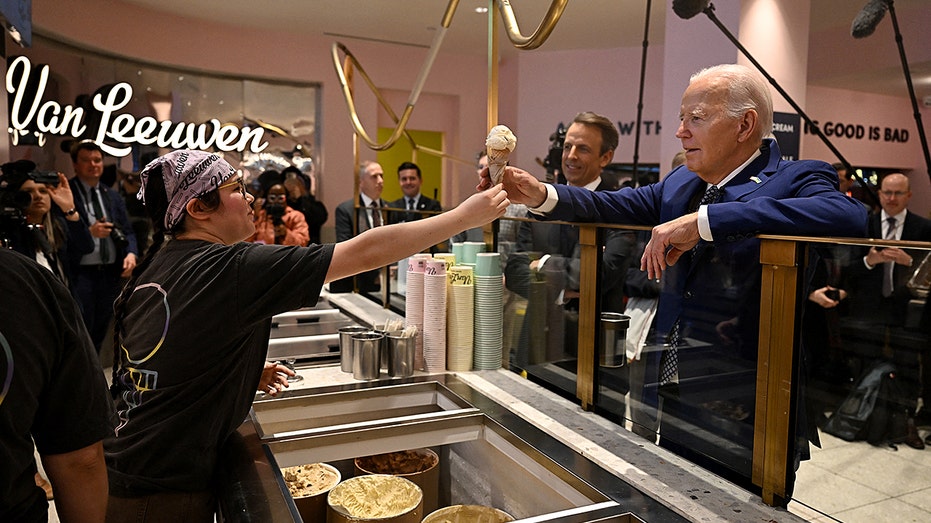
President Joe Biden, flanked by host Seth Meyers, patronized Van Leeuwen Ice Cream after taping an episode of “Late Night with Seth Meyers” in New York City on Feb. 26, 2024.(Jim Watson/AFP via Getty Images)
The current bankruptcy filing, while not explicitly stating the Van Leeuwen judgment as the *sole* cause, undeniably positions it as the overwhelming factor precipitating the Chapter 11 petition. The company’s immediate strategy, as indicated by its bankruptcy paperwork, is to pursue the appeal vigorously. Should the appeal succeed in overturning or significantly reducing the judgment, Rebel Creamery could see a dramatic shift in its financial standing, potentially allowing for a more viable reorganization plan or even a path out of bankruptcy. Conversely, a failed appeal would solidify the judgment as an undisputed liability, making a successful reorganization exceedingly difficult and potentially leading to liquidation.
CLICK HERE TO GET FOX BUSINESS ON THE GO
Market Impact:
Rebel Creamery’s Chapter 11 filing sends a potent signal across the consumer packaged goods (CPG) sector, particularly to investors and brands operating in competitive niche markets. Firstly, it underscores the escalating financial risks associated with intellectual property litigation; companies, especially those with rapid growth and national distribution, must meticulously guard against and proactively manage IP infringement claims. The “bad faith” finding against Rebel could amplify scrutiny on brand development practices across the industry. Secondly, for the “better-for-you” and specialized diet food segments (e.g., keto, vegan), this event highlights that while market demand is robust, operational missteps, particularly legal ones, can swiftly negate significant brand equity and market penetration. Competitors in the low-carb ice cream space may see opportunities to capture Rebel’s shelf space and market share, potentially leading to increased marketing spend and product innovation to fill the void. Furthermore, retailers like Walmart and Kroger will be closely monitoring the bankruptcy proceedings, as the disruption could affect supply chain stability and consumer choice in a popular product category. This case serves as a cautionary tale: market success, without robust legal diligence, can be fleeting.