
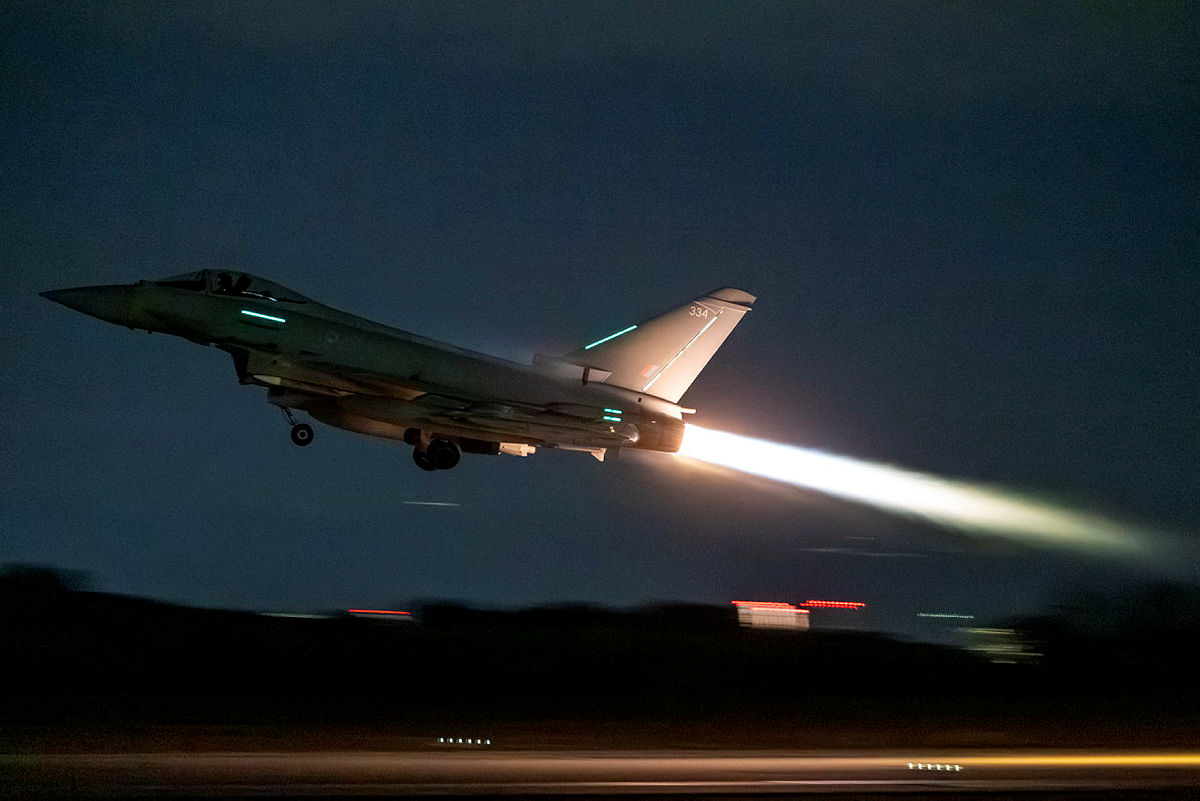
RAF Quick Reaction Alert Responds to Unidentified Aircraft Approaching UK Airspace
On Friday evening, Royal Air Force (RAF) Typhoon fighter jets were scrambled from RAF Lossiemouth in Scotland, responding to an unidentified aircraft approaching United Kingdom airspace. The incident, which occurred outside the station’s typical flying hours, prompted a Quick Reaction Alert (QRA) sortie, a routine but critical aspect of national air defence.
The operation involved multiple Typhoon fighters, supported by an RAF Voyager tanker aircraft, which provides air-to-air refuelling capabilities. Open-source flight tracking data indicated that a Typhoon departed Lossiemouth on a north-easterly heading, with the accompanying Voyager operating under a transponder code typically associated with NATO air policing missions. While the RAF aircraft were deployed in response, the unidentified aircraft maintained sufficient distance, negating the need for an immediate interception. Consequently, the RAF aircraft were observed returning to their base after completing their mission.
Quick Reaction Alert, or QRA, is the UK’s standing system designed to provide a rapid response to any aircraft that is either unidentified or whose behaviour raises concerns as it approaches or operates within areas of interest to British airspace security. This system operates 24 hours a day, 365 days a year, ensuring constant vigilance over the nation’s skies.
The RAF maintains QRA forces at two principal locations across the UK to ensure comprehensive national coverage. RAF Lossiemouth, situated in Moray, Scotland, is responsible for monitoring and responding to air activity approaching the United Kingdom from the northern sectors, including the crucial North Atlantic approaches. To the south, RAF Coningsby in Lincolnshire provides similar coverage for the southern parts of the UK. At both bases, dedicated teams of pilots, engineers, air traffic controllers, and supporting personnel are maintained at a high state of readiness, enabling fighter jets to be launched within minutes of an alert being raised.
Potential incidents prompting a QRA launch are diverse. They can range from foreign military aircraft operating close to UK-controlled airspace, often probing air defences, to civilian aircraft that have lost communication with air traffic control, experienced technical difficulties, or are behaving erratically. Each scenario requires a swift and decisive response to assess the situation and mitigate any potential threats or hazards.
The air picture around the United Kingdom is continuously monitored by a sophisticated network. This includes the Control and Reporting Centre (CRC) at RAF Boulmer in Northumberland, which serves as the central hub for air surveillance. Information from an array of military and civilian sensors, including ground-based radars, airborne early warning aircraft, and intelligence sources, is meticulously compiled to build a recognised air picture. When an aircraft cannot be readily identified, or its intentions require further investigation due to unusual flight patterns or lack of communication, a decision can be made to launch QRA fighters to visually investigate.
It is important to clarify that a QRA launch and subsequent investigation do not necessarily imply that an aircraft has entered UK sovereign airspace, which typically extends 12 nautical miles from the coastline. RAF Typhoons may be despatched to identify an aircraft visually in international airspace, to monitor its movements, to attempt to establish radio communications, or to escort it away from an area of concern or towards a designated landing site if it is a distressed civilian aircraft. The primary goal is always to assess the situation, ensure safety, and assert the UK’s right to manage its airspace. Moreover, a QRA launch does not always culminate in fighters reaching the aircraft involved; the situation can evolve rapidly while the Typhoons are airborne, with the target aircraft changing course or remaining sufficiently distant that an interception is no longer deemed necessary.
The Eurofighter Typhoon has been the backbone of the UK’s QRA role since 2007. This highly advanced, twin-engine multi-role fighter was designed with air defence and interception among its core missions. It is capable of achieving speeds exceeding twice the speed of sound at altitude, allowing for rapid response to distant threats. RAF Typhoons tasked with air defence can carry a comprehensive suite of air-to-air weapons, including the short-range Advanced Short-Range Air-to-Air Missile (ASRAAM) for close-quarters engagements and the long-range Meteor missile for beyond visual range intercepts. Additionally, the aircraft is equipped with an internally mounted 27 mm Mauser cannon. Its advanced radar and passive sensors, such as the PIRATE infrared search and track system, enable crews to detect, track, and identify airborne targets at considerable distances and without emitting their own radar signature, a crucial capability for stealthy identification.
For extended sorties, the RAF relies on the Voyager tanker aircraft to provide essential air-to-air refuelling. This capability significantly extends the time Typhoons can remain airborne and allows them to operate much farther from their home stations, providing greater flexibility and reach. The Voyager fleet fulfills both the RAF’s strategic air transport and air-to-air refuelling requirements, underscoring its versatility and importance to global operations.
RAF Lossiemouth’s strategic geographical location on the Moray Firth makes it particularly vital for monitoring the northern approaches to the UK and the wider North Atlantic region. Typhoons based at Lossiemouth routinely support both the UK’s national QRA commitment and broader NATO air policing missions, contributing to the collective security of the alliance.
Why This Matters
The routine deployment of Quick Reaction Alert (QRA) forces, as demonstrated by Friday’s scramble from RAF Lossiemouth, is a cornerstone of the United Kingdom’s national security and defence posture. While often out of the public eye, these operations serve several critical functions that are vital for maintaining national sovereignty, ensuring public safety, and contributing to international stability.
Firstly, QRA is essential for the **protection of UK airspace sovereignty**. Every nation has the right and responsibility to control its skies. The immediate response capability of QRA ensures that any unknown or potentially hostile aircraft approaching or entering UK-controlled airspace can be swiftly identified and intercepted. This acts as a clear assertion of territorial integrity and a deterrent against unauthorized incursions, particularly from foreign military aircraft that may be testing response times or gathering intelligence.
Secondly, QRA plays a crucial role in **aviation safety**. Many QRA launches involve civilian aircraft that have lost radio contact with air traffic control or are otherwise experiencing distress. In such scenarios, fighter jets are dispatched not as a threat, but as a rapid response mechanism to visually inspect the aircraft, attempt to establish communication, and potentially guide it to safety. This capability can be life-saving, preventing potential accidents or dangerous situations.
Thirdly, these operations underscore the **UK’s commitment to collective defence through NATO**. RAF Lossiemouth, in particular, is strategically positioned to monitor vital northern sea lanes and contribute to NATO’s broader air policing efforts in the North Atlantic. QRA sorties contribute to the alliance’s readiness and ability to respond to threats, reinforcing mutual security guarantees among member states.
Finally, the constant readiness and sophisticated capabilities of the QRA force, including the advanced Eurofighter Typhoons and Voyager tankers, represent a **significant ongoing investment in national defence**. This continuous vigilance and rapid response capability demonstrate the UK’s capacity and willingness to defend its interests and uphold international aviation norms, reflecting a robust and professional military force dedicated to safeguarding its citizens and allies.