
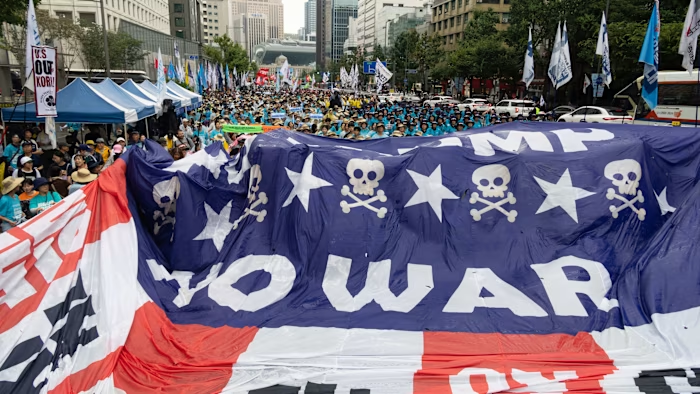
The recent directive from Donald Trump to scale back joint military exercises with South Korea has ignited a fresh wave of concern among Indo-Pacific allies regarding US reliability, a sentiment already strained by his aggressive rhetoric on Taiwan. From a market perspective, this geopolitical tremor introduces heightened uncertainty, impacting regional investment flows, defense sector valuations, and critical supply chains.
Key Takeaways:
- Geopolitical Risk Premium Rises:Trump’s unpredictable foreign policy is increasing the geopolitical risk premium across Asian markets, particularly for South Korea, Japan, and Taiwan. This translates to potential investor jitters, capital reallocation, and higher volatility in regional equities and currencies.
- Defense Spending Shifts & Sector Impact:The perceived erosion of US commitment may prompt allies to accelerate their indigenous defense capabilities and procurement, potentially benefiting local defense contractors while altering the landscape for major US arms exporters. Depleted US stockpiles further compound this, delaying deliveries and affecting long-term defense planning and spending.
- Supply Chain Vulnerability & Trade Implications:With China adopting a more assertive stance and US military presence seemingly in flux, the stability of critical supply chains—especially in semiconductors from Taiwan and broader manufacturing across Asia—comes under renewed scrutiny, posing significant risks for global industries and trade relations.
On Sunday, just hours before US and South Korean forces were slated to commence their annual Ulchi Freedom Shield exercises, Trump declared on Truth Social that the drills would send a “hostile” message to Pyongyang. This echoed North Korea’s long-standing criticism that the exercises constitute a “rehearsal for a war of aggression.” This abrupt decision, communicated via social media, immediately sent a jolt through diplomatic circles and, by extension, financial markets sensitive to stability in a region vital for global trade.
The move coincided with the USS George Washington aircraft carrier strike group departing the Pacific for the Middle East, leaving the Indo-Pacific without a US carrier as China continues to assert a more aggressive posture. For investors, this creates a vacuum of perceived security, potentially increasing the risk profile of assets in the region and prompting a cautious stance on new foreign direct investment (FDI).
Michael Green, head of the United States Studies Centre in Sydney and former top White House Asia adviser, vividly captured the sentiment, noting one US ally likened working with the Trump administration to “going into space with Sigourney Weaver” in the movieAlien. “The latest monster to spring from the ceiling was the president’s threat to cancel US military exercises with South Korea,” Green remarked. Such anecdotal insights, though not direct market signals, reflect a profound erosion of trust that can translate into increased hedging costs for businesses and a flight of capital towards perceived safer havens.
These recent developments, occurring five weeks before Chinese President Xi Jinping is expected to visit Washington, severely undermine US efforts to reassure allies by telling them to focus on Trump’s actions, not his rhetoric. Elbridge Colby, formerly a top Pentagon policy official, attempted to quell anxieties in Manila last week by stating the US would “not engage in peacocking” but would “speak softly” while carrying “the world’s biggest stick.” However, Trump’s decree to reduce military drills—which most experts agree are crucial for deterring Pyongyang and sending a clear message to Beijing—has sparked fresh anxiety about Washington’s commitment to regional stability. This sentiment directly impacts investor confidence, potentially leading to higher risk premiums on sovereign bonds and corporate equities across the region.
Asian allies were already grappling with the economic ramifications of Trump’s Iran war, which has severely depleted US weapon stockpiles and significantly delayed arms deliveries, including critical Tomahawk missiles earmarked for Japan. This supply chain disruption in the defense sector has direct implications for defense contractors, both US and international, affecting their order books and delivery schedules. For Japan, a key US ally and a major player in global finance, such delays underscore a vulnerability that could prompt increased indigenous defense spending, creating opportunities for Japanese defense firms but potentially straining national budgets.
Tokyo was further alarmed last year when Trump failed to defend Prime Minister Sanae Takaichi after Beijing criticized her comments about Japan’s potential involvement in a war over Taiwan. “Trump administration officials have trumpeted the ‘quiet, relentless strengthening of deterrence’ in Asia. But they are sending critical munitions and naval assets from Asia to the Middle East, while cancelling military exercises with Asian allies,” said Zack Cooper, an Asia security expert at the American Enterprise Institute. “The administration is walking more softly in Asia, but they seem to have forgotten to bring along their big stick.” Cooper noted similar concerns from Asian officials, highlighting how this perceived inconsistency directly impacts the risk calculus for businesses operating in the Indo-Pacific.
These developments undermine what several observers noted had been robust efforts by Pacific Command, which oversees US military operations in Asia, to maintain strong cooperation with allies. For instance, the Pentagon has ramped up military cooperation with the Philippines, inviting a record number of allies to participate in the largest-ever annual bilateral joint military exercise this year. The US, Japan, and South Korea also expanded their annual trilateral exercise, “Freedom Edge,” last year. Yet, the recent order to cut exercises with Seoul is a stark reminder to allies—and by extension, to global markets—that US support cannot be taken for granted, increasing the geopolitical premium associated with regional assets.
Green noted that while trust in the US was at a record low in critical countries like Japan and Australia, “support for the alliance with the US remains about the highest ever among frontline US allies in Asia.” He attributed this paradox to the “unprecedented China threat” and confidence in US public, congressional, and military support for alliances. This suggests that while political leadership may cause market jitters, the underlying strategic necessity for these alliances remains strong, potentially mitigating long-term market destabilization if the broader US institutional commitment holds.
The Pentagon declined to comment on allied concerns but confirmed it was “actively working on executing” Trump’s order to reduce the exercises. This perceived lack of clarity and direct communication from the US administration further contributes to market uncertainty, as investors struggle to price in unpredictable policy shifts.
The nervousness intensifies as Trump prepares to welcome Xi Jinping to Washington next month. Allies are particularly anxious about Trump’s Taiwan policy, especially after his May remark in Beijing that US arms sales to Taiwan were a “good bargaining chip.” While Trump has approved more weapons sales to Taipei than any US president, including a record $11.1 billion package in December, his delay in approving a planned $14 billion bundle has raised alarms in Taiwan. For the global tech sector, Taiwan’s stability is paramount, given its critical role in semiconductor manufacturing (e.g., TSMC). Any policy seen as weakening Taiwan’s defense could send shockwaves through tech stocks and global supply chains.
While many defense experts oppose the reduction in joint exercises with Seoul, Jennifer Kavanagh, a military analyst at Defense Priorities, offered a contrasting view. She argued the US is too stretched globally and should encourage allies to do more for their own defense. “The US shouldn’t fight a war with North Korea for South Korea,” Kavanagh said, adding, “I would rather have the US pushing South Korea to do more to fight itself. I don’t see cancelling exercises as pulling the rug out from under them. It is a signal that they need to start moving more quickly to increase their own defense.” This perspective, if adopted more broadly, could lead to a re-evaluation of defense spending portfolios within allied nations, potentially creating new market opportunities for domestic defense industries.
Some experts also placed blame on South Korea, citing frustrations among Trump officials that Seoul had not unveiled any projects related to its pledge to invest $350 billion in the US, as agreed in the countries’ trade deal. “South Korea is playing a dangerous game,” said Nick Snyder, an Asia expert at the Hudson Institute and former chief of staff to deputy secretary of state Christopher Landau. “They can’t sit on the sidelines and not be helpful with Iran and then expect the president to pay for exercises that help defend their interests.” This linkage of defense cooperation with economic pledges underscores the transactional nature of Trump’s foreign policy, forcing investors to consider reciprocal trade and investment commitments alongside traditional security guarantees.
The White House, via spokesperson Anna Kelly, rejected claims that Trump was undermining alliances, stating he had “successfully made America respected again.” Kelly added, “The president…is righting decades of wrongs of his predecessors by ensuring all of our diplomatic relationships are reciprocal.” This framing suggests a continued focus on balancing perceived economic inequities with security commitments, which will likely remain a significant factor in shaping US foreign policy and, consequently, global market dynamics.
Market Impact:
The implications of this evolving geopolitical landscape for financial markets are multi-faceted. Investors should brace for increased volatility in Asian equity markets, particularly the KOSPI and Nikkei, as well as in regional currencies like the Korean Won and Japanese Yen, which may experience periodic safe-haven flows into the US Dollar. The defense sector could see a re-rating globally; while US defense primes might face project delays or shifts in demand, allied nations intensifying their self-defense efforts could boost local defense industries and potentially lead to new procurement cycles. Furthermore, the perceived instability heightens supply chain risks, especially for critical sectors like semiconductors, raising manufacturing costs and prompting companies to explore diversification strategies away from potentially volatile regions. Long-term, this could lead to a realignment of foreign direct investment, with capital potentially shying away from regions perceived as less secure, and a higher geopolitical premium embedded in the valuation of assets across the Indo-Pacific. Trade relationships, particularly between the US and its allies, will also be under continuous scrutiny, influencing import/export dynamics and the viability of existing and future trade agreements.